| Availability: | |
|---|---|
| Quantity: | |

Product Description
The Four-Roller Precision Glue Spreader Plywood Production Line is a high-performance production system developed by Shandong Minghong Woodworking Machinery, based on core glue application technology. Centered around an industry-leading Four-Roller Precision Glue Spreader, this line achieves efficient operation across the entire process – from veneer feeding and precision gluing to automatic layup and hot pressing – through optimized automated workflow integration. It is specifically designed to address core pain points in plywood production, such as "uneven glue application, high glue consumption, and poor bonding," making it the ideal choice for businesses aiming to enhance product quality, reduce production costs, and strengthen market competitiveness.
The design essence of this production line is to maximize the core value of "precision glue application" and seamlessly integrate it with upstream and downstream processes.
Core Objective: To fundamentally ensure the interlayer bonding strength and flatness of the finished plywood by achieving ultimate uniformity in glue application, while significantly reducing adhesive consumption.
System Philosophy: Modular, Intelligent, Low-Maintenance. The production line is optimally arranged around the four-roller glue spreader, ensuring smooth material flow and maximum efficiency.
Applicable Scenarios: Suitable for medium-sized manufacturers with an annual output of 10,000 to 30,000 cubic meters, particularly ideal for producing high-quality furniture boards, decorative panels, and E0/E1 grade eco-friendly boards.
Plywood Production Process
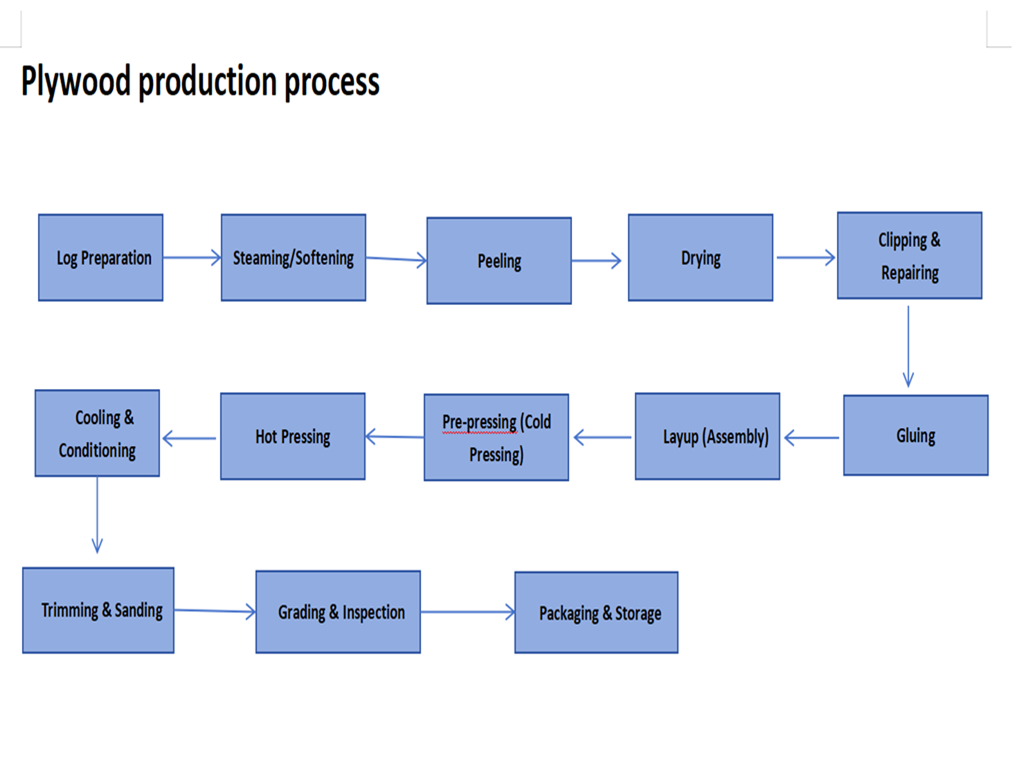
Plywood production is a process of bonding thin wood veneers peeled from logs into a solid panel using adhesives under pressure. The main production steps are as follows:
1. Log Processing & Peeling: Logs are debarked, softened by steaming/cooking, and then mounted on a lathe. They are rotated against a blade, peeling a continuous ribbon of veneer.
2. Veneer Drying & Preparation: The wet veneer from the lathe is fed into a dryer to reduce its moisture content to a suitable range (typically 8%-12%). It is then clipped, graded, and spliced in preparation for layup.
3. Gluing: Prepared adhesive (e.g., Urea-Formaldehyde) is applied evenly to both surfaces of the core veneers. This is a critical step determining bonding quality.
4. Layup (Assembling): The glued core veneers and unglued face/back veneers are assembled together, with the grain direction of adjacent layers perpendicular to each other, forming a "mat".
5. Pre-pressing: The mat is cold-pressed to achieve initial bonding, making it easier to handle and reducing deformation during hot pressing.
6. Hot Pressing: The mat is loaded into a hot press. Under high temperature and pressure, the adhesive cures completely in a short time, permanently bonding the multiple veneer layers into a solid panel.
7. Post-processing: The pressed panels undergo cooling, edge trimming, and sanding to become finished plywood with accurate dimensions and a smooth surface.
Major Production Equipment in the Line
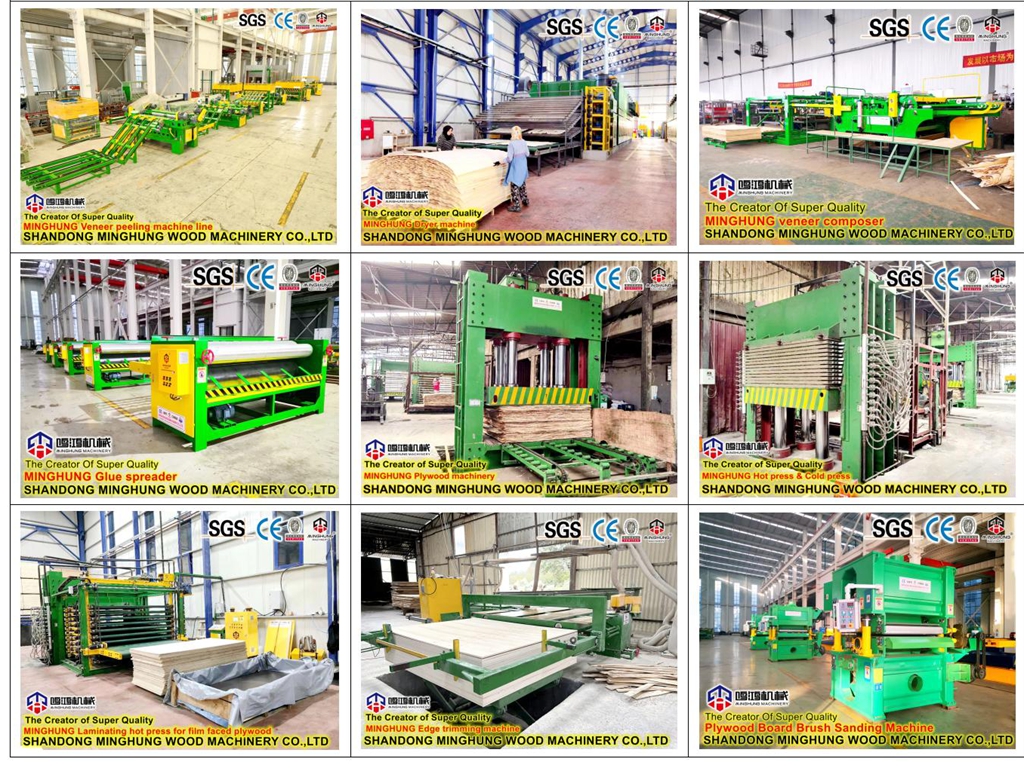
This production line integrates modern automated equipment required for the above processes, ensuring efficient and high-quality production.
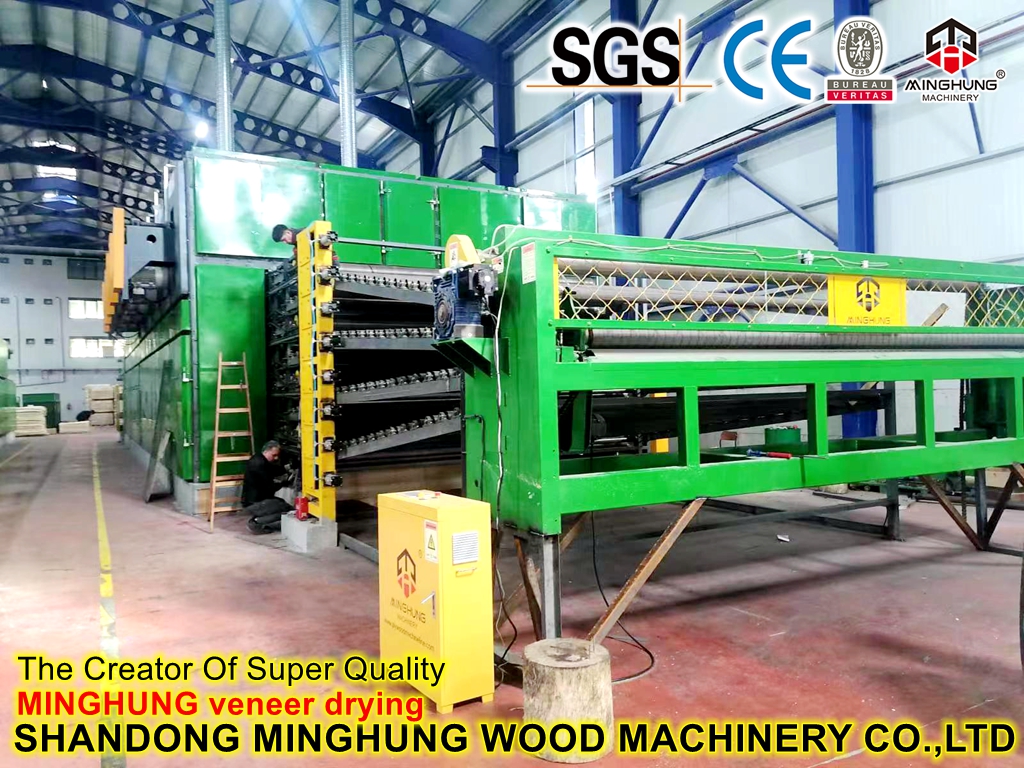
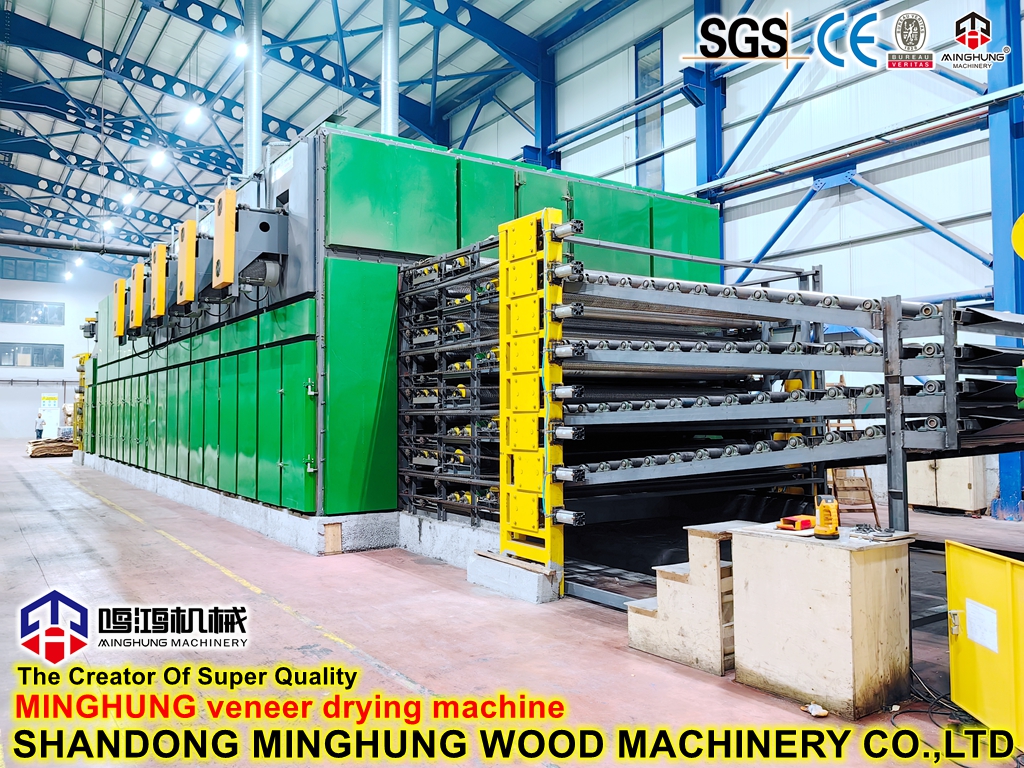
1. Veneer Dryer
Used to rapidly and uniformly dry the wet veneer after peeling to the appropriate moisture content. It is the fundamental equipment ensuring subsequent bonding quality and final panel flatness.
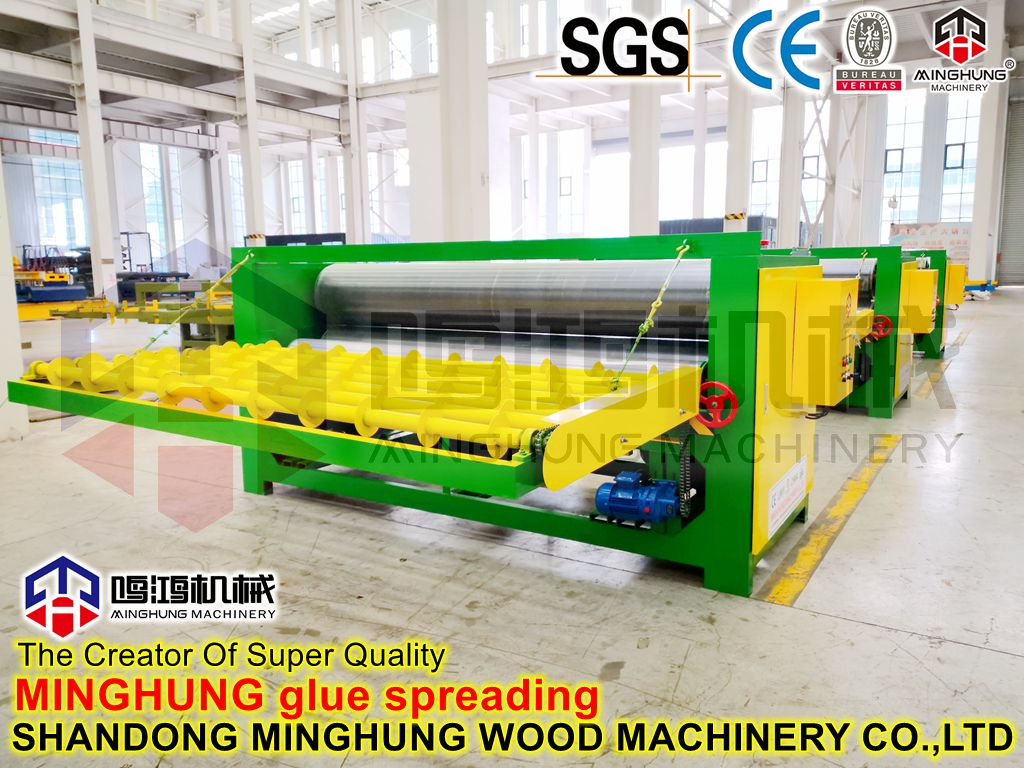
2. Four-Roller Precision Glue Spreader - Key Equipment
This is the core equipment of the production line, responsible for applying adhesive precisely and evenly onto the veneer surface.
Detailed Introduction:
Working Principle: It operates via the synchronized action of four precision-matched rollers (Pick-Up Roller, Metering Roller, Application Roller, and Reverse Compensation Roller). The adhesive is transferred and metered through these rollers, forming an ultra-thin, uniform film which is finally transferred onto the veneer.
Core Advantages:
Excellent Application Uniformity: Eliminates streaks or bare spots common in traditional spreaders, laying the foundation for producing high-strength plywood.
Precise Glue Control: Achieves significant glue savings (typically 10%-15% compared to two-roller machines), directly reducing production costs.
High Adaptability: Easy to adjust for different wood species, veneer thicknesses, and adhesive viscosities.
3. Automatic Layup Line
Automatically assembles and aligns glued and unglued veneers to form a mat. It fully replaces manual labor, offering high efficiency, low error, and ensuring a symmetrical mat structure.
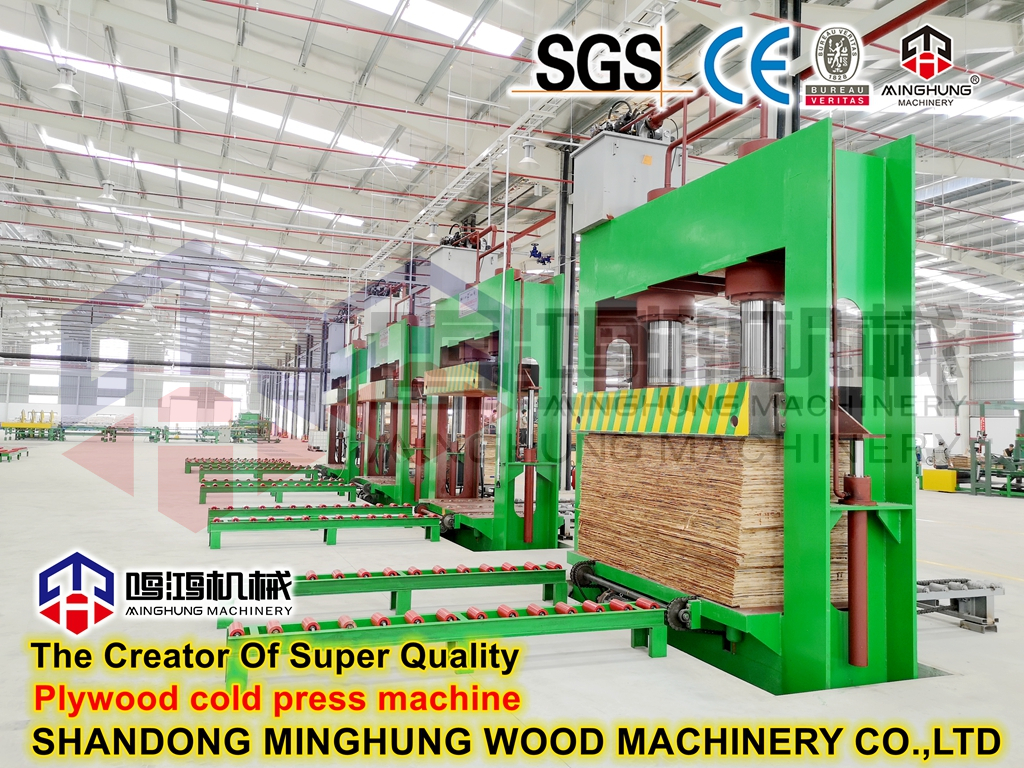
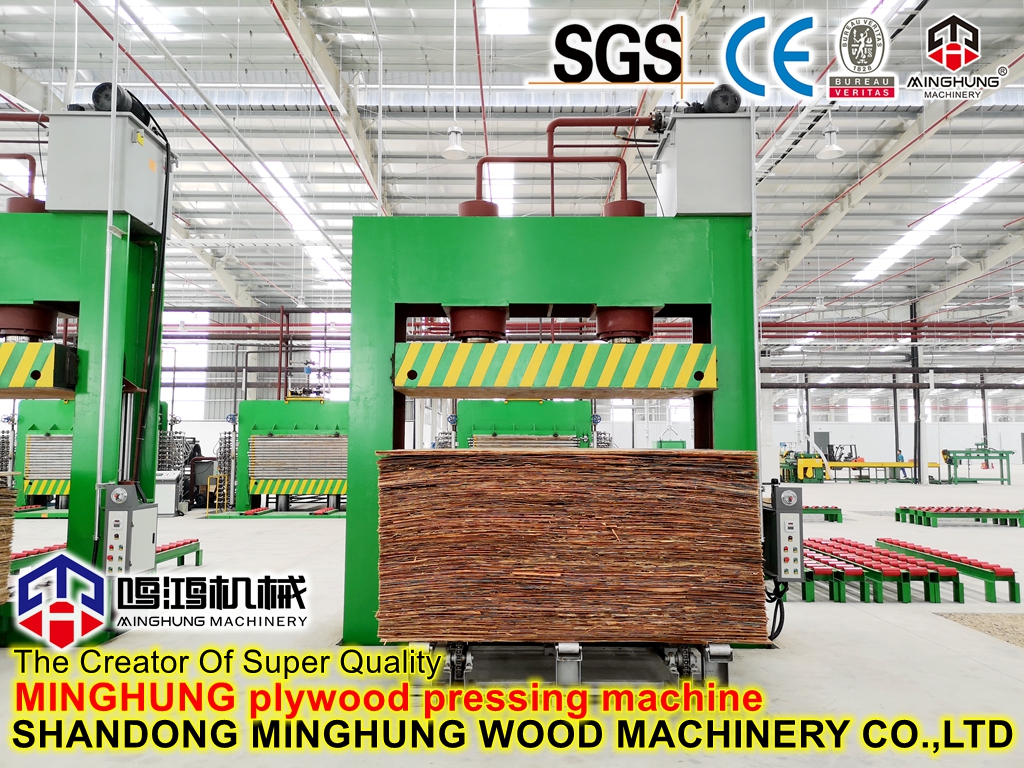
4. Pre-press
Applies pressure to the assembled mat to achieve initial bonding, increasing its strength for easier loading into the hot press while removing internal air.
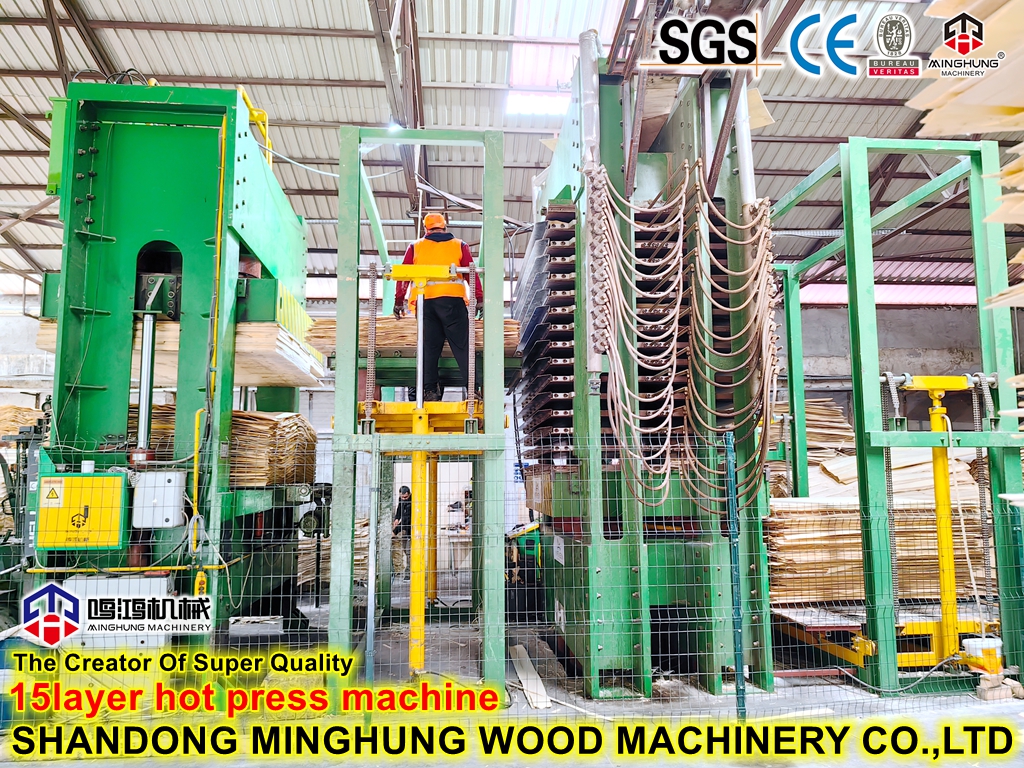
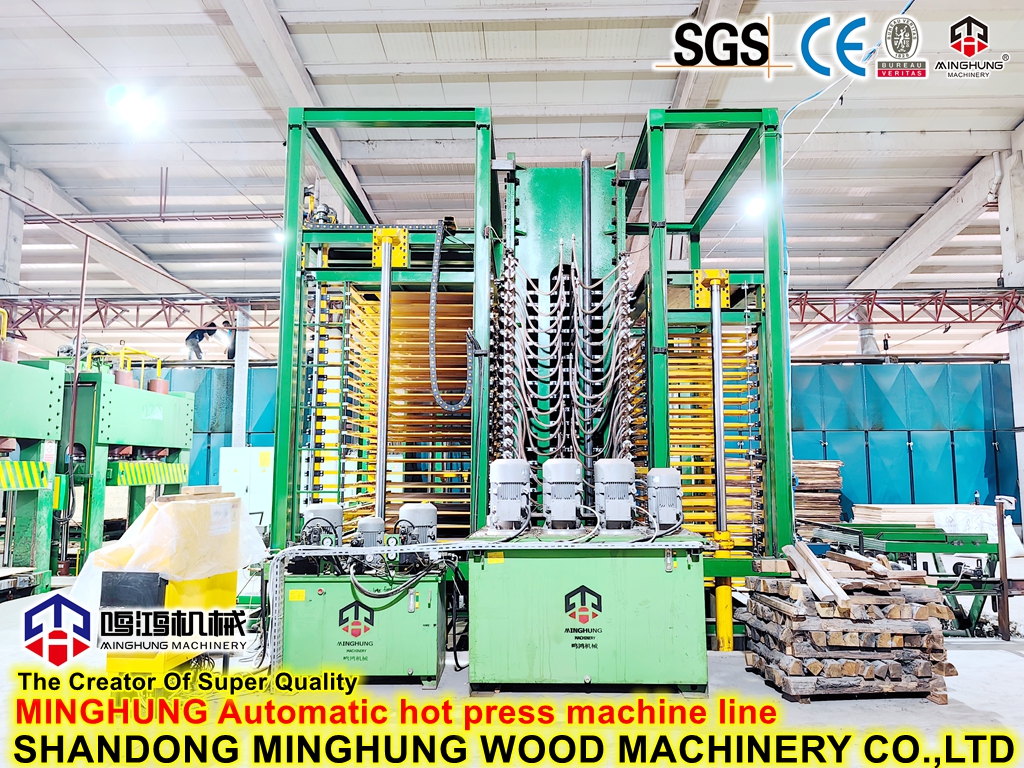
5. Hot Press
The "heart" of the production line. By providing a precise high-temperature and high-pressure environment, it rapidly cures the adhesive in the mat, achieving permanent bonding. Its performance directly determines the final mechanical strength and quality of the plywood.
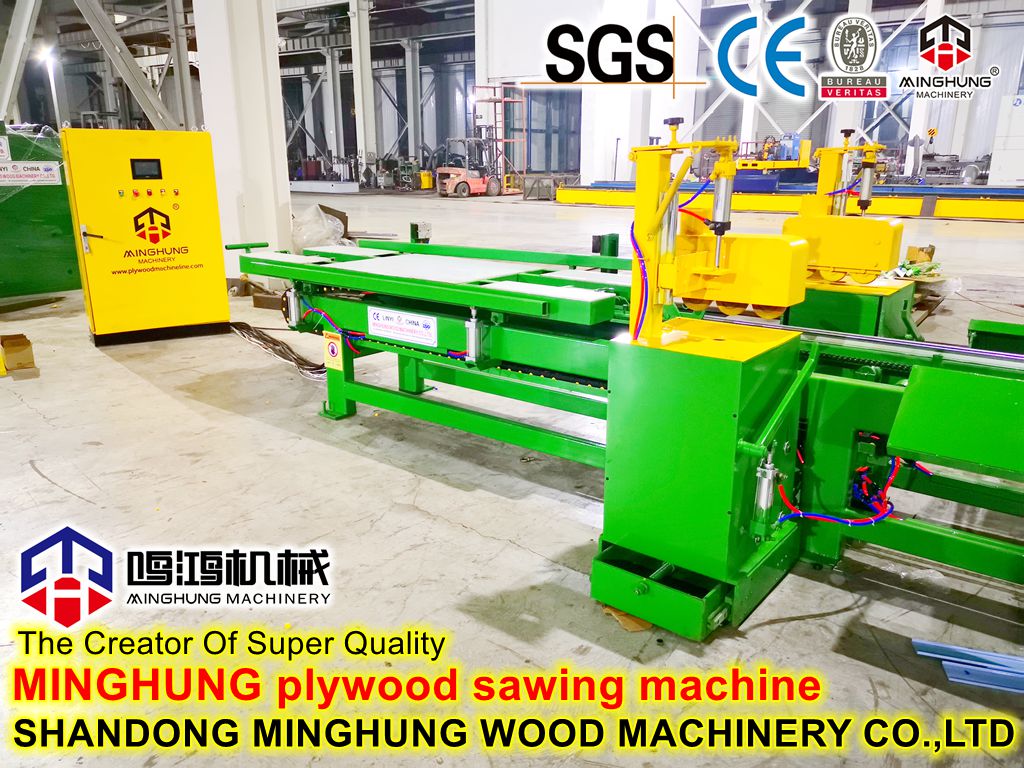
6. Post-processing Equipment Group
Cooling & Turning System: Allows the high-temperature panels after hot pressing to cool uniformly, preventing deformation.
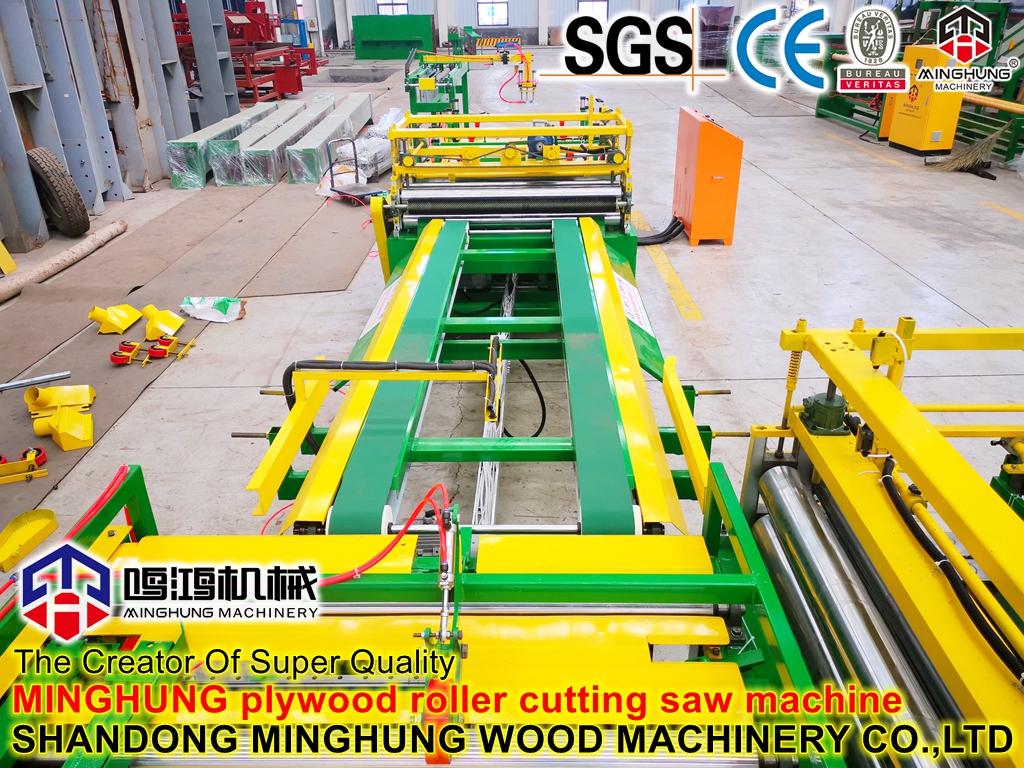
Cross-Cut & Trim Saws: Automatically cut the rough edges of the panels to standard dimensions.
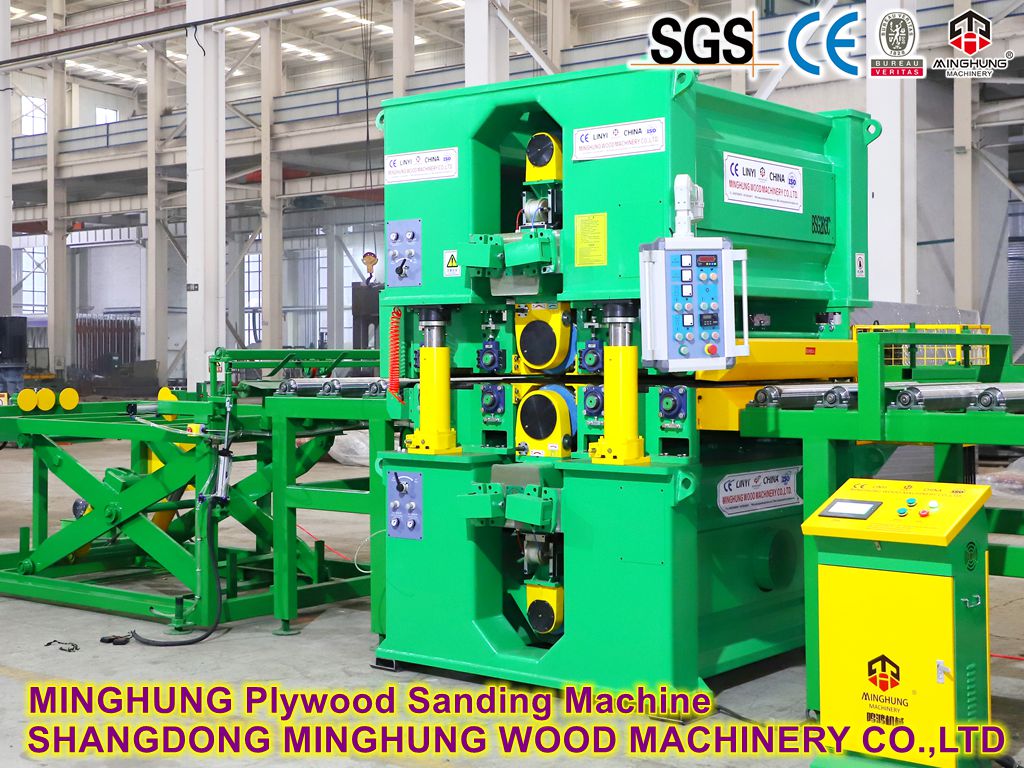
Double-Side Calibrating Sander: Precisely sands the top and bottom surfaces of the panel to ensure consistent thickness and a smooth surface, meeting the final product standard.
7. Central Control System (PLC)
Acts as the brain of the production line, uniformly controlling and coordinating the operation of all equipment, enabling parameter setting, process monitoring, fault diagnosis, and data logging.
1. Enhance Product Quality, Build Brand Reputation:
Uniform glue layers result in higher bonding strength, creating stable panel structures resistant to delamination and offering excellent physical properties.
Exceptional panel flatness provides a perfect substrate for subsequent deep processing like laminating or painting, enhancing product marketability.
2. Significantly Reduce Overall Production Costs:
Direct Glue Savings: 10%-15% savings in adhesive translate into substantial cost reduction over long-term production.
Reduce Rejection Rate: Defects like delamination and blistering caused by gluing issues are drastically reduced, improving overall output efficiency.
Lower Labor Costs: Automated line operation reduces dependence on skilled gluing operators, lowering management and labor costs.
3. Increase Production Stability & Efficiency:
Stable equipment operation with low failure rates ensures smooth execution of production schedules.
Efficient integration with the automatic layup system avoids production bottlenecks, resulting in high overall output efficiency.
4. Support Environmental Protection & Green Manufacturing:
Saving glue means reducing the overall usage and emission of chemicals like formaldehyde, making it easier to produce panels that meet international environmental standards like E0/E1, helping customers access high-end markets.
Parameter Item | Specification Description |
Core Gluing Equipment | Four-Roller Precision Glue Spreader |
Applicable Veneer Width | 1300mm, 1500mm (Customizable) |
Glue Application Control Range | Precisely adjustable, typically covering 100 - 400 g/m虏 (Depends on adhesive type) |
Production Line Automation Level | Fully automatic from gluing to layup |
Recommended Annual Capacity | 10,000 - 30,000 cubic meters |
Total Installed Power | Approx. 200 - 350 kW (Depends on specific configuration) |
Shandong Minghong Woodworking Machinery's Four-Roller Precision Glue Spreader Plywood Production Line is more than just a set of equipment; it embodies an engineering philosophy of "precision manufacturing." We are well aware that outstanding quality stems from the meticulous control of every core process.Choosing us means gaining a comprehensive partner who deeply understands plywood manufacturing processes and can provide all-around support from equipment selection and process debugging to long-term technical support. Let us help you build a lasting reputation in the global market with stable and reliable product quality.

Our contacts:
Whatsapp: +8618769900191 +8615589105786 +8618954906501
Email: osbmdfmachinery@gmail.com

Product Description
The Four-Roller Precision Glue Spreader Plywood Production Line is a high-performance production system developed by Shandong Minghong Woodworking Machinery, based on core glue application technology. Centered around an industry-leading Four-Roller Precision Glue Spreader, this line achieves efficient operation across the entire process – from veneer feeding and precision gluing to automatic layup and hot pressing – through optimized automated workflow integration. It is specifically designed to address core pain points in plywood production, such as "uneven glue application, high glue consumption, and poor bonding," making it the ideal choice for businesses aiming to enhance product quality, reduce production costs, and strengthen market competitiveness.
The design essence of this production line is to maximize the core value of "precision glue application" and seamlessly integrate it with upstream and downstream processes.
Core Objective: To fundamentally ensure the interlayer bonding strength and flatness of the finished plywood by achieving ultimate uniformity in glue application, while significantly reducing adhesive consumption.
System Philosophy: Modular, Intelligent, Low-Maintenance. The production line is optimally arranged around the four-roller glue spreader, ensuring smooth material flow and maximum efficiency.
Applicable Scenarios: Suitable for medium-sized manufacturers with an annual output of 10,000 to 30,000 cubic meters, particularly ideal for producing high-quality furniture boards, decorative panels, and E0/E1 grade eco-friendly boards.
Plywood Production Process
Plywood production is a process of bonding thin wood veneers peeled from logs into a solid panel using adhesives under pressure. The main production steps are as follows:
1. Log Processing & Peeling: Logs are debarked, softened by steaming/cooking, and then mounted on a lathe. They are rotated against a blade, peeling a continuous ribbon of veneer.
2. Veneer Drying & Preparation: The wet veneer from the lathe is fed into a dryer to reduce its moisture content to a suitable range (typically 8%-12%). It is then clipped, graded, and spliced in preparation for layup.
3. Gluing: Prepared adhesive (e.g., Urea-Formaldehyde) is applied evenly to both surfaces of the core veneers. This is a critical step determining bonding quality.
4. Layup (Assembling): The glued core veneers and unglued face/back veneers are assembled together, with the grain direction of adjacent layers perpendicular to each other, forming a "mat".
5. Pre-pressing: The mat is cold-pressed to achieve initial bonding, making it easier to handle and reducing deformation during hot pressing.
6. Hot Pressing: The mat is loaded into a hot press. Under high temperature and pressure, the adhesive cures completely in a short time, permanently bonding the multiple veneer layers into a solid panel.
7. Post-processing: The pressed panels undergo cooling, edge trimming, and sanding to become finished plywood with accurate dimensions and a smooth surface.

Major Production Equipment in the Line
This production line integrates modern automated equipment required for the above processes, ensuring efficient and high-quality production.
1. Veneer Dryer
Used to rapidly and uniformly dry the wet veneer after peeling to the appropriate moisture content. It is the fundamental equipment ensuring subsequent bonding quality and final panel flatness.

2. Four-Roller Precision Glue Spreader - Key Equipment
This is the core equipment of the production line, responsible for applying adhesive precisely and evenly onto the veneer surface.
Detailed Introduction:
Working Principle: It operates via the synchronized action of four precision-matched rollers (Pick-Up Roller, Metering Roller, Application Roller, and Reverse Compensation Roller). The adhesive is transferred and metered through these rollers, forming an ultra-thin, uniform film which is finally transferred onto the veneer.
Core Advantages:
Excellent Application Uniformity: Eliminates streaks or bare spots common in traditional spreaders, laying the foundation for producing high-strength plywood.
Precise Glue Control: Achieves significant glue savings (typically 10%-15% compared to two-roller machines), directly reducing production costs.
High Adaptability: Easy to adjust for different wood species, veneer thicknesses, and adhesive viscosities.

3. Automatic Layup Line
Automatically assembles and aligns glued and unglued veneers to form a mat. It fully replaces manual labor, offering high efficiency, low error, and ensuring a symmetrical mat structure.
4. Pre-press
Applies pressure to the assembled mat to achieve initial bonding, increasing its strength for easier loading into the hot press while removing internal air.

5. Hot Press
The "heart" of the production line. By providing a precise high-temperature and high-pressure environment, it rapidly cures the adhesive in the mat, achieving permanent bonding. Its performance directly determines the final mechanical strength and quality of the plywood.

6. Post-processing Equipment Group
Cooling & Turning System: Allows the high-temperature panels after hot pressing to cool uniformly, preventing deformation.
Cross-Cut & Trim Saws: Automatically cut the rough edges of the panels to standard dimensions.
Double-Side Calibrating Sander: Precisely sands the top and bottom surfaces of the panel to ensure consistent thickness and a smooth surface, meeting the final product standard.


7. Central Control System (PLC)
Acts as the brain of the production line, uniformly controlling and coordinating the operation of all equipment, enabling parameter setting, process monitoring, fault diagnosis, and data logging.
1. Enhance Product Quality, Build Brand Reputation:
Uniform glue layers result in higher bonding strength, creating stable panel structures resistant to delamination and offering excellent physical properties.
Exceptional panel flatness provides a perfect substrate for subsequent deep processing like laminating or painting, enhancing product marketability.
2. Significantly Reduce Overall Production Costs:
Direct Glue Savings: 10%-15% savings in adhesive translate into substantial cost reduction over long-term production.
Reduce Rejection Rate: Defects like delamination and blistering caused by gluing issues are drastically reduced, improving overall output efficiency.
Lower Labor Costs: Automated line operation reduces dependence on skilled gluing operators, lowering management and labor costs.
3. Increase Production Stability & Efficiency:
Stable equipment operation with low failure rates ensures smooth execution of production schedules.
Efficient integration with the automatic layup system avoids production bottlenecks, resulting in high overall output efficiency.
4. Support Environmental Protection & Green Manufacturing:
Saving glue means reducing the overall usage and emission of chemicals like formaldehyde, making it easier to produce panels that meet international environmental standards like E0/E1, helping customers access high-end markets.
Parameter Item | Specification Description |
Core Gluing Equipment | Four-Roller Precision Glue Spreader |
Applicable Veneer Width | 1300mm, 1500mm (Customizable) |
Glue Application Control Range | Precisely adjustable, typically covering 100 - 400 g/m虏 (Depends on adhesive type) |
Production Line Automation Level | Fully automatic from gluing to layup |
Recommended Annual Capacity | 10,000 - 30,000 cubic meters |
Total Installed Power | Approx. 200 - 350 kW (Depends on specific configuration) |
Shandong Minghong Woodworking Machinery's Four-Roller Precision Glue Spreader Plywood Production Line is more than just a set of equipment; it embodies an engineering philosophy of "precision manufacturing." We are well aware that outstanding quality stems from the meticulous control of every core process.Choosing us means gaining a comprehensive partner who deeply understands plywood manufacturing processes and can provide all-around support from equipment selection and process debugging to long-term technical support. Let us help you build a lasting reputation in the global market with stable and reliable product quality.
Our contacts:
Whatsapp: +8618769900191 +8615589105786 +8618954906501
Email: osbmdfmachinery@gmail.com
Shandong Minghung Wood Machinery Factory Shandong minghung wood machine factory produces plywood machinery in linyi city city, china, dedicated to providing high-quality and suitable machines veneer machine,plywood machine,veneer splicing machine.veneer dryer machine,veneer peeling machine,plywood v
How to produce Particle board? What is the production step of Making Particle board?Introduction:Particle board, also known as chipboard, is a versatile and cost-effective material widely used in the construction and furniture industries. It is made by compressing wood particles and adhesive togethe
The Ultimate Guide to Plywood Hot Press Machines: Crafting High-Quality Plywood Introduction:Plywood is a versatile and widely used material in various industries, from construction to furniture manufacturing. Behind the scenes, plywood hot press machines play a crucial role in the production proces
What is a veneer dryer?MINGHUNG Roller veneer dryer for drying original wood veneer, remove abundant humidity, in the end, the wood veneer humidity will be 5%-10%, so it is suitable for making plywood.Veneer roller dryer are suitable for big drying capacity per day, it can be different length, width
Recently, a high-performance plywood sander was prepared for shipment at Qingdao Port, ready for its journey to our valued partner in Russia.
This shipment not only demonstrates Minghung Machinery’s strong production coordination and international trade execution capabilities but also ensures the rapid commissioning of the customer's production line.
MINGHUNG is a leading company in the industry of OSB&MDF making machine. With a strongfocus on producing high-quality machinery, we specialize in manufacturing thecomplete production line of Medium density fiberboard (MDF), High densityfiberboard (HDF),Particle board (PB), Oriented strand board (OSB) and Veneerable super strong particle board (LSB).
Peeling is the pre-treatment process. Chopping and planing are both aimed at obtaining specific forms of wood materials, but the forms and application scenarios are different.
Shipping multiple containers of gluing equipment to multiple countries in a single batch is a testament not only to our current order fulfillment capacity but, more importantly, to the international market’s trust in the quality and reliability of the ‘MINGHUNG’ brand.
The Differences And Comparisons between PB OSB And MDF