| Availability: | |
|---|---|
| Quantity: | |
MH-CHP
MINGHUNG
Ⅰ. Particleboard
Structural Characteristics:
Three-layer gradient structure:
Surface: Fine particles (0.2–0.5mm) with high density (≥750kg/m³)
Core: Coarse particles (1–3mm) with low density (550–650kg/m³)
Density profile: U-shaped curve (surface density 40%+ higher than core)
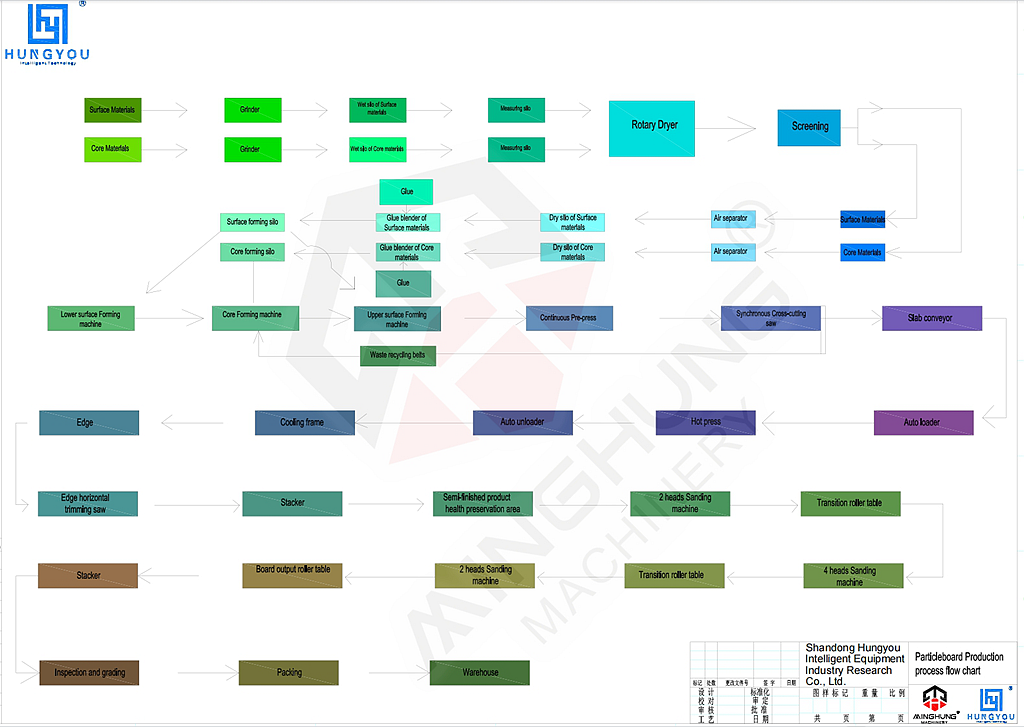
Production Process & Equipment:
Process | Equipment | Parameters |
Raw material | Drum chipper + Ring flaker | Capacity≥30t/h, L/W ratio 3:1 |
Drying | Triple-pass rotary dryer | MC: 40%→8% |
Gluing | High-speed ring blender | Resin 8–12%, ±0.5% acc. |
Forming | Mechanical/pneumatic former | Layer accuracy ±5g/m² |
Pre-pressing | Continuous belt pre-press | Compression 1:2.5, 0.5MPa |
Hot pressing | Continuous press (Core) | / |
Finishing | Cross-cutting + Cooling + Sanding | Sanding allowance 0.2–0.5mm |
Ⅱ. Continuous Press Dissection
Definition: Core equipment for panel production, forming mats continuously under heat/pressure via dual steel belts.
Working Principle:
Mat entry --> Preheating (180-190℃ )--> Main pressing (200-220℃/3-5MPa ) --> Curing (190-200℃/1-2MPa ) --> Panel exit
Key Components:
1. Frame system:
Portal frame (≥400mm cast steel)
Bending stiffness ≥10⁴ kN·m² (ensures ≤0.1mm/m deformation)
2. Hydraulic system:
Zoned cylinders (1 group per 50mm width, 60–120 zones)
Servo-proportional valves (response ≤10ms)
3. Heating system:
Platen design: Drilled channels (Ø12mm, pitch 25mm)
Zoned temperature: Independent PID control (±1.5℃)
4. Conveying system:
Steel belt: stainless (1.2–1.8mm thick)
Tension control: Hydraulic servo (±2% fluctuation)
5. Control system:
Multivariable coupling algorithm: Real-time pressure/temp/speed coordination
Laser thickness gauge: 200Hz scan, ±0.03mm accuracy

Ⅲ. Eco-friendly Technologies in Production
3.1 Full-process Emission Control
Stage | Technology | Effect |
Gluing | High-pressure resin spraying | 15% glue saving, 30% VOC reduction |
Pressing | Sealed belt edges + vacuum hood | 95% free formaldehyde capture |
Finishing | Enclosed sanding + Bag filter | Dust emission <5mg/m³ |
3.2 Exhaust Treatment
Three-stage system:
1. Cyclone separation (>10μm particles)
2. Wet electrostatic precipitator (0.1–10μm particles)
3. RTO (850℃ VOC decomposition, 99.5% efficiency)
Real-time monitoring:
FTIR analyzer (HCHO/benzene detection limit 0.01ppm)
3.3 Low-carbon Energy Solutions

IV. Advantages in terms of environmental protection and low emissions
1.Direct Emission Control (Source Reduction)
Emission Type | Traditional Multi-opening Press | Continuous Flat-press | Reduction Mechanism |
Formaldehyde/VOC | Open pressing (>40% fugitive emissions) | Fully sealed steel belt + vacuum hood (<5% fugitive) | Physical containment (≥95% capture) |
Dust | Open sanding (>50mg/m³) | Enclosed sanding + electrostatic precipitation (<5mg/m³) | Full-process containment |
Terpenes | No treatment (direct release) | RTO catalytic oxidation (>99% destruction) | Thermal decomposition at 850℃ |
> Case Data: Siempelkamp line measures VOC at 18mg/m³ (vs. 120–180mg/m³ for traditional presses)
2. Energy Efficiency Optimization (Indirect Emission Reduction)
2.1 Thermal Energy Recovery System
Three-stage heat recovery:
1. Press exhaust heat → captured by plate heat exchangers
2. Recovered energy distributed:
65% to raw material drying
25% to resin preparation preheating
10% to facility heating
3. Efficiency: >80% recovery → 35% steam consumption reduction (vs. <20% in traditional presses)
2.2 Precision Temperature Control
Zoned heating: 64 independent zones (vs. 3–5 zones in traditional presses)
Temperature fluctuation: ±1.5℃ (vs. ±8℃) → 30% less resin pyrolysis emissions
Heat medium: Thermal oil replaces steam → thermal efficiency increased from 65% to 92%
3. Adhesive Consumption & Pollution Control
Parameter | Traditional Press | Continuous Flat-press | Environmental Benefit |
Gluing accuracy | ±1.5% | ±0.5% | 20% less adhesive overuse |
Adhesive type | Conventional UF resin | Formaldehyde-free MDI | Zero formaldehyde emission |
Curing uniformity | >15℃ surface variation | <3℃ surface variation | 45% less thermal VOC |
> Test Data: MDI-based continuous press formaldehyde: 0.003mg/m³ (CARB-NAF limit: 0.025mg/m³)
4. Waste Recycling
4.1 Closed-loop Production Waste System
Material flow:
Forming scraps → pneumatic recycling → raw material silo
Sanding dust → RDF pelletizing → boiler fuel (15-30% thermal substitution)
Trim waste → shredding → raw material reuse
Resource recovery rate: 99.2% (vs. <70% in traditional lines)
4.2 Zero Liquid Discharge
Dryer exhaust condensate → MVR evaporation/crystallization → resin production reuse
80% water savings vs. traditional wet scrubbers
5. Life Cycle Carbon Footprint Comparison
Phase | Traditional Press (kg-CO₂e/m³) | Continuous Press (kg-CO₂e/m³) | Reduction |
Production | 82.5 | 48.3 | 0.415 |
Raw material transport | 18.2 | 15.1 | 0.17 |
Waste disposal | 12.7 | 2.4 | 0.811 |
Total | 113.4 | 65.8 | 0.42 |

For more information, welcome contact us, we will reply you quickly and offer working videos with you.
Whatsapp: +8618769900191 +8615589105786 +8618954906501
Email: osbmdfmachinery@gmail.com
This new facility marks a fresh start for our company. Guided by our enduring commitment to "precision engineering and quality first," we are now better equipped than ever to provide efficient, durable, and innovative machinery solutions for the worldwide wood-based panel industry.
As Christmas approaches, Shandong MINGHUNG wood based panel machinery Co., Ltd. has welcomed another peak in shipments.
In early December 2025, the culmination of close collaboration between the MINGHUNG foreign trade team and our partners — 9 containers fully loaded with the core equipment for a plywood production line .
Shandong Minghung Wood Machinery Factory Shandong minghung wood machine factory produces plywood machinery in linyi city city, china, dedicated to providing high-quality and suitable machines veneer machine,plywood machine,veneer splicing machine.veneer dryer machine,veneer peeling machine,plywood v
How to produce Particle board? What is the production step of Making Particle board?Introduction:Particle board, also known as chipboard, is a versatile and cost-effective material widely used in the construction and furniture industries. It is made by compressing wood particles and adhesive togethe