| Availability: | |
|---|---|
| Quantity: | |
MINGHUNG
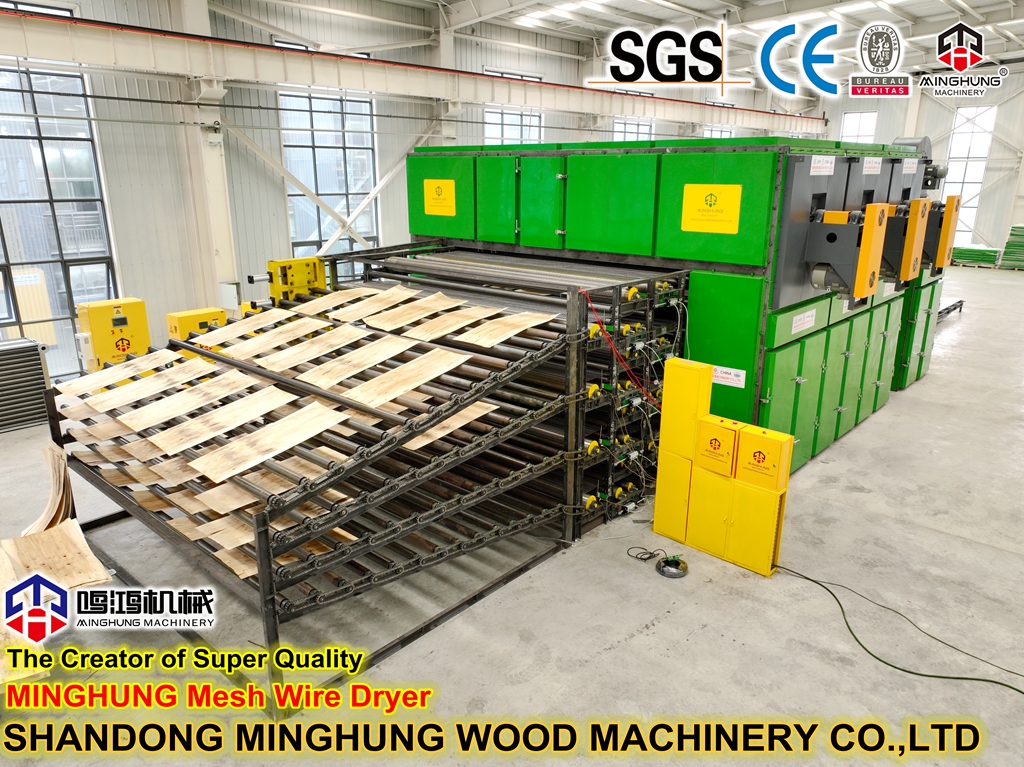
I. Mesh Belt Dryer for Veneer
1. Working Principle
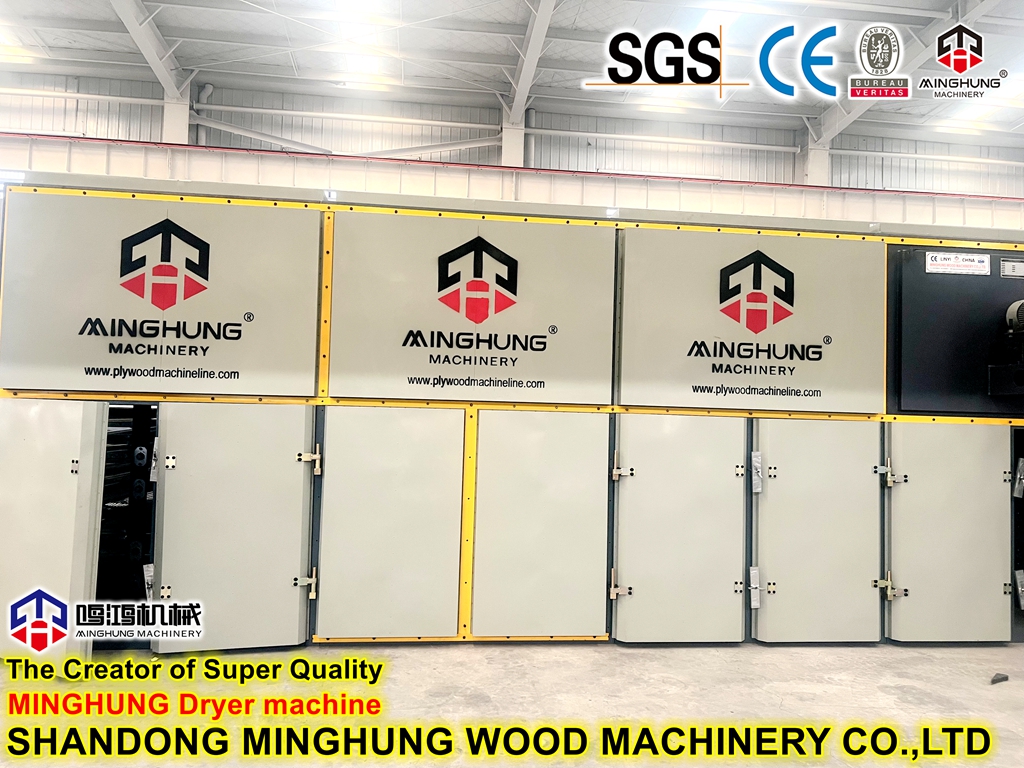
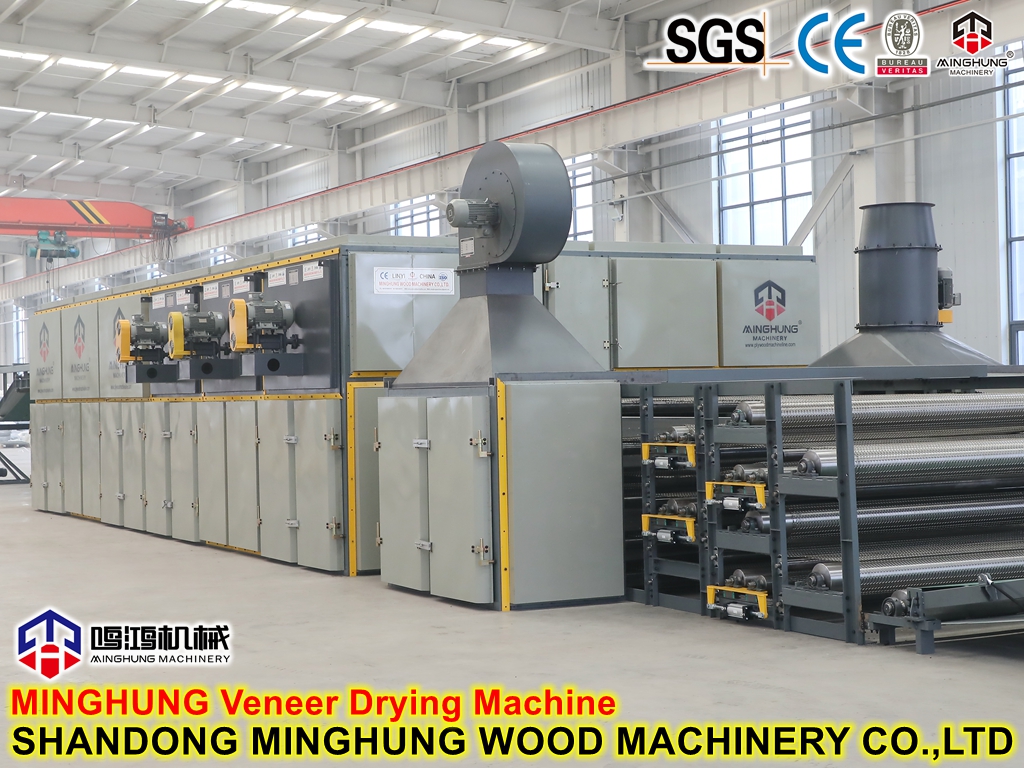
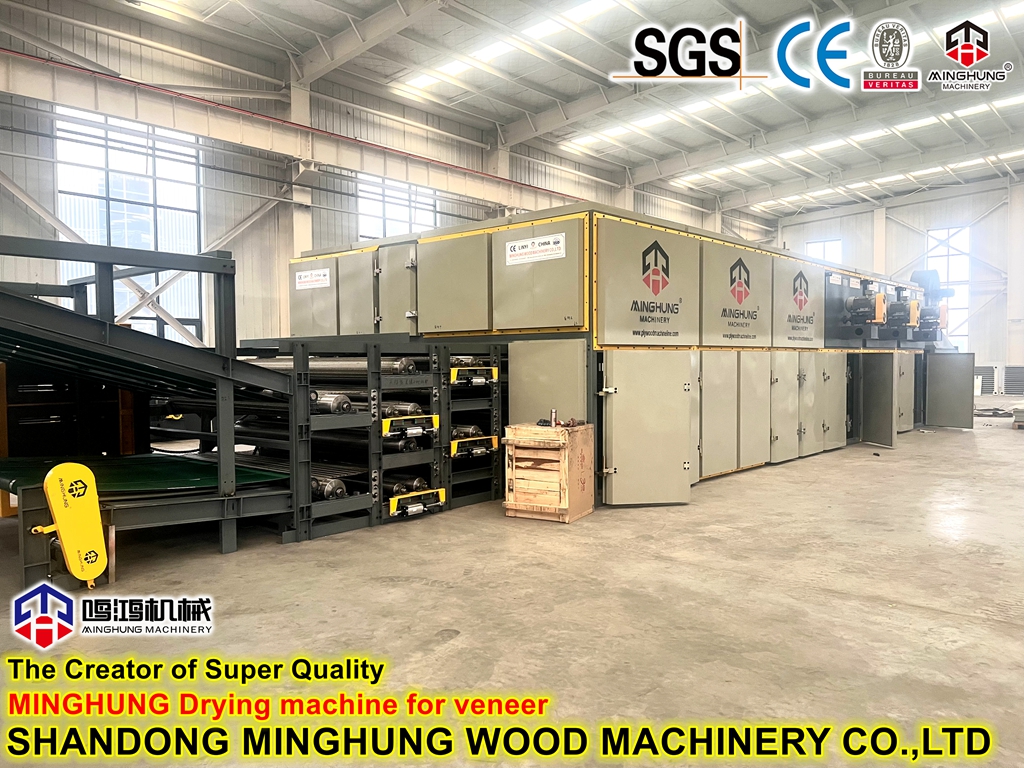
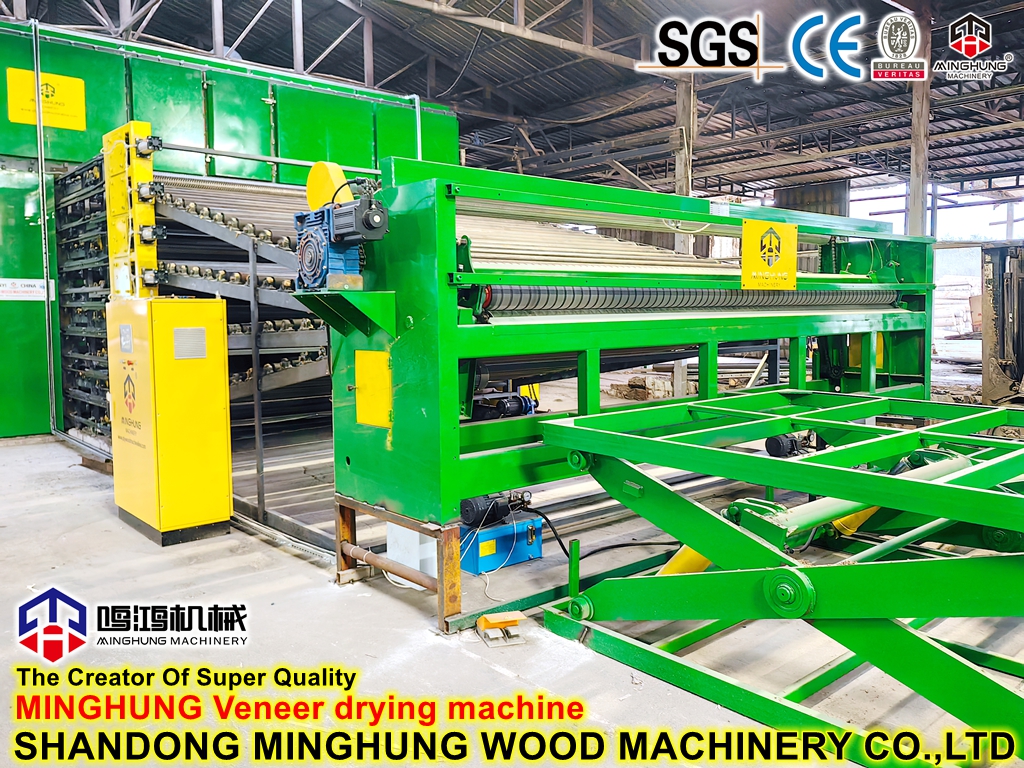
Wet veneer sheets are evenly and flatly placed onto a horizontally moving, porous stainless steel (or alloy) mesh belt at the feeding end. The belt carries the veneer through one or multiple drying chambers. In each chamber, high-temperature hot air, driven by circulating fans, is forced vertically through the upper and lower surfaces of the veneer via precisely designed upper and lower air ducts and nozzle systems. This "through-convection" method enables extremely efficient heat and moisture vapor exchange. The veneer moves at a constant speed with the belt, sequentially undergoing preheating, constant-rate drying, and falling-rate drying stages, finally reaching the target moisture content at the discharge end.
2. Key Structural Features
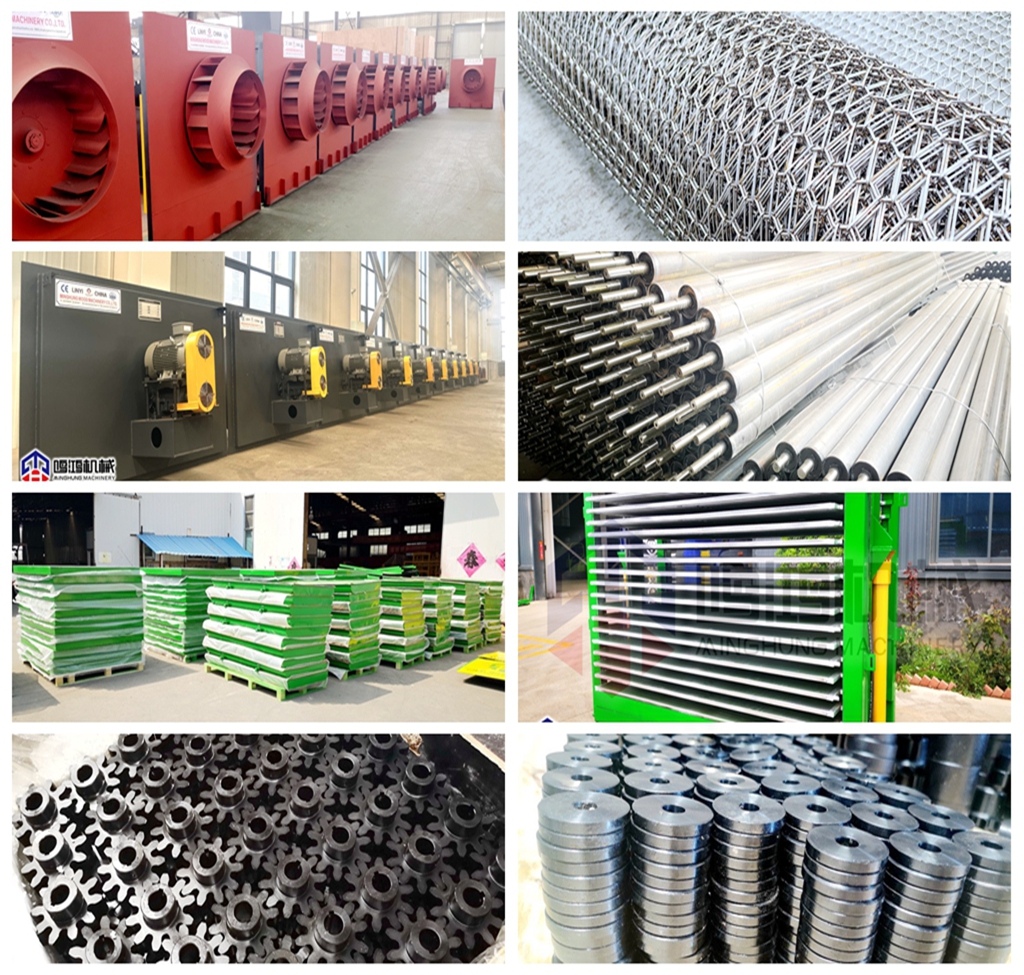
Conveyance System: Endless stainless steel mesh belt supported by drive and tension rollers, with stepless speed adjustment.
Drying Chamber: Divided into multiple independent zones with controlled temperature and humidity, allowing precise programming of drying schedules.
Air Circulation System: Each section has independent centrifugal fans, heaters (steam finned tubes / thermal oil tubes / gas hot air furnaces, etc.), and air distribution devices to ensure uniform air volume and velocity.
Casing: Color steel plate exterior with high-quality insulation filling, saving energy and improving the workshop environment.
Moisture Exhaust System: Equipped with automatically or manually adjustable exhaust dampers to promptly remove humid air.
3. Main Advantages
Superior Drying Quality: Vertical through-airflow ensures even heating on both sides, resulting in excellent moisture content uniformity. This significantly reduces veneer defects like warping, checking, and distortion, greatly improving grade yield.
Excellent Versatility: Particularly suitable for drying thin veneer (e.g., 1.0-2.0mm). Highly adaptable to different wood species (especially prone-to-warp species like poplar, eucalyptus) and varying initial moisture contents, with very low breakage rates.
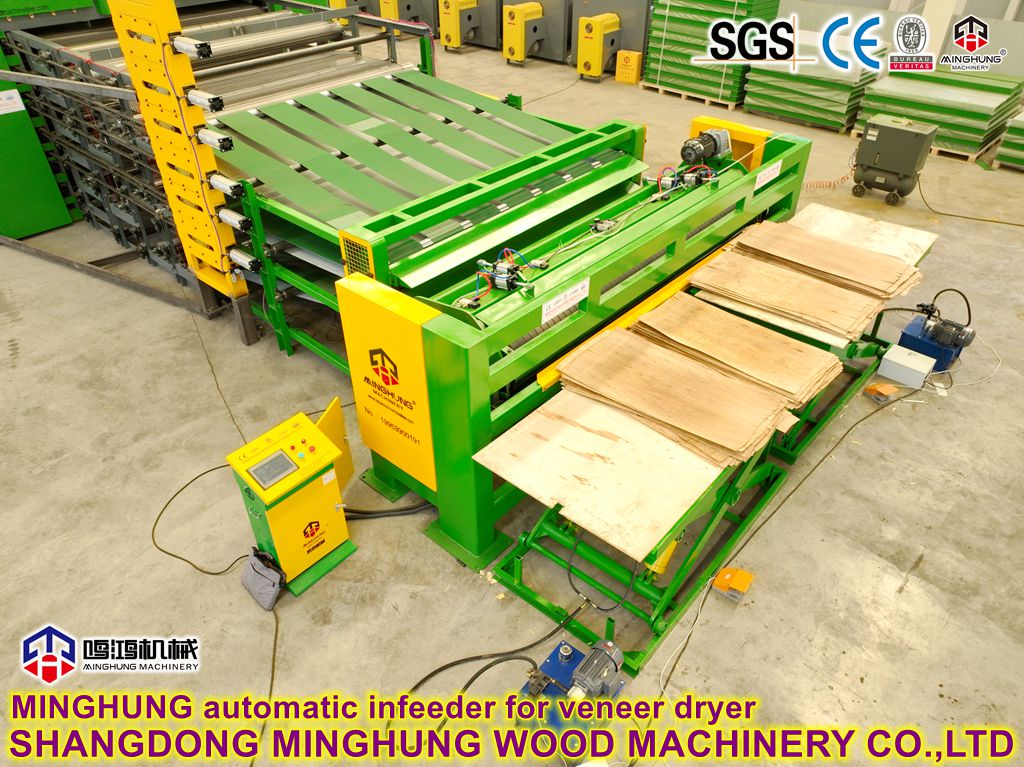
High Automation: Easily integrated into continuous, automated production lines with preceding and subsequent processes (e.g., peeling, clipping, splicing).
Advanced Technology: Modern models are typically equipped with PLC and touchscreen HMIs, capable of storing multiple drying schedules and offering precise control over process parameters (temperature, humidity, air speed, belt speed).
Enhanced Durability: Key components exposed to hot, humid air (e.g., inner chamber, ducts, mesh belt) can be made of stainless steel for corrosion resistance and long life.
4. Typical Applications
The mainstream choice for modern, large-scale, high-quality plywood production lines, especially for manufacturing products like concrete formwork and furniture panels that demand high veneer flatness and quality.

II. Roller (Hot Plate) Dryer for Veneer
1. Working Principle
Wet veneer passes between a series of synchronized, rotating heated metal rollers (or stationary heated plates). Heat is transferred primarily via conduction, directly from the hot roller surface to the veneer upon contact. Some models are supplemented by convective hot air from above or below. The veneer is propelled forward by friction with the rollers, which simultaneously serve to heat, convey, and to some extent, press the veneer.

2. Key Structural Features
Heating System: The core consists of hollow rollers through which steam or thermal oil circulates as the heating medium.
Drive System: All rollers are synchronized via gears or chains, with adjustable speed.
Pressure Mechanism: In some models, upper rollers can float or apply slight pressure to improve contact.
Auxiliary Air System: Typically features a hot air hood above the rollers to provide convective heat and assist in moisture removal.

3. Main Advantages
High Thermal Efficiency, Energy Saving: Heat transfer via contact conduction is more efficient than air convection. Specific steam consumption per unit of water evaporated is often lower, offering advantages in operational energy costs.
Fast Drying Speed: For thicker veneer (e.g., >2.5mm), direct conductive heating enables rapid drying rates.
Pressing/Smoothing Effect: Can partially improve the surface smoothness of the veneer.
Relatively Compact Structure: Generally requires less length per unit of capacity compared to mesh belt dryers.
Lower Initial Investment: Mechanical structure is relatively simpler, often resulting in competitive manufacturing costs.
4. Typical Applications
Still used in small to medium-sized plywood mills where extreme veneer flatness is not critical, or for producing thicker veneer. Also chosen in specific regions or for specific species due to its energy-saving advantages.
III. Key Comparative Summary
Feature | Mesh Belt Dryer | Roller Dryer |
Primary Heat Transfer | Convection (Hot air through-flow) | Conduction (Roller contact) |
Drying Uniformity | Excellent. Even on both sides, consistent MC. | Moderate. Temperature & drying gradient exists between contact/non-contact sides. |
Veneer Versatility | Very Wide. Excellent for thin veneer, warp-prone species. Low breakage. | Limited. Better for thick veneer. High breakage risk for thin veneer. |
Drying Quality | High. Flat veneer, fewer defects, high grade yield. | Moderate. Potential for internal stress & slight warping. |
Energy Efficiency | High (High electrical consumption, but good overall thermal efficiency). | Very High (High conductive efficiency, often lower specific steam consumption). |
Automation & Line Integration | Very Easy. Standard design for fully automatic lines. | Fairly Easy, but requires careful feeding alignment. |
Capital Investment | Higher | Lower |
Maintenance Focus | Belt cleaning/tracking, fan maintenance. | Roller surface cleaning/polishing, drive system maintenance. |
Eco-friendliness & Work Environment | Generally better sealed/insulated, superior workshop environment. | Potential local hot spots, warmer workshop feel. |
mesh wire dryer
roller dryer
We are Shandong MINGHUNG Wood Based Panel Machinery Co.,Ltd China factory and manufacturer of full sets of Plywood machinery and Veneer machinery. With many years production experience, advanced production technology,experienced workers and professional engineers, we can offer you the suitable, good and strong machinery for you.


Our contacts:
Whatsapp: +8618769900191 +8615589105786 +8618954906501
Email: osbmdfmachinery@gmail.com
I. Mesh Belt Dryer for Veneer
1. Working Principle
Wet veneer sheets are evenly and flatly placed onto a horizontally moving, porous stainless steel (or alloy) mesh belt at the feeding end. The belt carries the veneer through one or multiple drying chambers. In each chamber, high-temperature hot air, driven by circulating fans, is forced vertically through the upper and lower surfaces of the veneer via precisely designed upper and lower air ducts and nozzle systems. This "through-convection" method enables extremely efficient heat and moisture vapor exchange. The veneer moves at a constant speed with the belt, sequentially undergoing preheating, constant-rate drying, and falling-rate drying stages, finally reaching the target moisture content at the discharge end.

2. Key Structural Features
Conveyance System: Endless stainless steel mesh belt supported by drive and tension rollers, with stepless speed adjustment.
Drying Chamber: Divided into multiple independent zones with controlled temperature and humidity, allowing precise programming of drying schedules.
Air Circulation System: Each section has independent centrifugal fans, heaters (steam finned tubes / thermal oil tubes / gas hot air furnaces, etc.), and air distribution devices to ensure uniform air volume and velocity.
Casing: Color steel plate exterior with high-quality insulation filling, saving energy and improving the workshop environment.
Moisture Exhaust System: Equipped with automatically or manually adjustable exhaust dampers to promptly remove humid air.

3. Main Advantages
Superior Drying Quality: Vertical through-airflow ensures even heating on both sides, resulting in excellent moisture content uniformity. This significantly reduces veneer defects like warping, checking, and distortion, greatly improving grade yield.
Excellent Versatility: Particularly suitable for drying thin veneer (e.g., 1.0-2.0mm). Highly adaptable to different wood species (especially prone-to-warp species like poplar, eucalyptus) and varying initial moisture contents, with very low breakage rates.
High Automation: Easily integrated into continuous, automated production lines with preceding and subsequent processes (e.g., peeling, clipping, splicing).
Advanced Technology: Modern models are typically equipped with PLC and touchscreen HMIs, capable of storing multiple drying schedules and offering precise control over process parameters (temperature, humidity, air speed, belt speed).
Enhanced Durability: Key components exposed to hot, humid air (e.g., inner chamber, ducts, mesh belt) can be made of stainless steel for corrosion resistance and long life.
4. Typical Applications
The mainstream choice for modern, large-scale, high-quality plywood production lines, especially for manufacturing products like concrete formwork and furniture panels that demand high veneer flatness and quality.
II. Roller (Hot Plate) Dryer for Veneer
1. Working Principle
Wet veneer passes between a series of synchronized, rotating heated metal rollers (or stationary heated plates). Heat is transferred primarily via conduction, directly from the hot roller surface to the veneer upon contact. Some models are supplemented by convective hot air from above or below. The veneer is propelled forward by friction with the rollers, which simultaneously serve to heat, convey, and to some extent, press the veneer.

2. Key Structural Features
Heating System: The core consists of hollow rollers through which steam or thermal oil circulates as the heating medium.
Drive System: All rollers are synchronized via gears or chains, with adjustable speed.
Pressure Mechanism: In some models, upper rollers can float or apply slight pressure to improve contact.
Auxiliary Air System: Typically features a hot air hood above the rollers to provide convective heat and assist in moisture removal.

3. Main Advantages
High Thermal Efficiency, Energy Saving: Heat transfer via contact conduction is more efficient than air convection. Specific steam consumption per unit of water evaporated is often lower, offering advantages in operational energy costs.
Fast Drying Speed: For thicker veneer (e.g., >2.5mm), direct conductive heating enables rapid drying rates.
Pressing/Smoothing Effect: Can partially improve the surface smoothness of the veneer.
Relatively Compact Structure: Generally requires less length per unit of capacity compared to mesh belt dryers.
Lower Initial Investment: Mechanical structure is relatively simpler, often resulting in competitive manufacturing costs.
4. Typical Applications
Still used in small to medium-sized plywood mills where extreme veneer flatness is not critical, or for producing thicker veneer. Also chosen in specific regions or for specific species due to its energy-saving advantages.
III. Key Comparative Summary
Feature | Mesh Belt Dryer | Roller Dryer |
Primary Heat Transfer | Convection (Hot air through-flow) | Conduction (Roller contact) |
Drying Uniformity | Excellent. Even on both sides, consistent MC. | Moderate. Temperature & drying gradient exists between contact/non-contact sides. |
Veneer Versatility | Very Wide. Excellent for thin veneer, warp-prone species. Low breakage. | Limited. Better for thick veneer. High breakage risk for thin veneer. |
Drying Quality | High. Flat veneer, fewer defects, high grade yield. | Moderate. Potential for internal stress & slight warping. |
Energy Efficiency | High (High electrical consumption, but good overall thermal efficiency). | Very High (High conductive efficiency, often lower specific steam consumption). |
Automation & Line Integration | Very Easy. Standard design for fully automatic lines. | Fairly Easy, but requires careful feeding alignment. |
Capital Investment | Higher | Lower |
Maintenance Focus | Belt cleaning/tracking, fan maintenance. | Roller surface cleaning/polishing, drive system maintenance. |
Eco-friendliness & Work Environment | Generally better sealed/insulated, superior workshop environment. | Potential local hot spots, warmer workshop feel. |
mesh wire dryer
roller dryer
We are Shandong MINGHUNG Wood Based Panel Machinery Co.,Ltd China factory and manufacturer of full sets of Plywood machinery and Veneer machinery. With many years production experience, advanced production technology,experienced workers and professional engineers, we can offer you the suitable, good and strong machinery for you.


Our contacts:
Whatsapp: +8618769900191 +8615589105786 +8618954906501
Email: osbmdfmachinery@gmail.com
As Christmas approaches, Shandong MINGHUNG wood based panel machinery Co., Ltd. has welcomed another peak in shipments.
In early December 2025, the culmination of close collaboration between the MINGHUNG foreign trade team and our partners — 9 containers fully loaded with the core equipment for a plywood production line .
Shandong Minghung Wood Machinery Factory Shandong minghung wood machine factory produces plywood machinery in linyi city city, china, dedicated to providing high-quality and suitable machines veneer machine,plywood machine,veneer splicing machine.veneer dryer machine,veneer peeling machine,plywood v
How to produce Particle board? What is the production step of Making Particle board?Introduction:Particle board, also known as chipboard, is a versatile and cost-effective material widely used in the construction and furniture industries. It is made by compressing wood particles and adhesive togethe
The Ultimate Guide to Plywood Hot Press Machines: Crafting High-Quality Plywood Introduction:Plywood is a versatile and widely used material in various industries, from construction to furniture manufacturing. Behind the scenes, plywood hot press machines play a crucial role in the production proces
Shandong Minghung will continue to focus on the research, development, and manufacturing of wood processing machinery. We are committed to building long-term, mutually beneficial partnerships with global clients through reliable products, timely deliveries, and professional service.
What is a veneer dryer?MINGHUNG Roller veneer dryer for drying original wood veneer, remove abundant humidity, in the end, the wood veneer humidity will be 5%-10%, so it is suitable for making plywood.Veneer roller dryer are suitable for big drying capacity per day, it can be different length, width
Particleboard (also known as chipboard) is a common engineered wood panel made by mixing wood fragments or particles with adhesives (such as urea-formaldehyde resin) and then hot-pressing them into shape.
Recently, a high-performance plywood sander was prepared for shipment at Qingdao Port, ready for its journey to our valued partner in Russia.
This shipment not only demonstrates Minghung Machinery’s strong production coordination and international trade execution capabilities but also ensures the rapid commissioning of the customer's production line.