| Availability: | |
|---|---|
| Quantity: | |
MINGHUNG

Core Equipment (Optimized for Poplar/Pine)
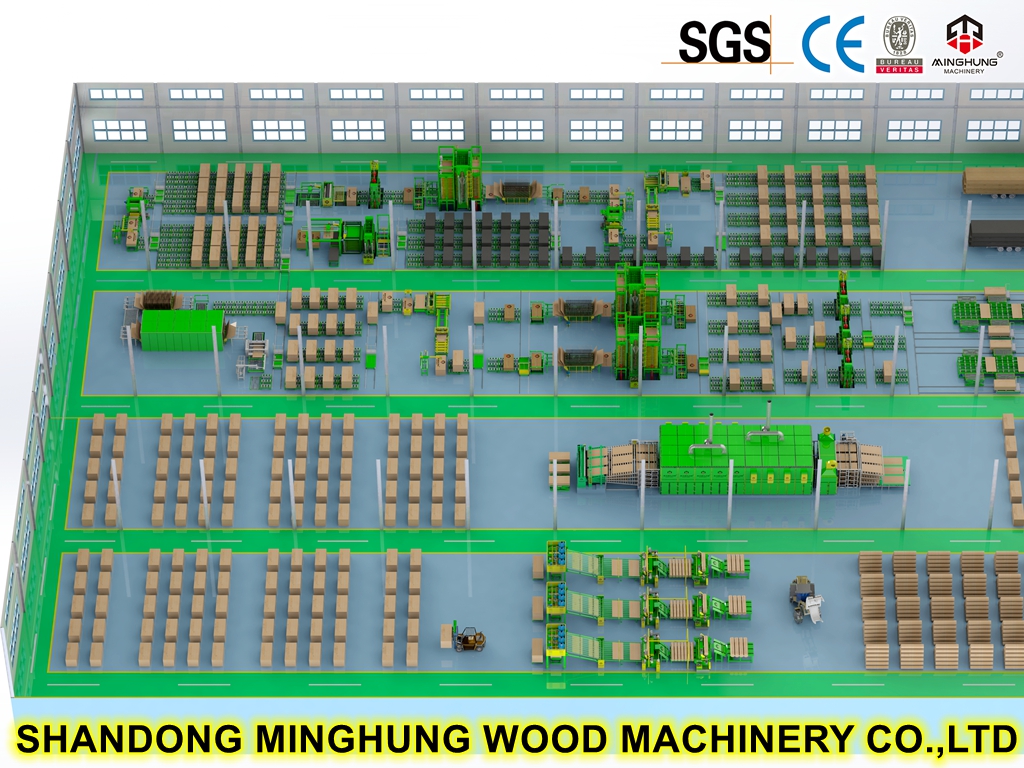
This production line is an integrated industrial solution specifically developed for the physical characteristics of poplar (soft, low density) and pine (resin-rich, uneven texture) wood. It aims to achieve efficient, stable, and high-quality continuous production from logs to finished panels.
1. Log Processing Section
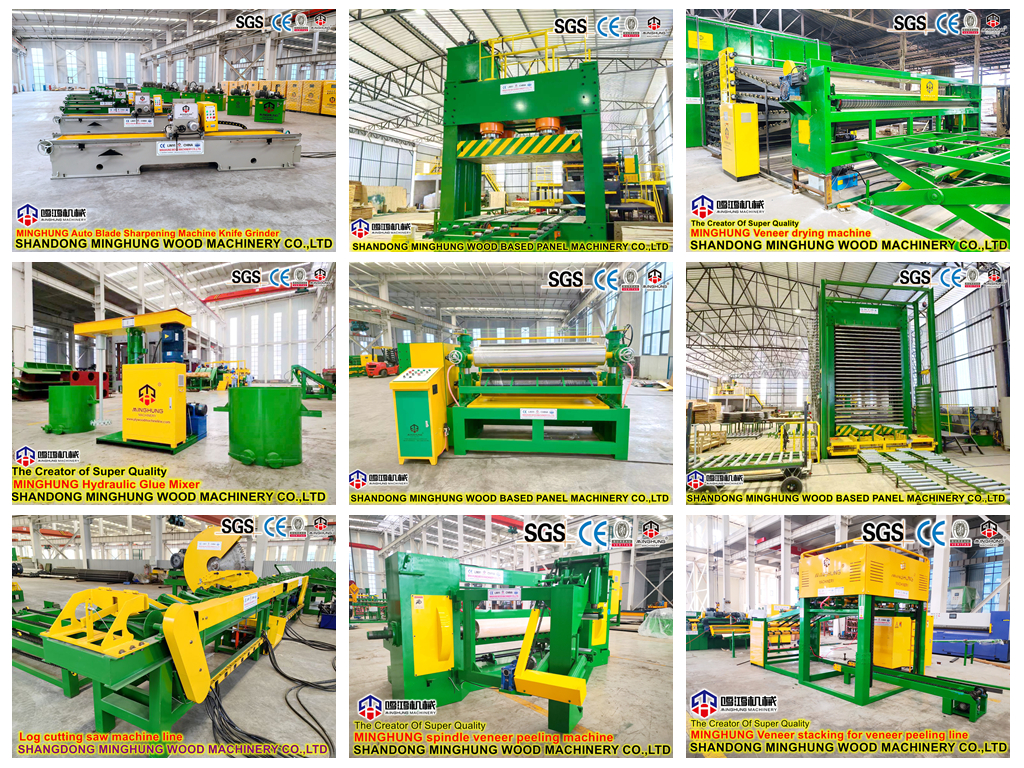
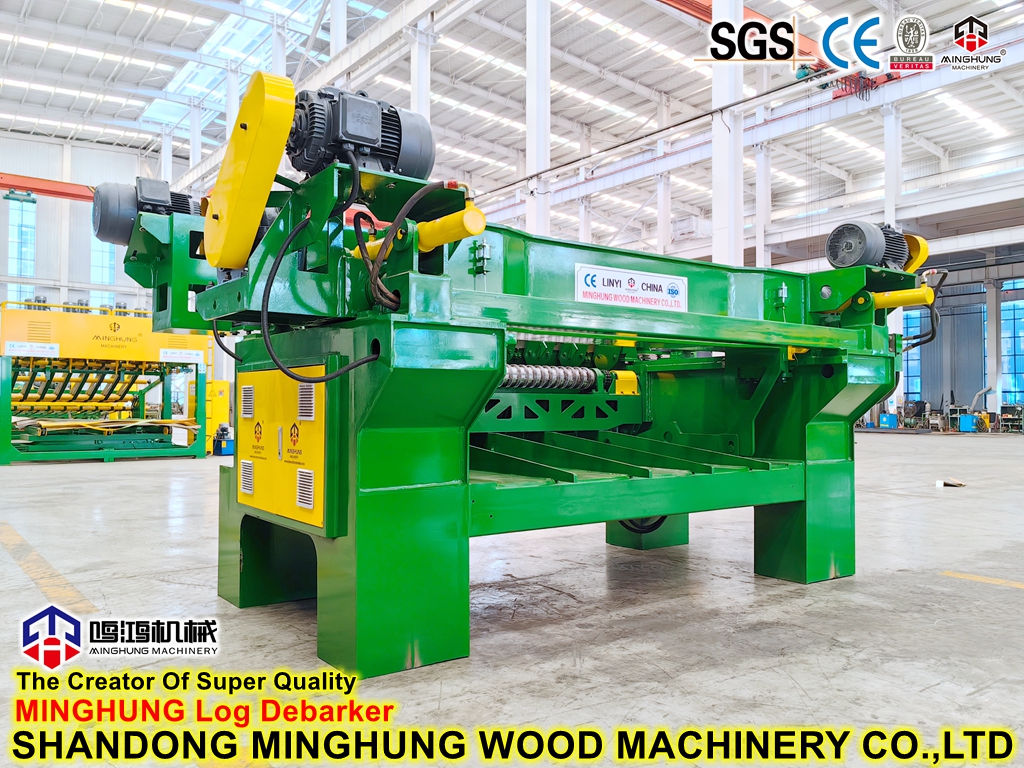
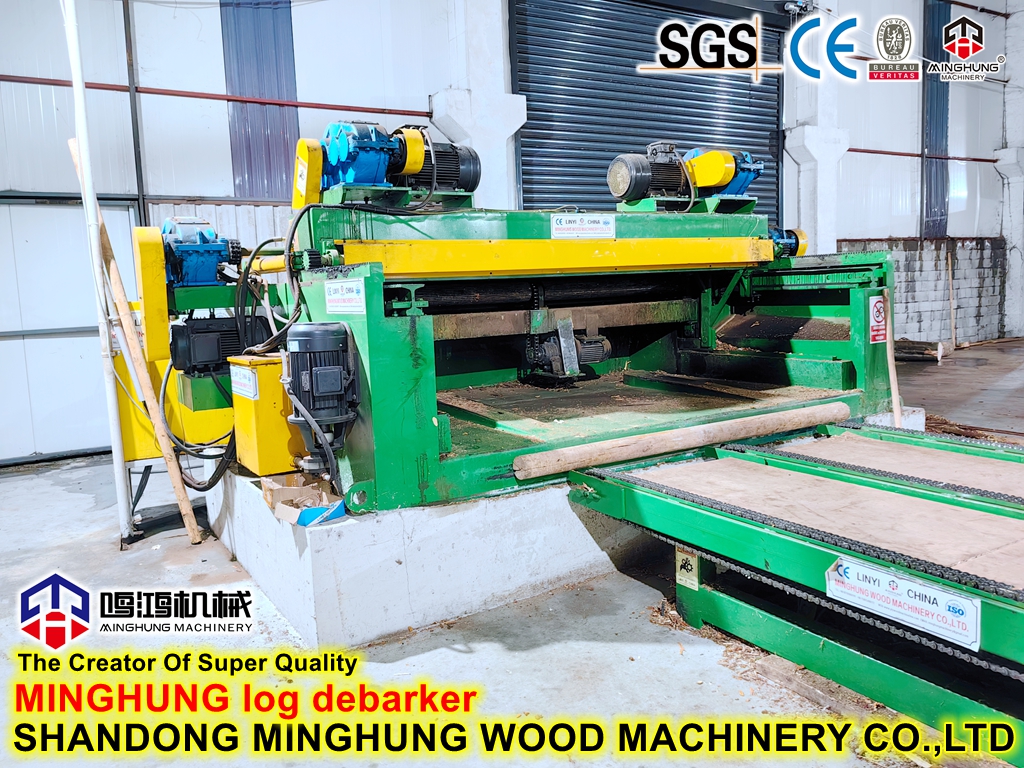
Heavy-Duty Debarker: Utilizes cutter drums or rollers designed to forcefully remove the rough bark of pine and the softer outer bark of poplar, providing a clean surface for peeling and reducing tool wear.
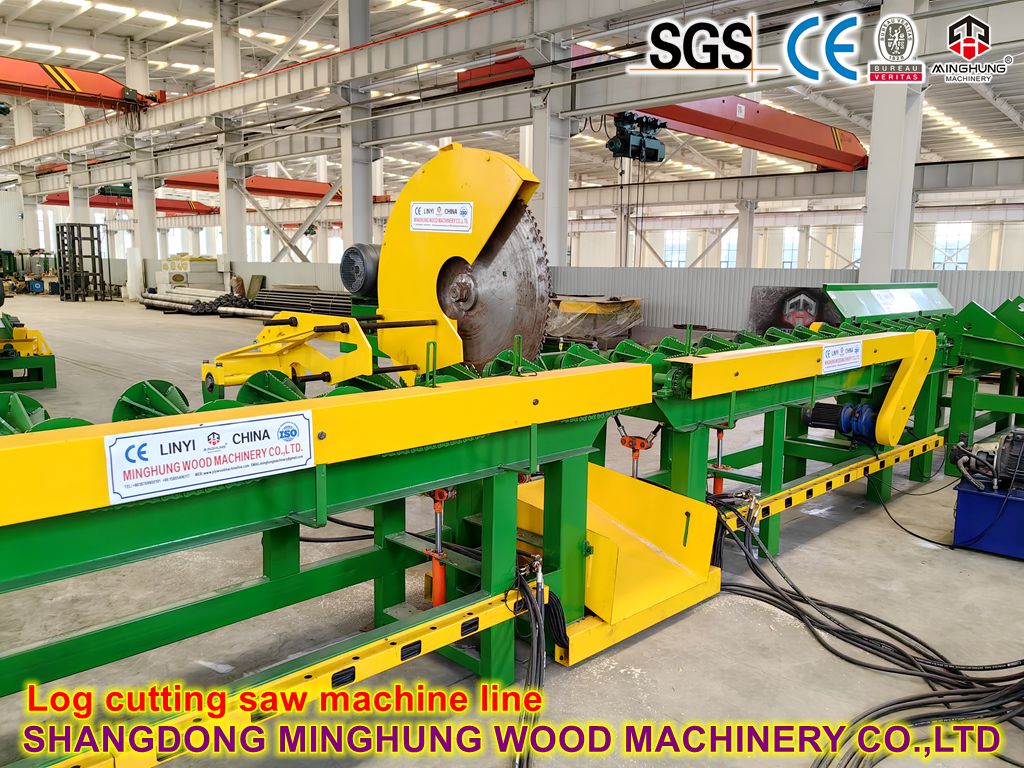
Length-Cutting Saw: Precisely cuts logs to the required peeling length (e.g., 1300mm, 1500mm, 1830mm) to optimize yield.
Hydro-Thermal Softening System:
Function: Critical for both wood types. Softens wood fibers through hot water soaking or steam treatment.
For Poplar: Prevents excessive "checking" (splits) on the veneer back during peeling, improving veneer integrity and surface smoothness.
For Pine: Promotes partial softening and even distribution of internal resin, reducing "brittle breaks" and "blade sticking" during peeling caused by resin.
2. Veneer Preparation & Drying Section
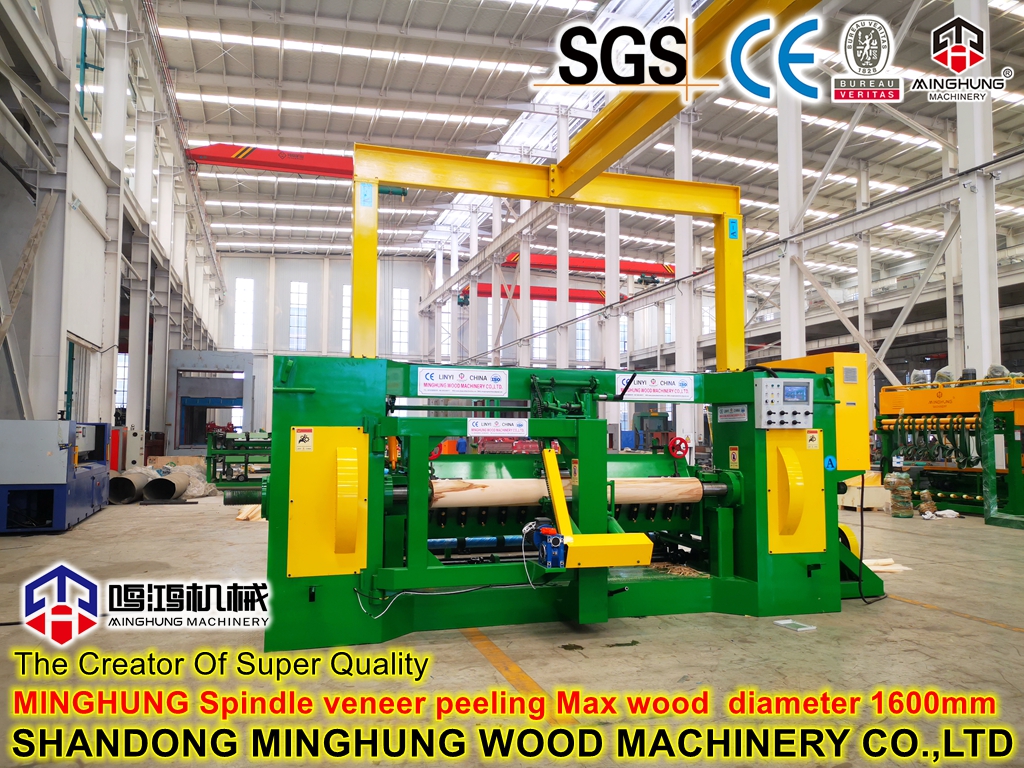
Large-Diameter Hydraulic Peeler (Key Equipment):
Function: Peels the conditioned log block into continuous veneer ribbons.
Poplar Optimization: Designed for high precision and speed, leveraging poplar's easy-cutting nature for high-output production while maintaining uniform veneer thickness.
Pine Optimization: Equipped with high-strength spindles and special alloy blades to handle knots and uneven hardness. The knife and nose bar settings account for potential resin adhesion.
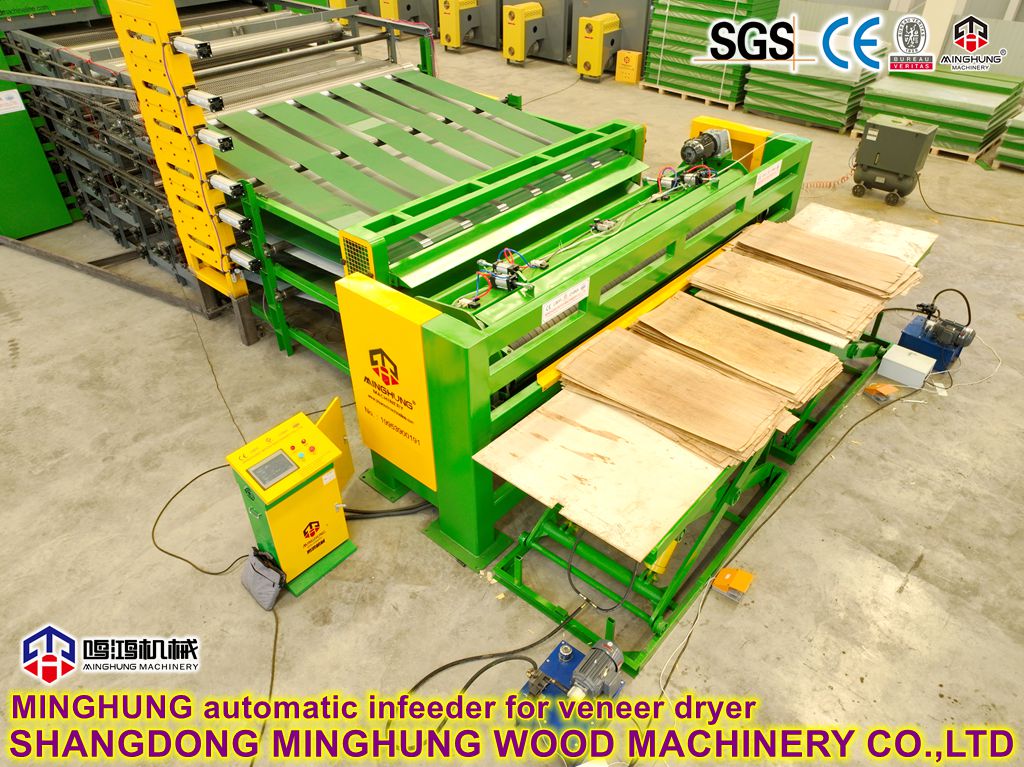
Veneer Clipping/Rolling System: Automatically shears or reels the continuous ribbon into set lengths for transport to the dryer.
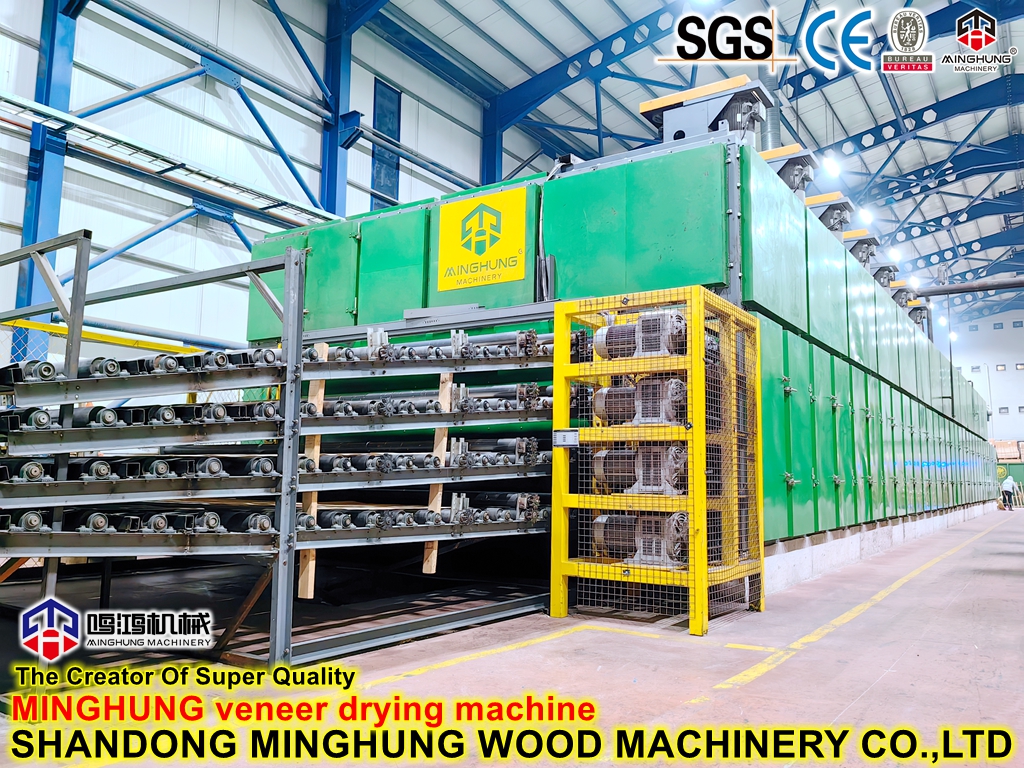
Roller/Mesh Belt Dryer (Core Process Equipment):
Function: Reduces veneer moisture content from over 60% (green) to 8-12%.
Pine Resin Control: The drying curve (temperature, air flow, humidity) must be precisely controlled. A "stepwise temperature increase" process is used, where initial low-to-medium temperatures allow resin to cure slowly within the wood rather than bleeding to the surface, preventing "oil spots" and ensuring glue bond strength.
Poplar Anti-Warping: Requires even drying to avoid high temperatures that cause excessive shrinkage, warping, or embrittlement.
3. Veneer Finishing & Gluing Section
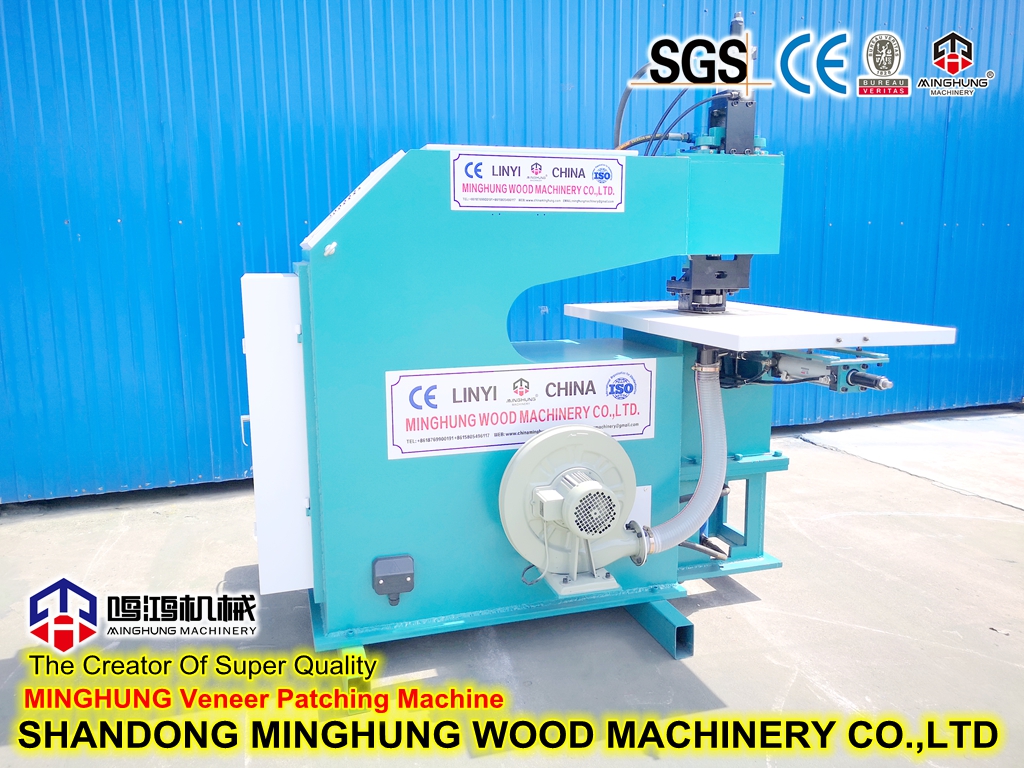
Veneer Patching & Splicing Line: Automatically detects and patches knot holes in dried veneer, and splices narrow strips into full-size face/back sheets. This is particularly crucial for improving the utilization rate of knotty pine veneer.
Automatic/Semi-Auto Glue Spreader: Typically a four-roller machine that precisely controls the amount of adhesive applied (poplar absorbs more glue; pine requires a continuous glue film despite resin).

Layup & Pre-press System:
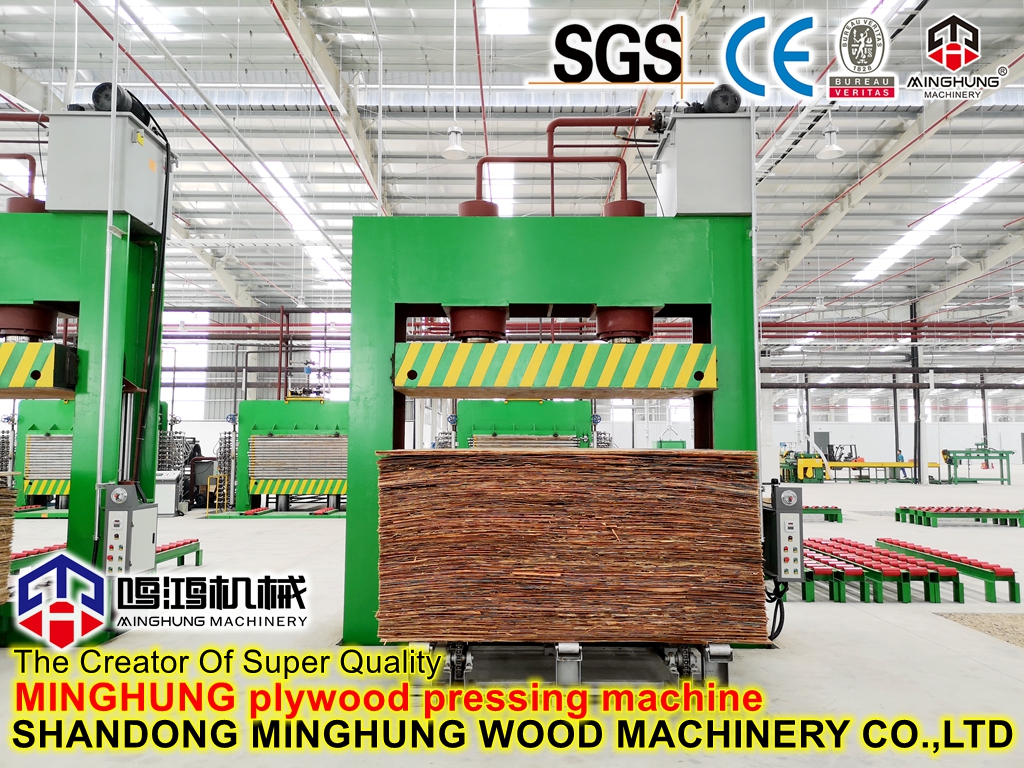
Function: Assembles glued veneer into a cross-banded mat (e.g., pine face/back veneers with poplar core veneers) and applies cold pre-pressing.
Optimization: Pre-pressing forms the mat, expelling air and preventing shifting during hot pressing, which is especially important for the soft-structured poplar core.
4. Pressing & Finishing Section
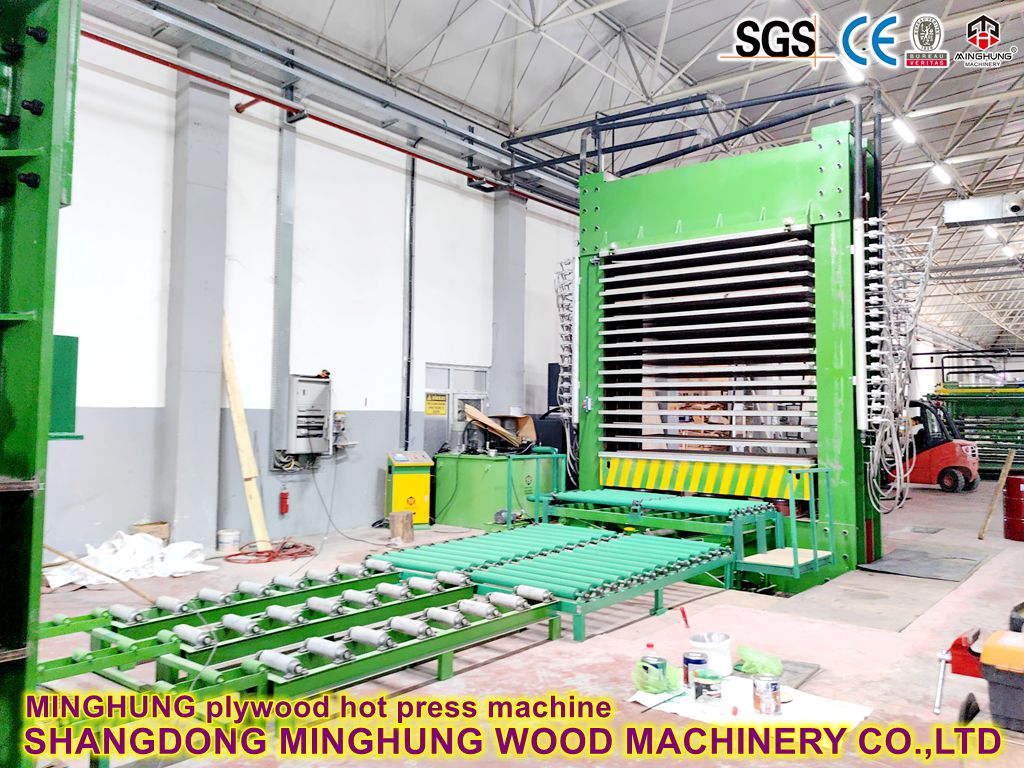
Intelligent Multi-Opening Hot Press (Core Forming Equipment):
Function: Cures the adhesive under high temperature and pressure.
Process Optimization:
For Pine Resin: Press temperature should not be excessively high, or a "stepwise pressure" process is used to prevent residual resin from re-liquefying and causing "blisters" or "delamination."
Pressure & Time: The pressure curve is adjusted according to the compressibility of the poplar core to ensure intimate contact between all layers.
Cooling & Unstacking System: Uniformly cools the hot pressed panels to set their shape and release internal stress, preventing deformation.
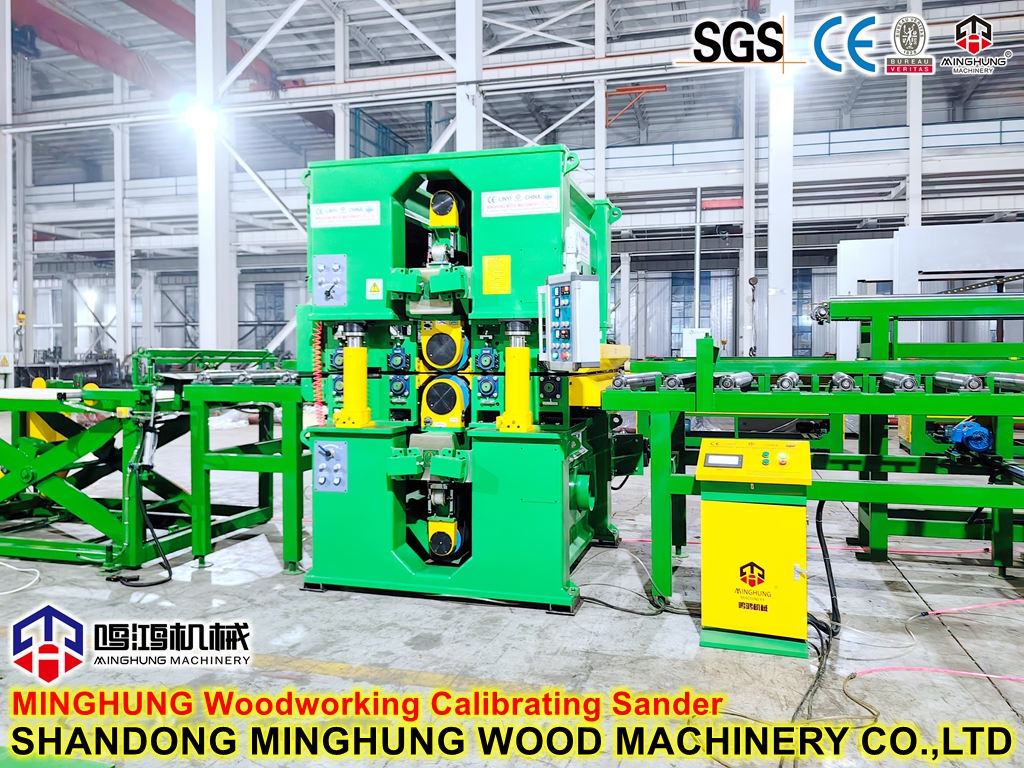
Calibrating Sander Line: Employs either "sand-then-trim" or "trim-then-sand" sequence. The sander (usually a double-sided calibrating type) removes thickness variation and the pre-cured surface layer, resulting in a smooth, even panel surface suitable for the decorative needs of pine-faced plywood.
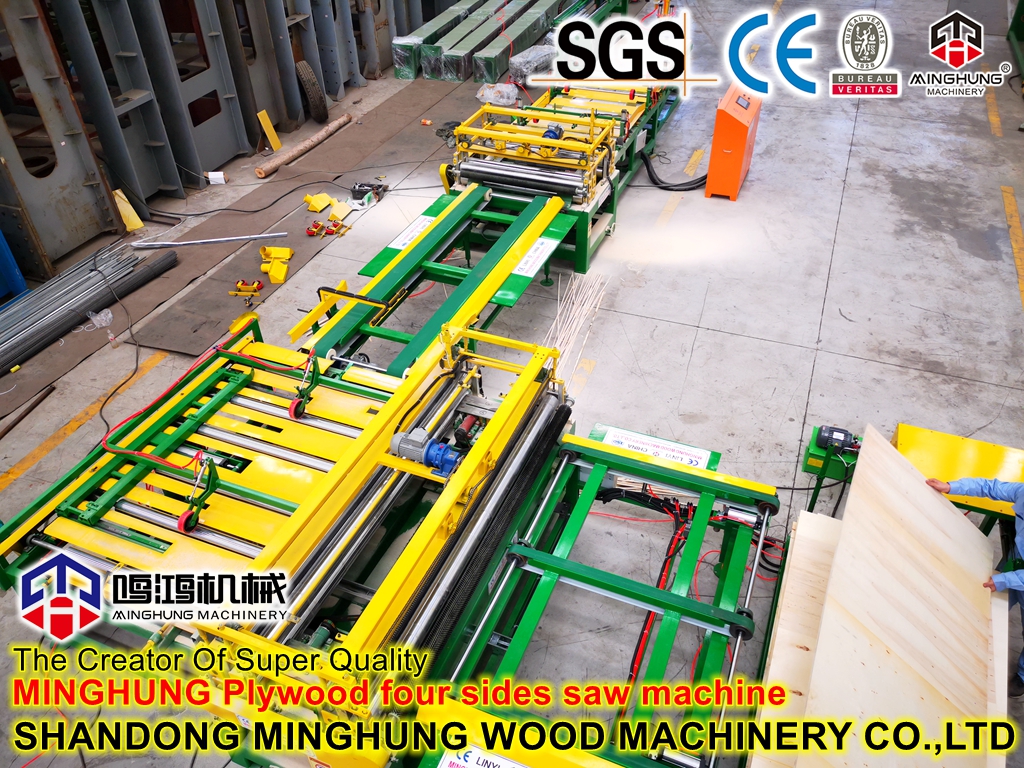
Trimming Saw & Grading/Packaging Line: Cuts panels to standard dimensions, grades them manually or automatically, and finally packages for storage.
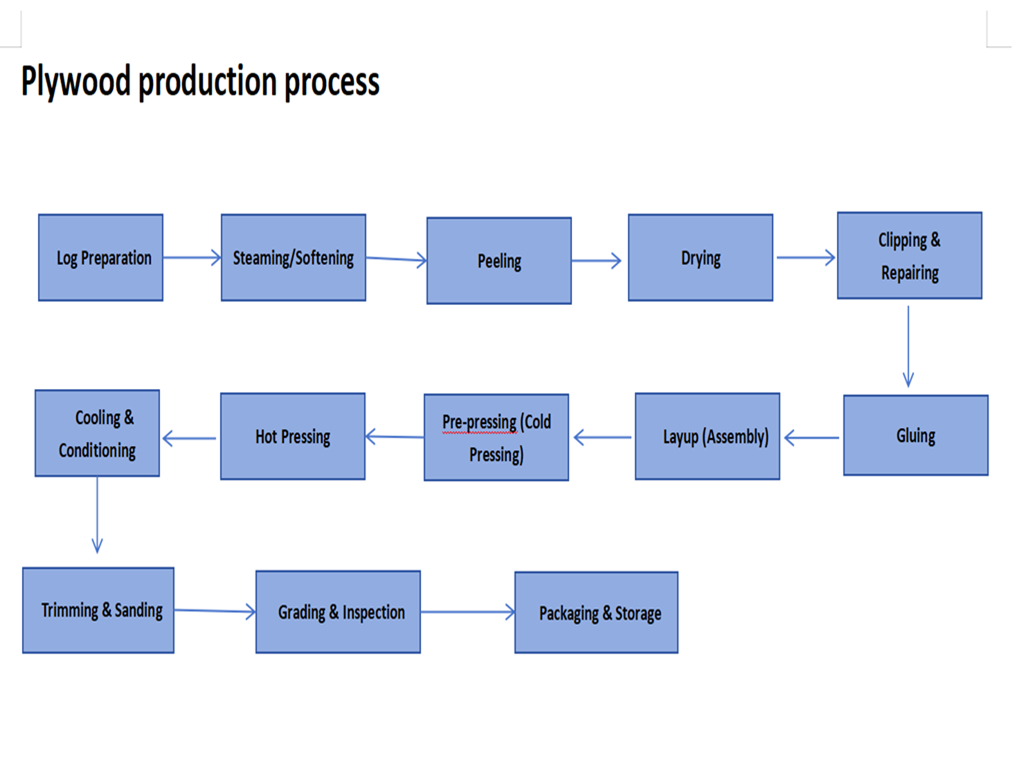
Log intake → Debarking → Cross-cutting → (Hydro-Thermal Conditioning) → Peeling → Veneer clipping/rolling → (Veneer Drying - Core Process) → Veneer patching/splicing → Glue spreading → Layup (Poplar core + Pine face/back) → Pre-pressing → Hot Pressing (Core Process) → Cooling → Sanding → Trimming → Grading & Inspection → Packaging & Dispatch.
Core Advantages Proposition of This Line
1. Exceptional Raw Material Adaptability: Specifically designed for poplar/pine, solving the challenges of pine resin and poplar's softness, transforming these affordable and readily available woods into high-value-added plywood.
2. Complete & Synergistic Process Chain: Parameters at every stage—from conditioning and drying to hot pressing—are matched and optimized for the wood characteristics, forming a coherent "process chain." This synergy, unattainable with disparate machines, directly determines product stability and yield rate.
3. Outstanding Product Quality:
The targeted process results in plywood with uniform structure and high strength.
Pine faces have attractive grain with well-controlled resin, free from oil spots or delamination.
Poplar core provides good fill, resulting in excellent panel flatness.
4. High Production Efficiency & Automation: The complete flow-line design minimizes intermediate handling and pauses. Automation in key sections (e.g., drying, pressing) ensures consistent production rhythm and stable quality, suitable for medium-to-large scale continuous operation.
5. Significant Comprehensive Economic Benefits:
High Utilization Rate: Advanced veneer finishing equipment maximizes the use of knotty pine veneer and poplar veneer.
Low Energy Consumption: Optimized drying and pressing processes reduce energy use per unit product.
High Product Value: The resulting commercial/construction-grade plywood has strong market competitiveness.
6. Turnkey Project & Technical Support: As a complete line, suppliers typically offer full-service support from layout design, installation & commissioning, process formulation, to personnel training, ensuring clients quickly master core techniques and achieve smooth production start-up.
Characteristic Dimension | Poplar | Pine |
Physical Properties | Light & Soft: Low density (typically 0.4-0.5 g/cm³), lightweight. | Medium-Soft: Higher density than poplar (0.5-0.6 g/cm³), relatively strong. |
Uniform Grain: Straight and fine grain, uniform structure, few knots. | Distinct & Attractive Grain: Prominent annual rings, darker heartwood, straight or slanted grain. Knots are a characteristic feature. | |
Easy to Machine: Loose fibers make it excellent for peeling, sanding, etc., with low energy consumption. | Resin-Rich: High resin content can cause blade/tape sticking during processing, affecting glue adhesion. | |
Prone to Warping During Drying: High shrinkage rate; improper drying can easily cause warping and buckling. | Demanding Drying Requirements: Requires controlled drying to prevent resin bleeding and surface checking. | |
Chemical & Mechanical Properties | High Acidity: Low pH can affect the curing speed of certain adhesives. | Resin Affects Bonding: Free resin can hinder glue film formation, requiring process intervention. |
Lower Strength: Generally has lower mechanical strength (especially MOE and MOR). | Good Strength: Better bending, compressive strength, and toughness compared to poplar. | |
High Hygroscopicity: Prone to moisture absorption and dimensional instability. | Natural Durability: Heartwood has some natural decay resistance (especially in species like Southern Pine). | |
Processing & Cost | High Yield: High veneer recovery rate during peeling, less backside checking, high utilization. | Processing Challenges: Requires handling resin and knots, demands higher-grade tools, complex drying process. |
Low Processing Cost: Low tool wear, relatively shorter drying cycles. | High Aesthetic Value: Natural grain and color provide decorative value. | |
Abundant & Low-Cost: Fast-growing plantation wood, stable supply, primary source for low-cost core material. | Higher Cost: Raw material price and processing costs are typically higher than poplar. |
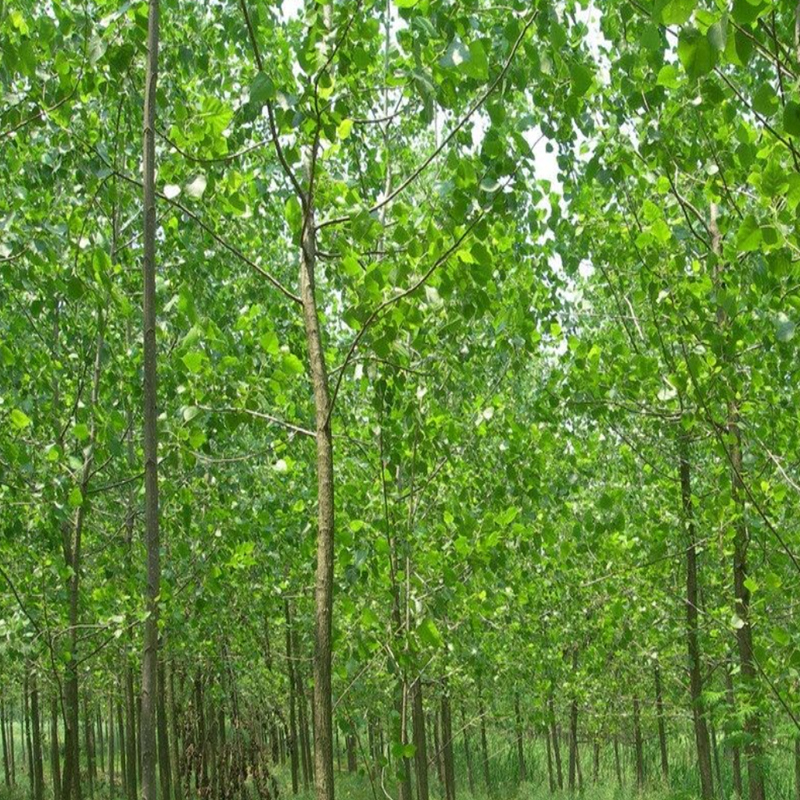
poplar
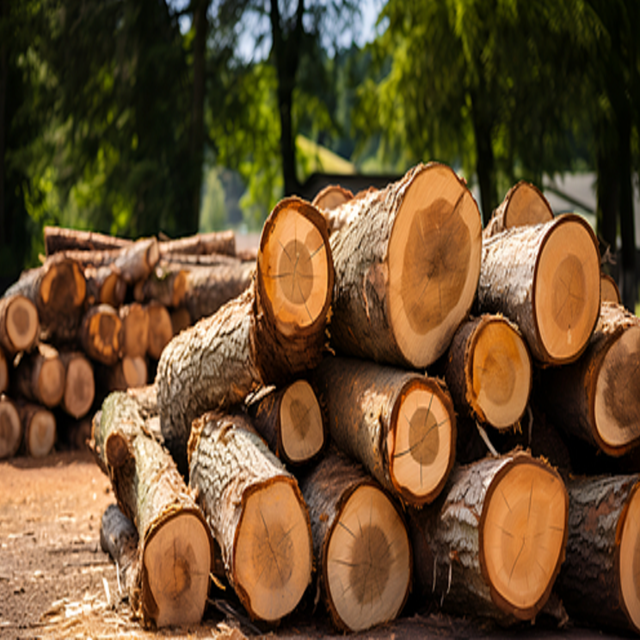
pine
Primary Application Scenarios
1. Construction & Formwork (Core Application Market)
Concrete Formwork:
Poplar Core, Pine Face Formwork: The classic combination. The inner poplar core is light and inexpensive, reducing overall cost. The surface pine face is harder, more wear-resistant, and, when overlaid with film, can be reused multiple times. Pine's grain also aids in release.
All-Poplar Formwork: Economical formwork, suitable for projects with lower reuse requirements.
Advantages: Controllable cost, sufficient strength, and convenient construction.
2. Furniture & Interior Decoration
Panel Furniture Substrate: Poplar plywood is an excellent substrate for cabinet side panels, shelves, drawer bottoms, etc. Its surface is smooth and ideal for overlaying with melamine paper (laminates), PVC film, or wood veneer.
Pine Face Furniture Panels: Utilizes the beautiful natural grain of pine directly for making table tops, cabinet doors, headboards, etc., in rustic, Scandinavian, or cottage-style furniture, often finished with clear varnish.
Interior Fit-out: Used for wall paneling, ceiling backing, partitions, display case construction, etc.
3. Packaging & Logistics
Export Crates/Packaging Cases: Poplar/pine plywood offers high strength-to-weight ratio, complying with international standards for wood packaging material (e.g., IPPC standards). Widely used for crates packaging heavy machinery, electronics, ceramics, etc.
Pallets & Dunnage: Its lightweight yet strong nature makes it ideal for manufacturing logistics pallets and warehouse dunnage, especially suitable for air freight or situations requiring frequent handling.
4. Other Industrial Applications
Flooring Underlayment: Used as a subfloor under hardwood or laminate flooring for leveling, moisture resistance, and enhancing foot feel.
Truck/Trailer Linings: Utilizes its lightweight advantage for interior lining panels in modified vehicle bodies.
DIY & Craft Materials: Popular among hobbyists due to its ease of working and moderate price.
Contact us for a free quote today!
Our contacts:
Whatsapp: +8618769900191 +8615589105786 +8618954906501
Email: osbmdfmachinery@gmail.com

Core Equipment (Optimized for Poplar/Pine)
This production line is an integrated industrial solution specifically developed for the physical characteristics of poplar (soft, low density) and pine (resin-rich, uneven texture) wood. It aims to achieve efficient, stable, and high-quality continuous production from logs to finished panels.
1. Log Processing Section
Heavy-Duty Debarker: Utilizes cutter drums or rollers designed to forcefully remove the rough bark of pine and the softer outer bark of poplar, providing a clean surface for peeling and reducing tool wear.

Length-Cutting Saw: Precisely cuts logs to the required peeling length (e.g., 1300mm, 1500mm, 1830mm) to optimize yield.

Hydro-Thermal Softening System:
Function: Critical for both wood types. Softens wood fibers through hot water soaking or steam treatment.
For Poplar: Prevents excessive "checking" (splits) on the veneer back during peeling, improving veneer integrity and surface smoothness.
For Pine: Promotes partial softening and even distribution of internal resin, reducing "brittle breaks" and "blade sticking" during peeling caused by resin.
2. Veneer Preparation & Drying Section
Large-Diameter Hydraulic Peeler (Key Equipment):
Function: Peels the conditioned log block into continuous veneer ribbons.
Poplar Optimization: Designed for high precision and speed, leveraging poplar's easy-cutting nature for high-output production while maintaining uniform veneer thickness.
Pine Optimization: Equipped with high-strength spindles and special alloy blades to handle knots and uneven hardness. The knife and nose bar settings account for potential resin adhesion.

Veneer Clipping/Rolling System: Automatically shears or reels the continuous ribbon into set lengths for transport to the dryer.
Roller/Mesh Belt Dryer (Core Process Equipment):
Function: Reduces veneer moisture content from over 60% (green) to 8-12%.
Pine Resin Control: The drying curve (temperature, air flow, humidity) must be precisely controlled. A "stepwise temperature increase" process is used, where initial low-to-medium temperatures allow resin to cure slowly within the wood rather than bleeding to the surface, preventing "oil spots" and ensuring glue bond strength.
Poplar Anti-Warping: Requires even drying to avoid high temperatures that cause excessive shrinkage, warping, or embrittlement.

3. Veneer Finishing & Gluing Section
Veneer Patching & Splicing Line: Automatically detects and patches knot holes in dried veneer, and splices narrow strips into full-size face/back sheets. This is particularly crucial for improving the utilization rate of knotty pine veneer.

Automatic/Semi-Auto Glue Spreader: Typically a four-roller machine that precisely controls the amount of adhesive applied (poplar absorbs more glue; pine requires a continuous glue film despite resin).

Layup & Pre-press System:
Function: Assembles glued veneer into a cross-banded mat (e.g., pine face/back veneers with poplar core veneers) and applies cold pre-pressing.
Optimization: Pre-pressing forms the mat, expelling air and preventing shifting during hot pressing, which is especially important for the soft-structured poplar core.

4. Pressing & Finishing Section
Intelligent Multi-Opening Hot Press (Core Forming Equipment):
Function: Cures the adhesive under high temperature and pressure.
Process Optimization:
For Pine Resin: Press temperature should not be excessively high, or a "stepwise pressure" process is used to prevent residual resin from re-liquefying and causing "blisters" or "delamination."
Pressure & Time: The pressure curve is adjusted according to the compressibility of the poplar core to ensure intimate contact between all layers.

Cooling & Unstacking System: Uniformly cools the hot pressed panels to set their shape and release internal stress, preventing deformation.
Calibrating Sander Line: Employs either "sand-then-trim" or "trim-then-sand" sequence. The sander (usually a double-sided calibrating type) removes thickness variation and the pre-cured surface layer, resulting in a smooth, even panel surface suitable for the decorative needs of pine-faced plywood.

Trimming Saw & Grading/Packaging Line: Cuts panels to standard dimensions, grades them manually or automatically, and finally packages for storage.

Log intake → Debarking → Cross-cutting → (Hydro-Thermal Conditioning) → Peeling → Veneer clipping/rolling → (Veneer Drying - Core Process) → Veneer patching/splicing → Glue spreading → Layup (Poplar core + Pine face/back) → Pre-pressing → Hot Pressing (Core Process) → Cooling → Sanding → Trimming → Grading & Inspection → Packaging & Dispatch.

Core Advantages Proposition of This Line
1. Exceptional Raw Material Adaptability: Specifically designed for poplar/pine, solving the challenges of pine resin and poplar's softness, transforming these affordable and readily available woods into high-value-added plywood.
2. Complete & Synergistic Process Chain: Parameters at every stage—from conditioning and drying to hot pressing—are matched and optimized for the wood characteristics, forming a coherent "process chain." This synergy, unattainable with disparate machines, directly determines product stability and yield rate.
3. Outstanding Product Quality:
The targeted process results in plywood with uniform structure and high strength.
Pine faces have attractive grain with well-controlled resin, free from oil spots or delamination.
Poplar core provides good fill, resulting in excellent panel flatness.
4. High Production Efficiency & Automation: The complete flow-line design minimizes intermediate handling and pauses. Automation in key sections (e.g., drying, pressing) ensures consistent production rhythm and stable quality, suitable for medium-to-large scale continuous operation.
5. Significant Comprehensive Economic Benefits:
High Utilization Rate: Advanced veneer finishing equipment maximizes the use of knotty pine veneer and poplar veneer.
Low Energy Consumption: Optimized drying and pressing processes reduce energy use per unit product.
High Product Value: The resulting commercial/construction-grade plywood has strong market competitiveness.
6. Turnkey Project & Technical Support: As a complete line, suppliers typically offer full-service support from layout design, installation & commissioning, process formulation, to personnel training, ensuring clients quickly master core techniques and achieve smooth production start-up.
Characteristic Dimension | Poplar | Pine |
Physical Properties | Light & Soft: Low density (typically 0.4-0.5 g/cm³), lightweight. | Medium-Soft: Higher density than poplar (0.5-0.6 g/cm³), relatively strong. |
Uniform Grain: Straight and fine grain, uniform structure, few knots. | Distinct & Attractive Grain: Prominent annual rings, darker heartwood, straight or slanted grain. Knots are a characteristic feature. | |
Easy to Machine: Loose fibers make it excellent for peeling, sanding, etc., with low energy consumption. | Resin-Rich: High resin content can cause blade/tape sticking during processing, affecting glue adhesion. | |
Prone to Warping During Drying: High shrinkage rate; improper drying can easily cause warping and buckling. | Demanding Drying Requirements: Requires controlled drying to prevent resin bleeding and surface checking. | |
Chemical & Mechanical Properties | High Acidity: Low pH can affect the curing speed of certain adhesives. | Resin Affects Bonding: Free resin can hinder glue film formation, requiring process intervention. |
Lower Strength: Generally has lower mechanical strength (especially MOE and MOR). | Good Strength: Better bending, compressive strength, and toughness compared to poplar. | |
High Hygroscopicity: Prone to moisture absorption and dimensional instability. | Natural Durability: Heartwood has some natural decay resistance (especially in species like Southern Pine). | |
Processing & Cost | High Yield: High veneer recovery rate during peeling, less backside checking, high utilization. | Processing Challenges: Requires handling resin and knots, demands higher-grade tools, complex drying process. |
Low Processing Cost: Low tool wear, relatively shorter drying cycles. | High Aesthetic Value: Natural grain and color provide decorative value. | |
Abundant & Low-Cost: Fast-growing plantation wood, stable supply, primary source for low-cost core material. | Higher Cost: Raw material price and processing costs are typically higher than poplar. |
poplar
pine
Primary Application Scenarios
1. Construction & Formwork (Core Application Market)
Concrete Formwork:
Poplar Core, Pine Face Formwork: The classic combination. The inner poplar core is light and inexpensive, reducing overall cost. The surface pine face is harder, more wear-resistant, and, when overlaid with film, can be reused multiple times. Pine's grain also aids in release.
All-Poplar Formwork: Economical formwork, suitable for projects with lower reuse requirements.
Advantages: Controllable cost, sufficient strength, and convenient construction.
2. Furniture & Interior Decoration
Panel Furniture Substrate: Poplar plywood is an excellent substrate for cabinet side panels, shelves, drawer bottoms, etc. Its surface is smooth and ideal for overlaying with melamine paper (laminates), PVC film, or wood veneer.
Pine Face Furniture Panels: Utilizes the beautiful natural grain of pine directly for making table tops, cabinet doors, headboards, etc., in rustic, Scandinavian, or cottage-style furniture, often finished with clear varnish.
Interior Fit-out: Used for wall paneling, ceiling backing, partitions, display case construction, etc.
3. Packaging & Logistics
Export Crates/Packaging Cases: Poplar/pine plywood offers high strength-to-weight ratio, complying with international standards for wood packaging material (e.g., IPPC standards). Widely used for crates packaging heavy machinery, electronics, ceramics, etc.
Pallets & Dunnage: Its lightweight yet strong nature makes it ideal for manufacturing logistics pallets and warehouse dunnage, especially suitable for air freight or situations requiring frequent handling.
4. Other Industrial Applications
Flooring Underlayment: Used as a subfloor under hardwood or laminate flooring for leveling, moisture resistance, and enhancing foot feel.
Truck/Trailer Linings: Utilizes its lightweight advantage for interior lining panels in modified vehicle bodies.
DIY & Craft Materials: Popular among hobbyists due to its ease of working and moderate price.
Contact us for a free quote today!
Our contacts:
Whatsapp: +8618769900191 +8615589105786 +8618954906501
Email: osbmdfmachinery@gmail.com
As Christmas approaches, Shandong MINGHUNG wood based panel machinery Co., Ltd. has welcomed another peak in shipments.
In early December 2025, the culmination of close collaboration between the MINGHUNG foreign trade team and our partners — 9 containers fully loaded with the core equipment for a plywood production line .
Shandong Minghung Wood Machinery Factory Shandong minghung wood machine factory produces plywood machinery in linyi city city, china, dedicated to providing high-quality and suitable machines veneer machine,plywood machine,veneer splicing machine.veneer dryer machine,veneer peeling machine,plywood v
How to produce Particle board? What is the production step of Making Particle board?Introduction:Particle board, also known as chipboard, is a versatile and cost-effective material widely used in the construction and furniture industries. It is made by compressing wood particles and adhesive togethe
The Ultimate Guide to Plywood Hot Press Machines: Crafting High-Quality Plywood Introduction:Plywood is a versatile and widely used material in various industries, from construction to furniture manufacturing. Behind the scenes, plywood hot press machines play a crucial role in the production proces
What is a veneer dryer?MINGHUNG Roller veneer dryer for drying original wood veneer, remove abundant humidity, in the end, the wood veneer humidity will be 5%-10%, so it is suitable for making plywood.Veneer roller dryer are suitable for big drying capacity per day, it can be different length, width
Particleboard (also known as chipboard) is a common engineered wood panel made by mixing wood fragments or particles with adhesives (such as urea-formaldehyde resin) and then hot-pressing them into shape.
Recently, a high-performance plywood sander was prepared for shipment at Qingdao Port, ready for its journey to our valued partner in Russia.
This shipment not only demonstrates Minghung Machinery’s strong production coordination and international trade execution capabilities but also ensures the rapid commissioning of the customer's production line.
MINGHUNG is a leading company in the industry of OSB&MDF making machine. With a strongfocus on producing high-quality machinery, we specialize in manufacturing thecomplete production line of Medium density fiberboard (MDF), High densityfiberboard (HDF),Particle board (PB), Oriented strand board (OSB) and Veneerable super strong particle board (LSB).