| Availability: | |
|---|---|
| Quantity: | |
MH-CHP
MINGHUNG

I. Particleboard Fundamentals
1. Definition
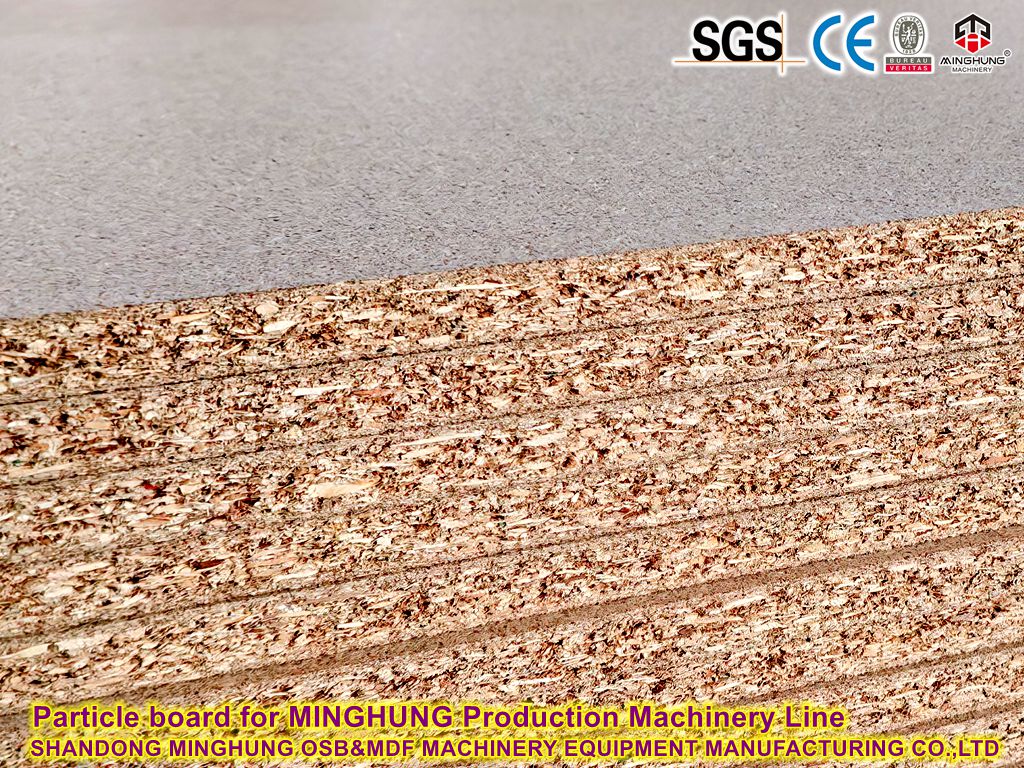
Particleboard is a composite panel made from wood particles (shavings, chips) bonded with synthetic resins (typically UF or MUF) through drying, gluing, forming, and hot pressing.

2. Types
By Density: Low-density (<550 kg/m³), Medium-density (550–750 kg/m³), High-density (>750 kg/m³).
By Structure: Single-layer, Three-layer (fine surface/coarse core), Graduated structure.
Special Types: Moisture-resistant (wax added), Fire-retardant (chemical additives).
3. Production Process
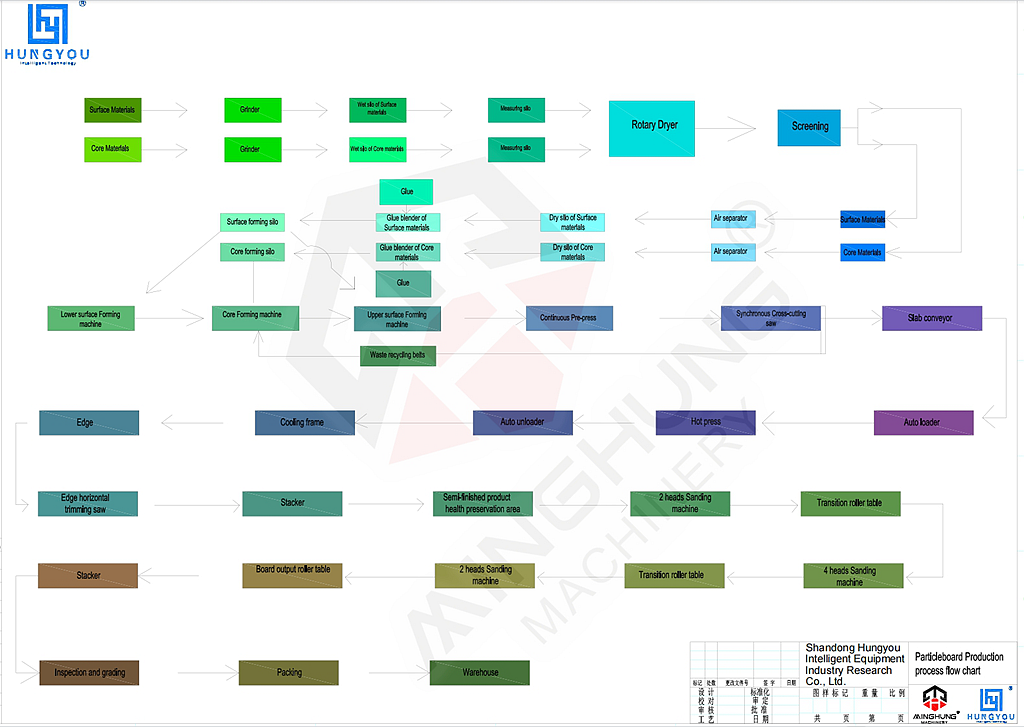
Raw Material Preparation --> Particle Drying --> Blending with Resin --> Mat Forming --> Pre-pressing --> Continuous Flat Pressing --> Cooling & Trimming --> Sanding & Grading

4. Applications
Furniture manufacturing (cabinets, countertop substrates)
Building interiors (partition walls, floor underlayment)
Packaging materials (pallets, crates)
Emerging fields: Prefabricated building modules, decorative molding substrates
II. Continuous Flat Press Technology
1. Concept
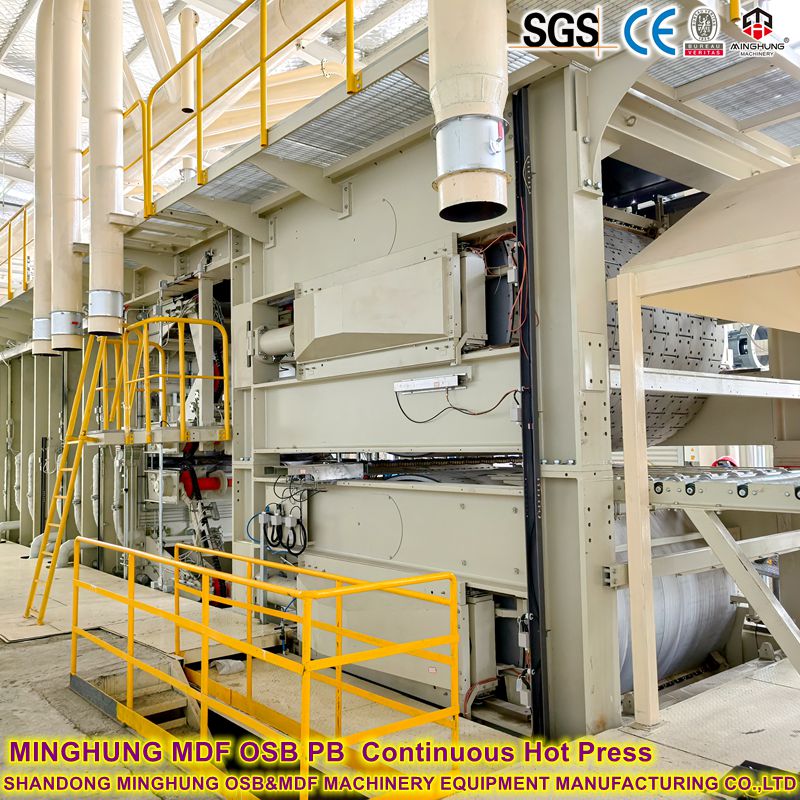
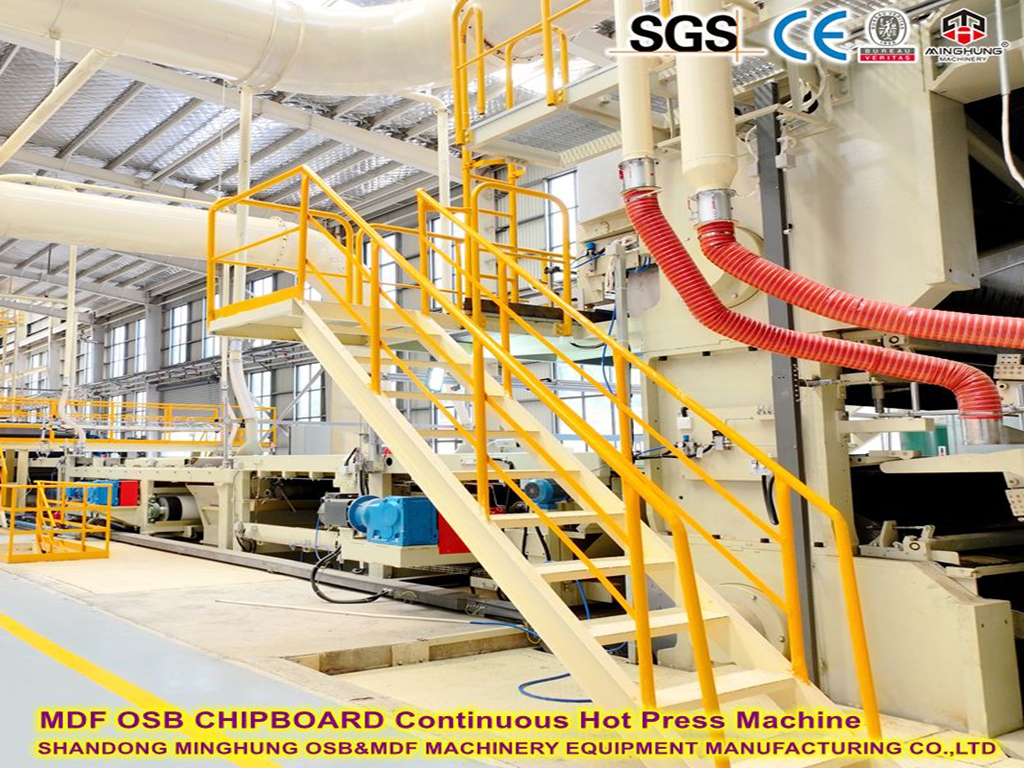
The Continuous Flat Press utilizes two parallel heated platens moving synchronously to apply uniform temperature and pressure to a continuously advancing mat, enabling non-stop production.

2. Key Parameters
Parameter | Typical Range |
Max. Width | 1.2–4.5 m (customizable) |
Working Pressure | 3–6 MPa |
Temperature Range | 180–240°C |
Line Speed | 20–100 m/min |
Max. Capacity | 1,000–3,000 m³/day |
3. Working Principle
Infeed Section: Pre-pressed mat enters via steel belts.
Pressing Zone:
Independent pressure control in hydraulic zones
Heating via thermal oil circulation in platens
Pressure Profile: High pressure (plasticizing) → Pressure relief (de-gassing) → Constant thickness (curing)
Outfeed Section: Automatic belt separation for cooling.
4. Core Components
Heated Platens:
Material: Alloy steel (surface hardness ≥45 HRC)
Thickness: 80–120 mm (thermal stability)
Hydraulic System:
Multi-cylinder synchronization (±0.1 mm precision)
Zones: Typically 8–24
Steel Belt Drive:
Automatic tension compensation
High-temp coating (≤300°C)
Temperature Control:
Closed-loop thermal oil circulation
Zoned regulation (±2°C accuracy)

Ⅲ. Customizable Width
I. Core Customization Principles
1.1 Modular Mechanical Architecture
Width-Adjustable Units: Standard 500mm modules assemble via hydraulic locking pins (±0.05mm precision).
Seamless Platen Joints: Laser welding + plasma polishing (Ra≤0.8μm).
1.2 Adaptive Hydraulic System
Width Increase | Additional Cylinders | Uniformity Control |
Per 1 meter | 4–6 cylinders | Edge pressure +15% + closed-loop feedback |
>3.5 meters | 8 cylinders/meter | Secondary pressure valves (<50ms response) |
1.3 Thermal Management
Zoned Heating:
Center: 180–220°C
Edges: +10–20°C compensation
Expansion Control:
Pre-cambered platens (0.1–0.3mm/m arch)
Low-expansion cast iron frames (CTE 1.2×10⁻⁶/K)
2. Key Technologies
2.1 Edge Effect Elimination
Physical Solutions:
Double-density heating tubes (edge: ≤80mm spacing)
Extendable platen wings (hydraulic-driven, +100mm)
Control Systems:
Infrared thermography (0.5°C resolution) → Dynamic edge temperature adjustment
Pressure sensor array (1 sensor/200mm) → Adaptive pressure compensation
2.2 Dynamic Rigidity Assurance
Structural Enhancements:
Component | Wide-version Reinforcement |
Main Frame | Box steel +40% internal ribs |
Platen Supports | Tungsten carbide-coated guides |
Vibration Suppression:
Active damping (0–50Hz frequency range)
Belt tension control (±1% precision)
2.3 Intelligent Control Logic
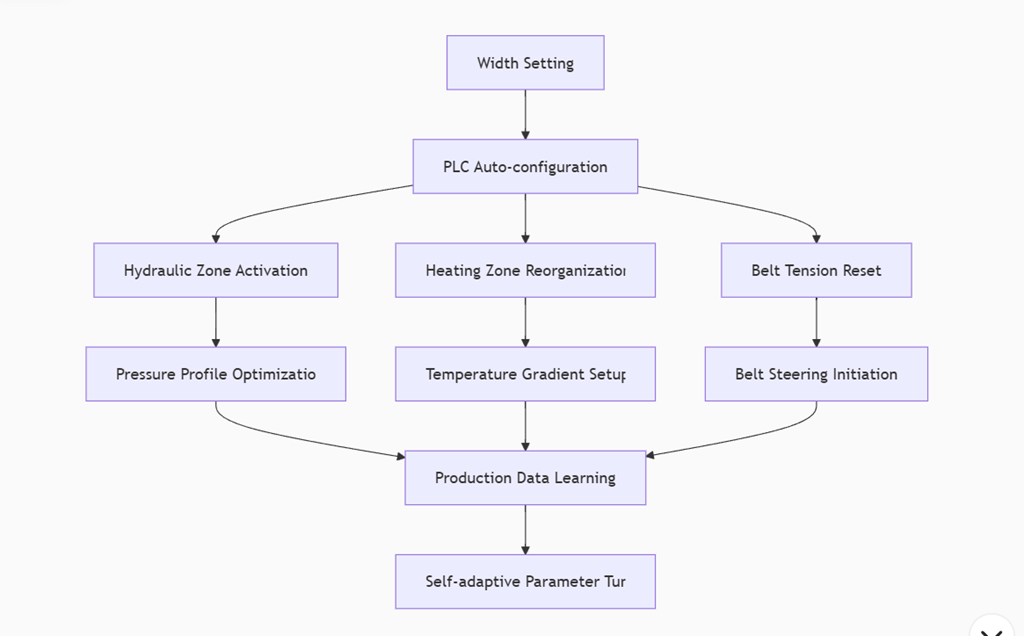
3. Customization Validation
3.1 Performance Comparison (2.8m vs 4.2m Press)
Metric | 2.8m Press | 4.2m Press | Technical Differentiation |
Density Variation | ±3% | ±4.5% | +12 edge cylinders |
Thickness Tolerance | ±0.15mm | ±0.22mm | Reinforced frame + laser gauges |
Warpage | ≤0.8mm/m | ≤1.2mm/m | Edge temp control ±1.5°C |
Capacity Increase | Baseline | 0.5 | Max. belt speed 110m/min |
3.2 Implementation Cases
Narrow-width Line (1.2m):
Application: R&D lab/specialty boards
Key tech: Quick-change system (45-min width switch)
Extra-wide Line (4.5m):
Application: Structural panels for construction
Innovation: Split platens (10mm expansion gap)
4. Customization Workflow
Requirement Analysis --> Feasibility Study --> Modular Configuration --> Critical Component Upgrade --> Control System Programming --> F[Factory Pre-assembly --> On-site Commissioning --> Process Parameter Tuning --> Production Acceptance

Upgrade your production line now!
We provide global installation support and technical training, 2-year machine warranty, and 24-hour online response - let your particleboard production enter a new era of intelligence and low carbonization.
Whatsapp: +8618769900191 +8615589105786 +8618954906501
Email: osbmdfmachinery@gmail.com
This new facility marks a fresh start for our company. Guided by our enduring commitment to "precision engineering and quality first," we are now better equipped than ever to provide efficient, durable, and innovative machinery solutions for the worldwide wood-based panel industry.
As Christmas approaches, Shandong MINGHUNG wood based panel machinery Co., Ltd. has welcomed another peak in shipments.
In early December 2025, the culmination of close collaboration between the MINGHUNG foreign trade team and our partners — 9 containers fully loaded with the core equipment for a plywood production line .
Shandong Minghung Wood Machinery Factory Shandong minghung wood machine factory produces plywood machinery in linyi city city, china, dedicated to providing high-quality and suitable machines veneer machine,plywood machine,veneer splicing machine.veneer dryer machine,veneer peeling machine,plywood v
How to produce Particle board? What is the production step of Making Particle board?Introduction:Particle board, also known as chipboard, is a versatile and cost-effective material widely used in the construction and furniture industries. It is made by compressing wood particles and adhesive togethe