| Availability: | |
|---|---|
| Quantity: | |
MH-CHP
MINGHUNG
raw materials for PB
particle board/chipboard
I. Particleboard (PB) Detailed Introduction
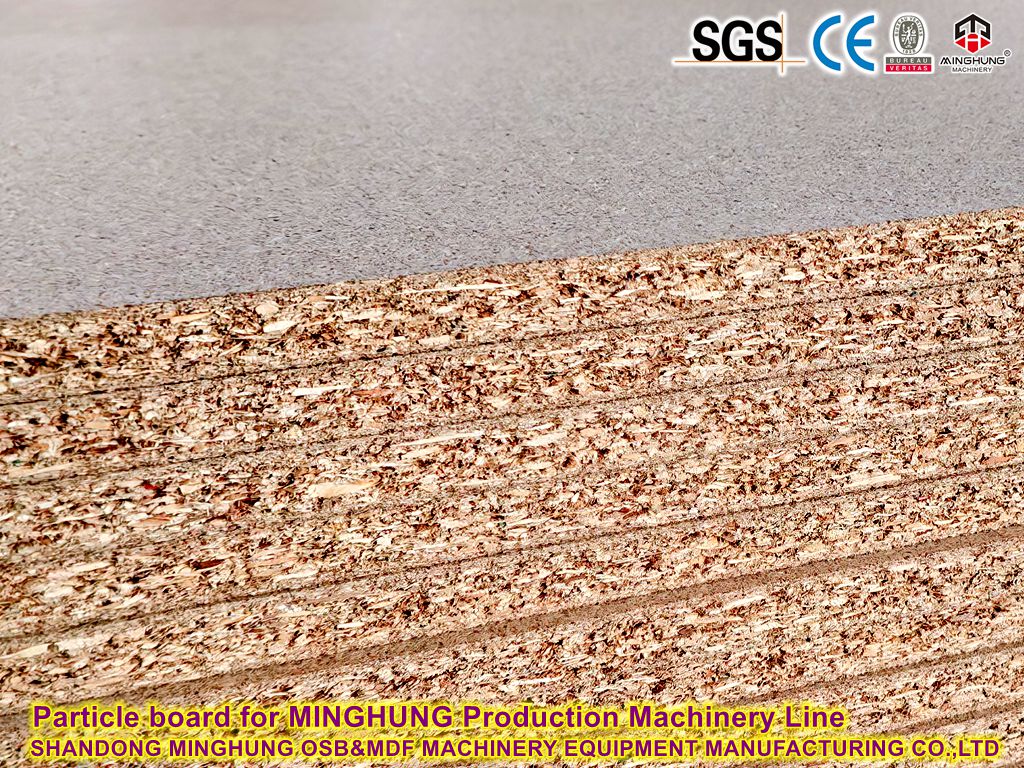
An engineered wood panel manufactured from wood or non-wood plant fibers (e.g., shavings, chips) through drying, resin application (urea-formaldehyde/phenolic/MDI), mat forming, and hot-pressing for curing.
Construction characteristic
Parameter | Conventional PB | High-Speed Requirements |
Surface Particle | 0.2-0.5mm | ≤0.3mm (fine screening) |
Core Layer Ratio | 60-70% | 55-65% (reduced compression resistance) |
Resin Type | Urea-Formaldehyde (UF) | Fast-curing Phenolic (PF) |
| Moisture Content | 10-12% | 8-10% (shorter vaporization time) |
Core Properties
Parameter | Typical Range | Remarks |
Density | 550–750 kg/m³ | Differs from MDF |
Thickness | 2.5–40 mm (customizable) | Common for furniture/flooring: 6–25mm |
Eco-Class | E0/E1 (formaldehyde emission) | ENF (formaldehyde-free) = high-end trend |
Applications | Furniture substrate, flooring core, building partitions | Requires surface finishing (veneer/melamine paper) |
Production Process Flow:
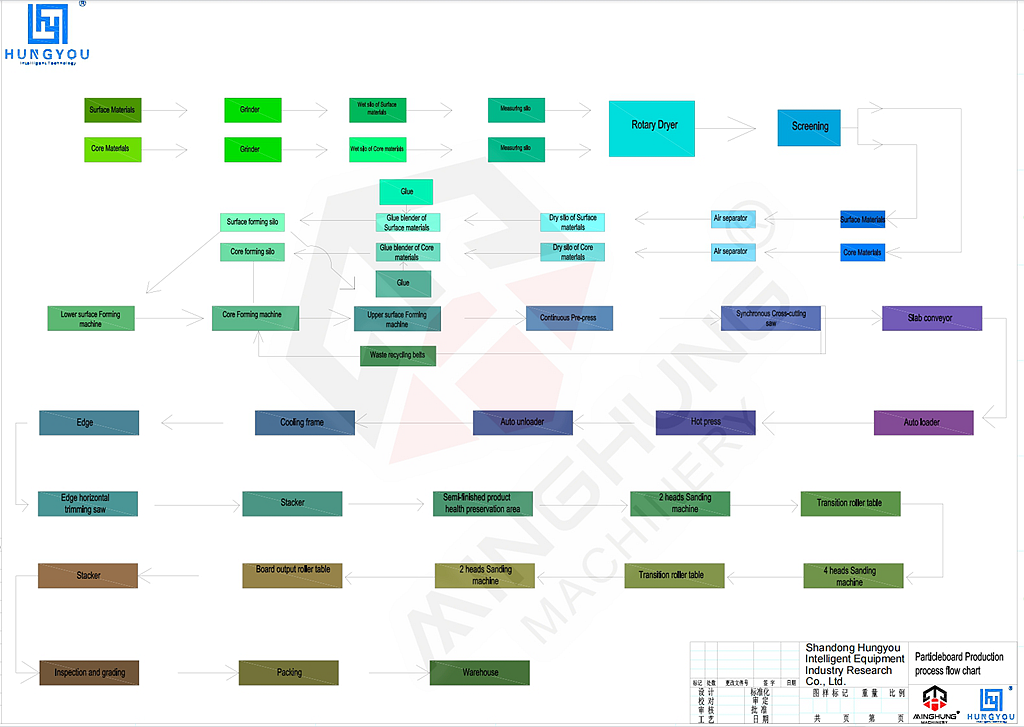
Raw material preparation → Drying → Resin application → Mat forming → Pre-pressing → Continuous hot-pressing → Cooling & sawing → Sanding

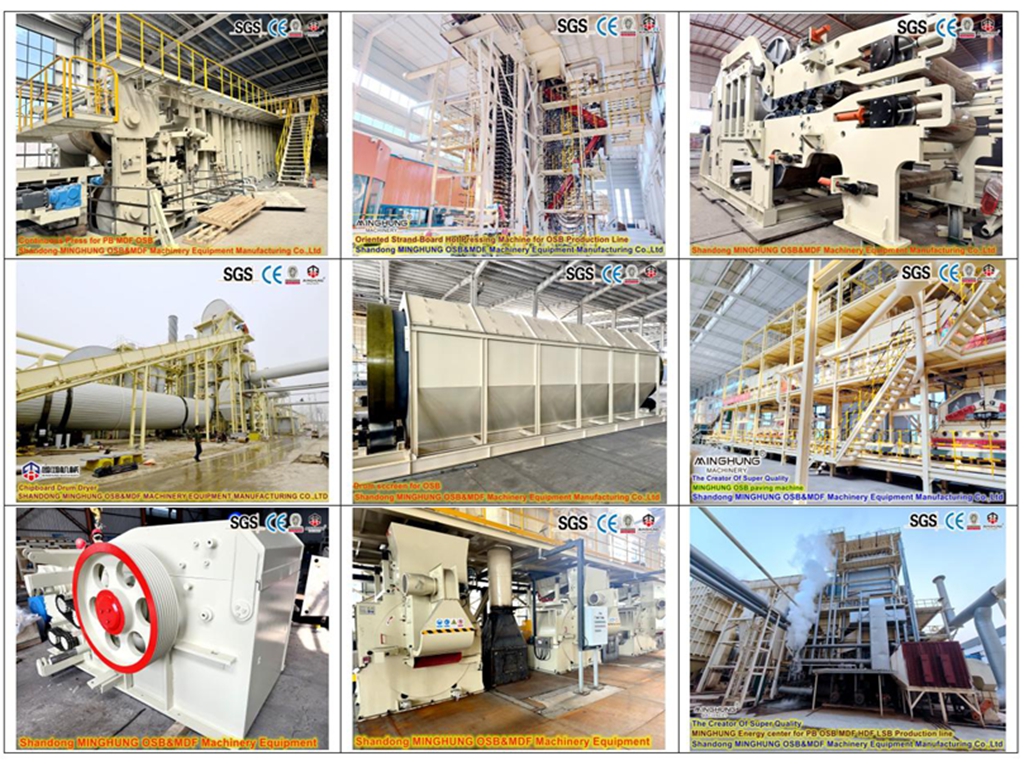
Main machinery

II. High-Speed PB Continuous Flat Press (Continuous Press) In-Depth Analysis
Core Design Objective:
Maximize linear production speed while ensuring quality to achieve economies of scale.
Key Technological Innovations:
1. Dual Steel Belt Synchronized Pressing System
Upper/lower high-temp steel belts (230–250°C) synchronously drive the mat under high pressure (2.5–4.0 MPa).
Laser-engraved micro-texture on belt surface ensures zero-slip mat transport.
2. Zonal Pressure & Temperature Control
Press length: 30–60m, divided into 15–30 independently controlled zones:
Entry Zone: High-pressure rapid compression (eliminate fluffiness)
Middle Zone: Constant pressure/temperature (full resin curing)
Exit Zone: Pressure reduction & shaping (prevent springback)
3. Upgraded Thermal System
Thermal oil circulation (±0.5°C accuracy) replaces steam, increasing heating rate by 40%.
Zone-specific temperature control adapts to core curing needs of different thicknesses.
4. Intelligent Control System
Real-time monitoring of mat density profile (X-ray scanning) & moisture content (microwave sensing) for dynamic pressure adjustments.
III. Quantitative Analysis of Production Speed & Capacity
Typical Line Speeds by Thickness (60m press example):
Thickness (mm) | Line Speed Range (m/min) | Technical Notes |
3–5 | 45–75 | Ultra-high-speed mode, belt tension limit |
6–8 | 30–50 | Mainstream speed for thin furniture panels |
12–15 | 15–25 | Economic speed for flooring cores |
18–22 | 8–15 | Requires extended press dwell time |
≥25 | 4–8 | Speed limited by core curing rate |
Performance Comparison of Typical Lines:
Press Specification | Target Thickness (mm) | Annual Capacity (10km³) | Speed Advantage Scenario |
High-Speed (60m) | 3–18 | 35–55 | Thin boards (≤12mm) = 70% output |
Universal (45m) | 8–25 | 25–40 | Balanced production |
Thick-Board (70m+) | 15–40 | 18–30 | Prioritizes quality over speed |
IV. Economic Breakthroughs of High-Speed Presses
1. Energy Reduction:
Thin-board energy consumption: ≤180 kWh/m³ (vs. 220 kWh/m³ for multi-opening presses)
2. Quality Enhancement:
Density profile SD: <0.02 g/cm³ (vs. 0.05+ for conventional presses)
Thickness tolerance (after sanding): ±0.15mm
3. Production Flexibility:
Thickness changeover time: ≤3 minutes (real-time online adjustment)
Ⅴ.The production speed of a PB continuous press
1. Core Performance Metrics:
Line Speed: Typically expressed in meters per minute (m/min). This is the actual running speed at which the mat enters the press and the finished board exits the press.
Annual Capacity: Typically expressed in cubic meters per year (m³/year) or square meters per year (m²/year). This is a broader, more commonly used commercial metric that considers line speed, board thickness, board width, operating time (working days per year, operating hours per day), and equipment utilization rate.
2. Key Factors Influencing Production Speed:
2.1 Product Thickness: This is the most critical factor affecting speed.
Thin Boards: Production speed is fast. Thin boards have high heat transfer efficiency, allowing the core layer temperature to reach the curing temperature required by the adhesive resin more quickly, resulting in a shorter required hot-pressing time (dwell time of the mat inside the press). For example, producing 3mm or 5mm thin boards can achieve line speeds of 60 m/min or even higher.
Thick Boards: Production speed is slow. Thick boards have slower core layer heating and require a longer hot-pressing time to ensure complete resin curing. When producing 25mm, 30mm, or even thicker boards, line speeds may be only 5-15 m/min.
2.2 Product Density: Higher density boards typically require longer hot-pressing times (or higher pressure/temperature) to achieve the desired physical and mechanical properties, resulting in slightly lower speeds compared to lower density boards of the same thickness.
2.3 Process Formulation: The type of adhesive used (urea-formaldehyde, phenol-formaldehyde, MDI, etc.) and its curing characteristics (curing temperature, curing time) directly affect the required hot-pressing time. Faster-curing resins allow higher production speeds.
2.4 Press Specifications:
Press Length: A longer press means the mat stays under high temperature and pressure for a longer time (at the same line speed). To produce thick boards or use slower-curing resins, a longer press is needed to provide sufficient hot-pressing time. A long press enables the production of thick boards at lower line speeds or thin boards at higher line speeds.
Press Opening Height: Determines the maximum board thickness that can be produced. Producing thick boards requires more space for the steel belt travel path.
Drive Power & Control System: Powerful drive systems and precise synchronization control are fundamental for achieving high-speed, stable operation.
2.5 Thermal Energy Supply Capacity: The heating platens must provide sufficient heat to rapidly heat the mat. The power and efficiency of the thermal oil or steam system affect the heating rate, indirectly influencing speed.
2.6 Raw Material Characteristics: Particle geometry, moisture content, resin distribution uniformity, etc., also affect heat transfer efficiency and pressing results.
2.7 Target Product Quality Requirements: Higher requirements for board density profile, internal bond strength, surface quality, thickness tolerance, etc., may necessitate more precise control and/or slightly longer hot-pressing times, potentially limiting the maximum achievable speed.
3. Typical Speed Range (Line Speed - m/min):
Ultra-Thin Boards: e.g., <3mm, speeds can reach > 60 m/min (very high speed).
Thin Boards: e.g., 3-8mm, speed range typically 20 - 60 m/min.
Medium/Thick Boards: e.g., 8-19mm, speed range typically 10 - 30 m/min.
Thick Boards: e.g., 19-40mm, speed range typically 5 - 15 m/min.
Ultra-Thick Boards: e.g., >40mm, speeds may be < 5 m/min.
4. Typical Capacity Range (Annual Capacity - m³/year):
Modern large-scale continuous press lines (press width >2.5m, length >30m) typically have annual capacities in the range of 200,000 - 500,000 m³/year or even higher.
Per Minute Example: A line with 300,000 m³/year capacity has an average production rate of approximately 1.14 m³/minute (300,000 / (365 days 24 hours 60 minutes) considering utilization rate). However, this is an average; the actual per-minute production varies significantly with board thickness (much lower when producing thick boards, much higher when producing thin boards).



Q:Are you a factory or a trading company?
A:We are an industry and trade integrated company with 40 years of experience.
Q:How to choose the right machine?
A:We will check and confirm the type of furniture you manufacture, the process used and the size of the board to recommend the most suitable machine to you.
Q:Can you provide on-site engineer services?
A:Yes, usually our
Q:What is your warranty? Can you provide us with more services? What we hope to be protected after purchasing the machine?
A:We are pleased to provide continuous after-sales service for our products. Within 12 months, if the spare parts are damaged, we will respond promptly. We are willing to help you solve any problems you encounter when using the machine at any time. We will serve all customers' questions or difficulties 24 hours a day and provide solutions within 48 hours.
Upgrade your production line now!
We provide global installation support and technical training, 2-year machine warranty, and 24-hour online response - let your Particleboard production enter a new era of intelligence and low carbonization.
Whatsapp: +8618769900191 +8615589105786 +8618954906501
Email: osbmdfmachinery@gmail.com
raw materials for PB
particle board/chipboard
I. Particleboard (PB) Detailed Introduction
An engineered wood panel manufactured from wood or non-wood plant fibers (e.g., shavings, chips) through drying, resin application (urea-formaldehyde/phenolic/MDI), mat forming, and hot-pressing for curing.
Construction characteristic
Parameter | Conventional PB | High-Speed Requirements |
Surface Particle | 0.2-0.5mm | ≤0.3mm (fine screening) |
Core Layer Ratio | 60-70% | 55-65% (reduced compression resistance) |
Resin Type | Urea-Formaldehyde (UF) | Fast-curing Phenolic (PF) |
| Moisture Content | 10-12% | 8-10% (shorter vaporization time) |
Core Properties
Parameter | Typical Range | Remarks |
Density | 550–750 kg/m³ | Differs from MDF |
Thickness | 2.5–40 mm (customizable) | Common for furniture/flooring: 6–25mm |
Eco-Class | E0/E1 (formaldehyde emission) | ENF (formaldehyde-free) = high-end trend |
Applications | Furniture substrate, flooring core, building partitions | Requires surface finishing (veneer/melamine paper) |
Production Process Flow:
Raw material preparation → Drying → Resin application → Mat forming → Pre-pressing → Continuous hot-pressing → Cooling & sawing → Sanding

Main machinery

II. High-Speed PB Continuous Flat Press (Continuous Press) In-Depth Analysis
Core Design Objective:
Maximize linear production speed while ensuring quality to achieve economies of scale.
Key Technological Innovations:
1. Dual Steel Belt Synchronized Pressing System
Upper/lower high-temp steel belts (230–250°C) synchronously drive the mat under high pressure (2.5–4.0 MPa).
Laser-engraved micro-texture on belt surface ensures zero-slip mat transport.
2. Zonal Pressure & Temperature Control
Press length: 30–60m, divided into 15–30 independently controlled zones:
Entry Zone: High-pressure rapid compression (eliminate fluffiness)
Middle Zone: Constant pressure/temperature (full resin curing)
Exit Zone: Pressure reduction & shaping (prevent springback)
3. Upgraded Thermal System
Thermal oil circulation (±0.5°C accuracy) replaces steam, increasing heating rate by 40%.
Zone-specific temperature control adapts to core curing needs of different thicknesses.
4. Intelligent Control System
Real-time monitoring of mat density profile (X-ray scanning) & moisture content (microwave sensing) for dynamic pressure adjustments.
III. Quantitative Analysis of Production Speed & Capacity
Typical Line Speeds by Thickness (60m press example):
Thickness (mm) | Line Speed Range (m/min) | Technical Notes |
3–5 | 45–75 | Ultra-high-speed mode, belt tension limit |
6–8 | 30–50 | Mainstream speed for thin furniture panels |
12–15 | 15–25 | Economic speed for flooring cores |
18–22 | 8–15 | Requires extended press dwell time |
≥25 | 4–8 | Speed limited by core curing rate |
Performance Comparison of Typical Lines:
Press Specification | Target Thickness (mm) | Annual Capacity (10km³) | Speed Advantage Scenario |
High-Speed (60m) | 3–18 | 35–55 | Thin boards (≤12mm) = 70% output |
Universal (45m) | 8–25 | 25–40 | Balanced production |
Thick-Board (70m+) | 15–40 | 18–30 | Prioritizes quality over speed |
IV. Economic Breakthroughs of High-Speed Presses
1. Energy Reduction:
Thin-board energy consumption: ≤180 kWh/m³ (vs. 220 kWh/m³ for multi-opening presses)
2. Quality Enhancement:
Density profile SD: <0.02 g/cm³ (vs. 0.05+ for conventional presses)
Thickness tolerance (after sanding): ±0.15mm
3. Production Flexibility:
Thickness changeover time: ≤3 minutes (real-time online adjustment)
Ⅴ.The production speed of a PB continuous press
1. Core Performance Metrics:
Line Speed: Typically expressed in meters per minute (m/min). This is the actual running speed at which the mat enters the press and the finished board exits the press.
Annual Capacity: Typically expressed in cubic meters per year (m³/year) or square meters per year (m²/year). This is a broader, more commonly used commercial metric that considers line speed, board thickness, board width, operating time (working days per year, operating hours per day), and equipment utilization rate.
2. Key Factors Influencing Production Speed:
2.1 Product Thickness: This is the most critical factor affecting speed.
Thin Boards: Production speed is fast. Thin boards have high heat transfer efficiency, allowing the core layer temperature to reach the curing temperature required by the adhesive resin more quickly, resulting in a shorter required hot-pressing time (dwell time of the mat inside the press). For example, producing 3mm or 5mm thin boards can achieve line speeds of 60 m/min or even higher.
Thick Boards: Production speed is slow. Thick boards have slower core layer heating and require a longer hot-pressing time to ensure complete resin curing. When producing 25mm, 30mm, or even thicker boards, line speeds may be only 5-15 m/min.
2.2 Product Density: Higher density boards typically require longer hot-pressing times (or higher pressure/temperature) to achieve the desired physical and mechanical properties, resulting in slightly lower speeds compared to lower density boards of the same thickness.
2.3 Process Formulation: The type of adhesive used (urea-formaldehyde, phenol-formaldehyde, MDI, etc.) and its curing characteristics (curing temperature, curing time) directly affect the required hot-pressing time. Faster-curing resins allow higher production speeds.
2.4 Press Specifications:
Press Length: A longer press means the mat stays under high temperature and pressure for a longer time (at the same line speed). To produce thick boards or use slower-curing resins, a longer press is needed to provide sufficient hot-pressing time. A long press enables the production of thick boards at lower line speeds or thin boards at higher line speeds.
Press Opening Height: Determines the maximum board thickness that can be produced. Producing thick boards requires more space for the steel belt travel path.
Drive Power & Control System: Powerful drive systems and precise synchronization control are fundamental for achieving high-speed, stable operation.
2.5 Thermal Energy Supply Capacity: The heating platens must provide sufficient heat to rapidly heat the mat. The power and efficiency of the thermal oil or steam system affect the heating rate, indirectly influencing speed.
2.6 Raw Material Characteristics: Particle geometry, moisture content, resin distribution uniformity, etc., also affect heat transfer efficiency and pressing results.
2.7 Target Product Quality Requirements: Higher requirements for board density profile, internal bond strength, surface quality, thickness tolerance, etc., may necessitate more precise control and/or slightly longer hot-pressing times, potentially limiting the maximum achievable speed.
3. Typical Speed Range (Line Speed - m/min):
Ultra-Thin Boards: e.g., <3mm, speeds can reach > 60 m/min (very high speed).
Thin Boards: e.g., 3-8mm, speed range typically 20 - 60 m/min.
Medium/Thick Boards: e.g., 8-19mm, speed range typically 10 - 30 m/min.
Thick Boards: e.g., 19-40mm, speed range typically 5 - 15 m/min.
Ultra-Thick Boards: e.g., >40mm, speeds may be < 5 m/min.
4. Typical Capacity Range (Annual Capacity - m³/year):
Modern large-scale continuous press lines (press width >2.5m, length >30m) typically have annual capacities in the range of 200,000 - 500,000 m³/year or even higher.
Per Minute Example: A line with 300,000 m³/year capacity has an average production rate of approximately 1.14 m³/minute (300,000 / (365 days 24 hours 60 minutes) considering utilization rate). However, this is an average; the actual per-minute production varies significantly with board thickness (much lower when producing thick boards, much higher when producing thin boards).


Q:Are you a factory or a trading company?
A:We are an industry and trade integrated company with 40 years of experience.
Q:How to choose the right machine?
A:We will check and confirm the type of furniture you manufacture, the process used and the size of the board to recommend the most suitable machine to you.
Q:Can you provide on-site engineer services?
A:Yes, usually our
Q:What is your warranty? Can you provide us with more services? What we hope to be protected after purchasing the machine?
A:We are pleased to provide continuous after-sales service for our products. Within 12 months, if the spare parts are damaged, we will respond promptly. We are willing to help you solve any problems you encounter when using the machine at any time. We will serve all customers' questions or difficulties 24 hours a day and provide solutions within 48 hours.
Upgrade your production line now!
We provide global installation support and technical training, 2-year machine warranty, and 24-hour online response - let your Particleboard production enter a new era of intelligence and low carbonization.
Whatsapp: +8618769900191 +8615589105786 +8618954906501
Email: osbmdfmachinery@gmail.com
Shandong Minghung Wood Machinery Factory Shandong minghung wood machine factory produces plywood machinery in linyi city city, china, dedicated to providing high-quality and suitable machines veneer machine,plywood machine,veneer splicing machine.veneer dryer machine,veneer peeling machine,plywood v
How to produce Particle board? What is the production step of Making Particle board?Introduction:Particle board, also known as chipboard, is a versatile and cost-effective material widely used in the construction and furniture industries. It is made by compressing wood particles and adhesive togethe
The Ultimate Guide to Plywood Hot Press Machines: Crafting High-Quality Plywood Introduction:Plywood is a versatile and widely used material in various industries, from construction to furniture manufacturing. Behind the scenes, plywood hot press machines play a crucial role in the production proces
What is a veneer dryer?MINGHUNG Roller veneer dryer for drying original wood veneer, remove abundant humidity, in the end, the wood veneer humidity will be 5%-10%, so it is suitable for making plywood.Veneer roller dryer are suitable for big drying capacity per day, it can be different length, width
Recently, a high-performance plywood sander was prepared for shipment at Qingdao Port, ready for its journey to our valued partner in Russia.
This shipment not only demonstrates Minghung Machinery’s strong production coordination and international trade execution capabilities but also ensures the rapid commissioning of the customer's production line.
MINGHUNG is a leading company in the industry of OSB&MDF making machine. With a strongfocus on producing high-quality machinery, we specialize in manufacturing thecomplete production line of Medium density fiberboard (MDF), High densityfiberboard (HDF),Particle board (PB), Oriented strand board (OSB) and Veneerable super strong particle board (LSB).
Peeling is the pre-treatment process. Chopping and planing are both aimed at obtaining specific forms of wood materials, but the forms and application scenarios are different.
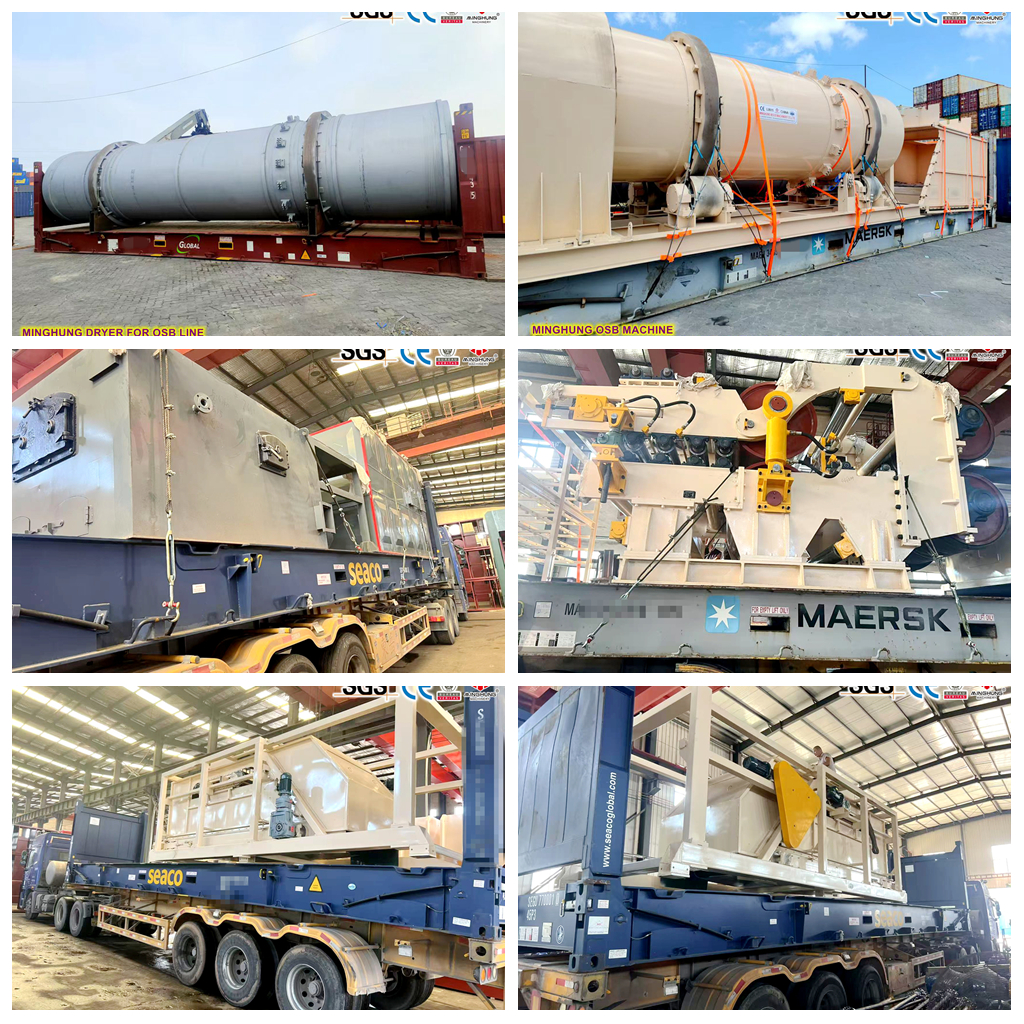
Shipping multiple containers of gluing equipment to multiple countries in a single batch is a testament not only to our current order fulfillment capacity but, more importantly, to the international market’s trust in the quality and reliability of the ‘MINGHUNG’ brand.
The Differences And Comparisons between PB OSB And MDF