Views: 0 Author: Site Editor Publish Time: 2026-09-04 Origin: Site
Core Working Principle of Veneer Peeling Line Machinery
A Veneer Peeling Line works by mounting a log on a rotating mechanism and feeding a sharp knife parallel to the log length to shave off continuous, uniform sheets of wood veneer.
Think of a veneer peeling machine like a giant pencil sharpener. The log is held tightly and spun at high speeds. As it rotates, a heavy-duty knife blade moves forward into the log at a set speed. The distance the knife advances per full turn determines how thick the wood veneer will be.
To make sure the wood sheet does not crack or tear as it is being shaved, a smooth pressure bar presses against the wood just ahead of the knife blade. This holds the wood fibers together and produces a smooth, flat sheet. The continuous veneer ribbon then rolls onto a conveyor belt toward the automatic cutting and stacking stations.
Key Parts of the System
Log Rotary Drive: Spins the timber log smoothly using strong motors and drive rollers.
Knife Feed System: Pushes the peeling blade forward at a precise speed to control sheet thickness.
Pressure Bar: Applies gentle pressure on the log surface right before the blade to prevent wood cracks.
Control System: Automatically adjusts spinning speeds and blade movement as the log gets smaller.
Preparation Stage
Before a log is peeled, it must be stripped of bark and aligned to its optimal center to get the highest possible sheet yield.
Raw logs straight from the forest carry bark, dirt, small rocks, and irregular shapes. If fed directly into the main knife blade, this debris would quickly damage the steel edge. Therefore, logs first pass through a debarking machine, where steel teeth scrape off the rough outer bark and dirt. Using high-efficiency preparation tools like our Veneer Debarker Machine ensures smooth workflow from the start.
After debarking, the log goes through a centering machine. Laser sensors scan the log’s outer shape to find its ideal geometric center. Finding the center ensures that the log becomes round as quickly as possible during peeling, turning maximum timber into usable veneer sheets rather than waste.
Steps in Log Preparation
Log Sorting: Logs are sorted by size and species before being loaded onto the conveyor belt.
Debarking: Heavy rollers scrape off outer bark and foreign dirt particles.
Centering: Laser scanners find the central axis to reduce wood waste during peeling.
Automated Loading: Mechanical arms quickly place the centered log into the lathe.
Spindled vs. Spindleless Rotary Lathes
Spindled lathes clamp the ends of large logs like a lathe chuck, while spindleless lathes rotate logs using outer rollers to peel down to small residual cores.
In veneer production, there are two main types of rotary lathes:
Spindled Lathes: These machines grip the log by driving heavy metal clamps (chucks) into both ends. They are great for large, heavy timber. However, because the chucks hold the ends, the machine must stop peeling once the log gets down to around 80-100mm in diameter, leaving a thick unused core.
Spindleless Lathes: Instead of clamping the ends, three powered rollers press against the outside of the log to spin it. Because there are no center chucks in the way, a high-efficiency Veneer Peeling Machine can peel the log down to a tiny residual core of just 25-35mm. This significantly increases wood yield and profits.
Main Advantages of Spindleless Peeling
Higher Wood Recovery: Uses almost the entire log, leaving behind minimal waste wood cores.
Great for Small Logs: Ideal for fast-growing, small-diameter plantation wood.
Consistent Thickness: Outer drive rollers keep uniform pressure across the log length.
spindle peeling machine
spindleless peeling machine
Cutting and Stacking Process
The continuous veneer ribbon is scanned for natural defects, clipped into standard panel sizes, and automatically stacked by moisture content.
As the continuous wood veneer ribbon travels along the conveyor, it passes an optical scanner and an automatic cutting shear (rotary clipper). The optical scanner detects natural flaws like big knots, holes, or cracks, and tells the rotary knife to quickly trim those parts out.
Clean veneer sections are cut into standard panel sizes (such as 4x8 feet). The cut sheets then pass through a moisture sensor that measures how wet the wood is. Automated drop arms or vacuum lifters then place wet and dry sheets into separate stacking bins ready for drying.
International buyers prioritize durability and reliability in these production lines. For example, our Veneer Peeling Machine And Debarker Successfully Shipped To Turkey demonstrates how full debarking, peeling, and cutting lines are built to meet strict European operational requirements.
Key Components of the Cutting and Sorting Line
Optical Vision Scanner: Identifies knots, cracks, and holes on the moving wood ribbon.
High-Speed Rotary Clipper: Cuts the veneer sheet cleanly at high conveyor speeds.
Moisture Sensor: Checks wood moisture content to pre-sort sheets before drying.
Automatic Stacker: Collects and stacks finished sheets neatly into different bins.
Machine Parameters and Structure Matrix
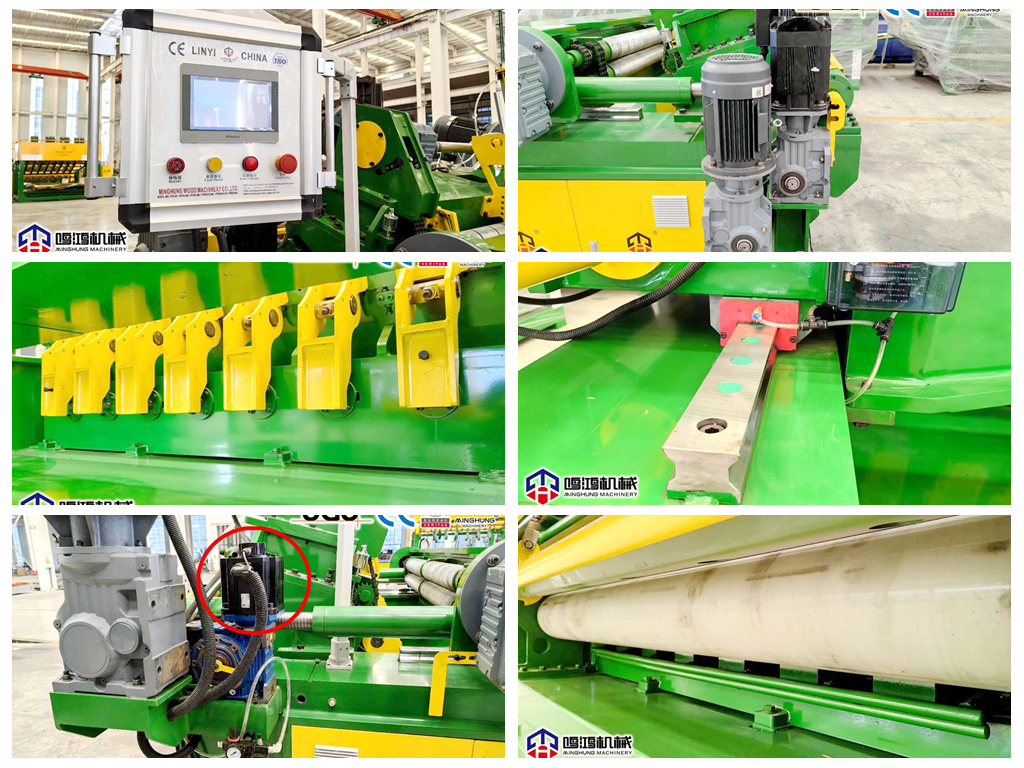
Veneer peeling lines rely on solid steel frames and durable motor drives built for heavy continuous operation.
The machinery base is built from heavy, vibration-resistant steel to keep the cutting blade steady during long shifts. The drive rollers are made from hardened steel to resist wear from rough wood bark and sap.
Modern control boxes use simple touchscreens to let operators set sheet thickness, check production counts, and adjust speeds with ease.
General Specifications Matrix
Component / Feature
Standard Specification
Typical Application
Maximum Log Diameter
400 mm - 600 mm
Small to medium timber processing
Core Diameter Left
28 mm - 35 mm
High-yield spindleless peeling
Veneer Thickness
0.5 mm - 3.6 mm
Plywood face and core sheet production
Peeling Speed
40 - 80 meters / minute
High-capacity factory output
Frame Structure
Heavy Welded Steel Plate
Long-term vibration resistance
Drive Rollers
Hardened Alloy Steel
Wear-resistant knurled surface
Main Control System
Digital Touchscreen PLC
Simple thickness and speed management
Maintenance Tips and Practical Guidelines
Daily blade inspection, correct pressure setup, and regular lubrication prevent machine wear and ensure steady sheet quality.
To keep your machinery running at peak performance, establish simple daily maintenance routines. The peeling blade takes the most force during operation, so keeping it sharp is crucial for good sheet surfaces.
Essential Operational Tips for Factory Operators
1. Adjust Blade Angles for Hard and Soft Wood: Softwoods (like pine) need slightly sharper knife angles, while hardwoods (like eucalyptus) need flatter angles to protect the knife edge from chipping.
2. Set Correct Pressure Bar Settings: Ensure the pressure bar gently squeezes the log face as it cuts. Too little pressure creates rough, cracked sheets; too much pressure crushes the wood and strains the motor.
3. Keep Automatic Lubrication Working: Make sure automatic grease pumps are topped up so linear rails and bearings stay lubricated and free of wood dust.
4. Check Roller Parallelism Periodically: Inspect drive rollers regularly to ensure they stay parallel to the knife frame, avoiding thin edges on peeled sheets.
Summary and Conclusion
A modern veneer peeling line turns raw logs into high-quality veneer sheets through automated debarking, centering, rotary peeling, defect trimming, and stacking.
By combining robust mechanical construction with easy-to-use digital controls, modern Veneer Peeling Line machinery helps wood factories maximize timber recovery, cut down labor costs, and maintain consistent sheet quality.
Whether you are upgrading an existing workshop or setting up a new production line, choosing reliable equipment—such as the solutions offered in our Veneer Peeling Machine range—ensures efficient material use, reliable operations, and lasting productivity for your business.
On October 20, 2026, the foreign trade team of Shandong Minghung Wood Base Panel Machinery Co., Ltd. set off from China and flew to Istanbul, Turkey, to take part in the 39th International Woodworking Machinery, Cutting Tools and Hand Tools Exhibition (WoodTech Istanbul 2026). The show runs from October 22 to 25 at the Tüyap Fair and Congress Center in Istanbul, and Minghung's booth number is 905E.
The first day of the 2026 Shanghai International Woodworking Machinery Fair – if this morning's keyword was "surprise," then this afternoon's keywords are definitely "explosive" and "confidence"!
This trip to Shanghai was not only a display of products, but also a dissemination of our brand and a connection of emotions. We will continue to stay true to our original aspiration and repay every customer's trust and support with even better products and services. The future is full of promise, and we are always on the way!
The Mid-Autumn Festival is approaching, and the moon is growing round. While many people are beginning to prepare for family reunions, the company’s factory tells a different story: forklifts weaving through the yard, crane arms rising and falling, containers lined up in rows, and loading work proceeding in a tense yet orderly manner.
How to produce Particle board? What is the production step of Making Particle board?Introduction:Particle board, also known as chipboard, is a versatile and cost-effective material widely used in the construction and furniture industries. It is made by compressing wood particles and adhesive togethe