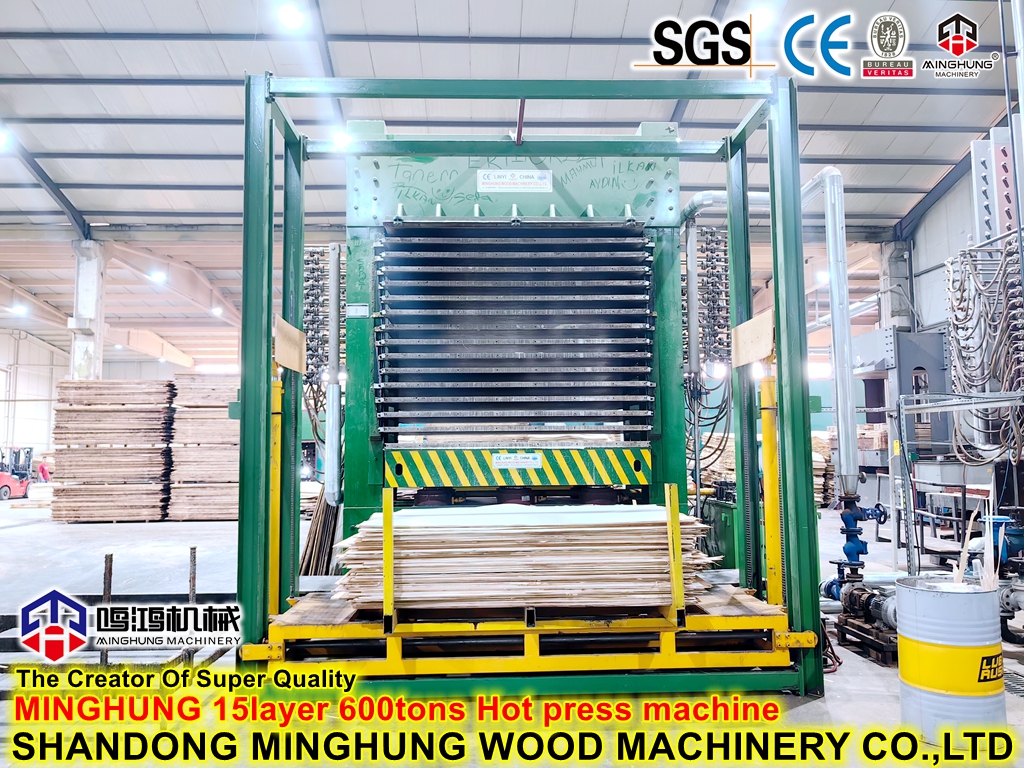
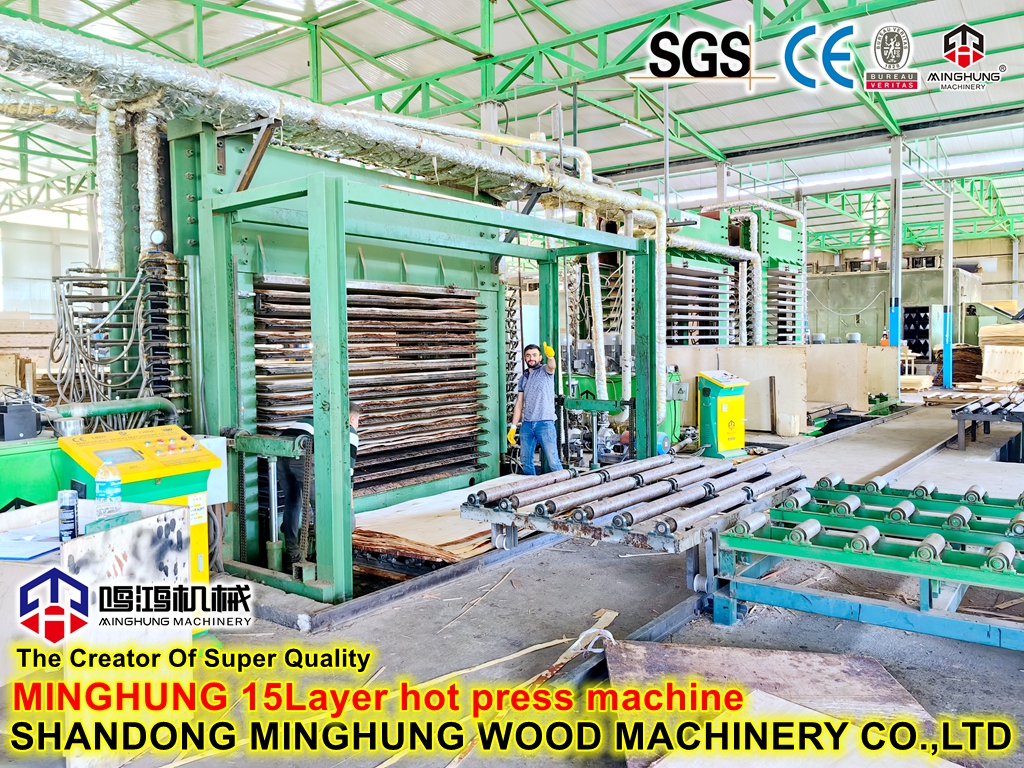
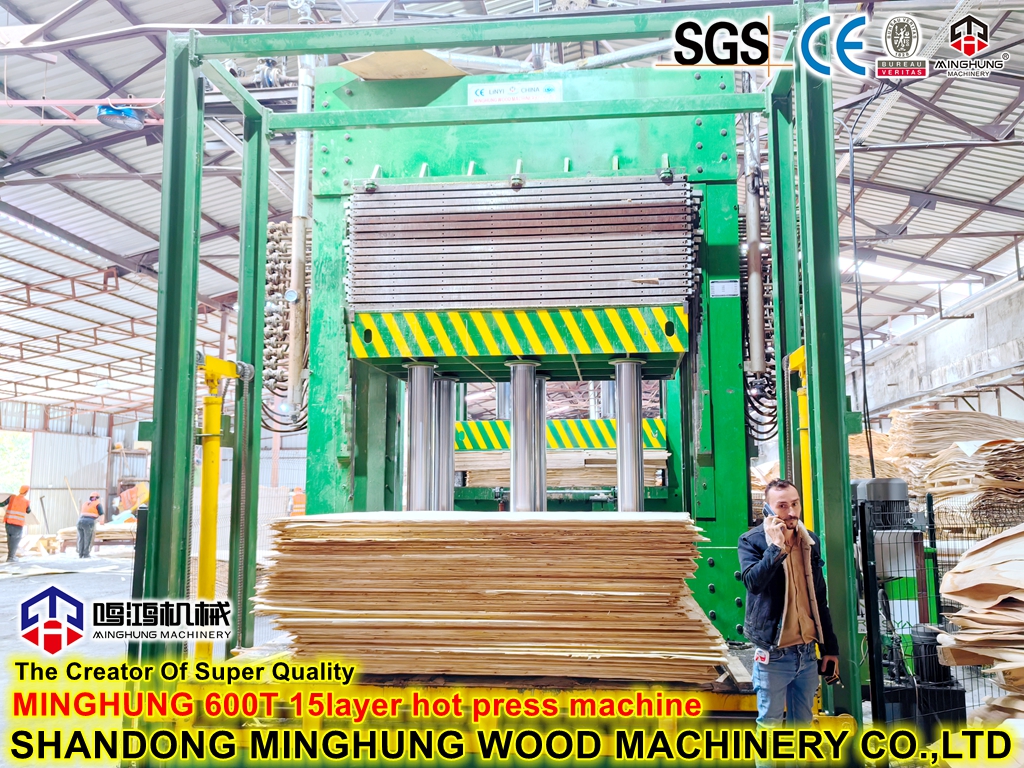
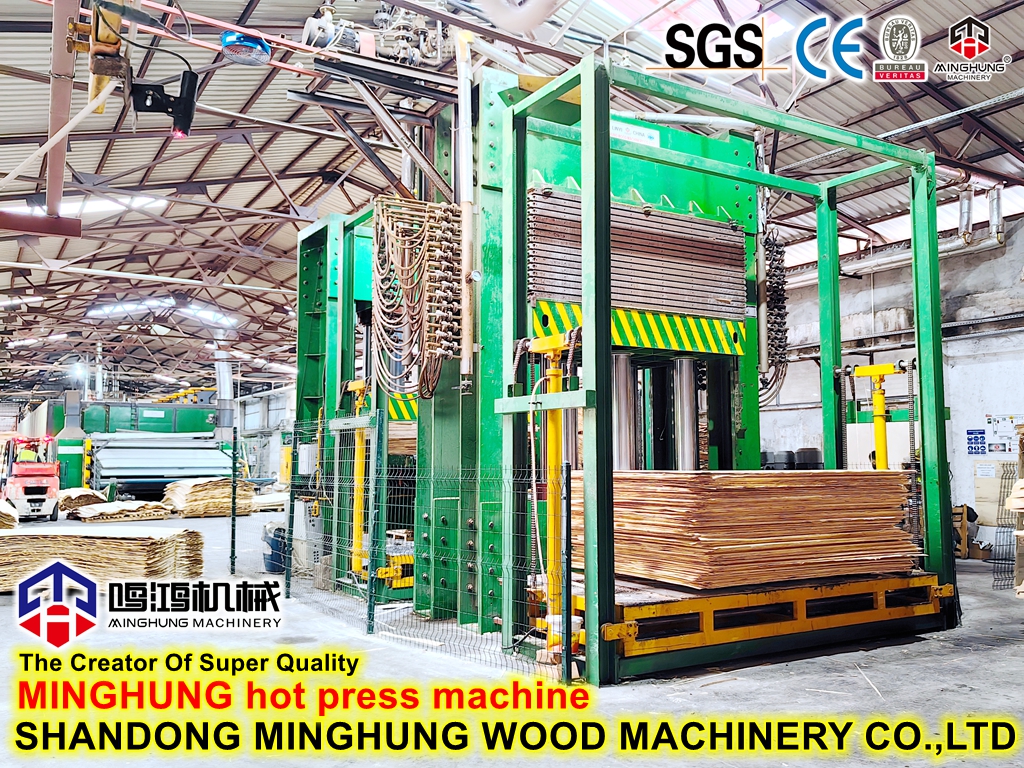
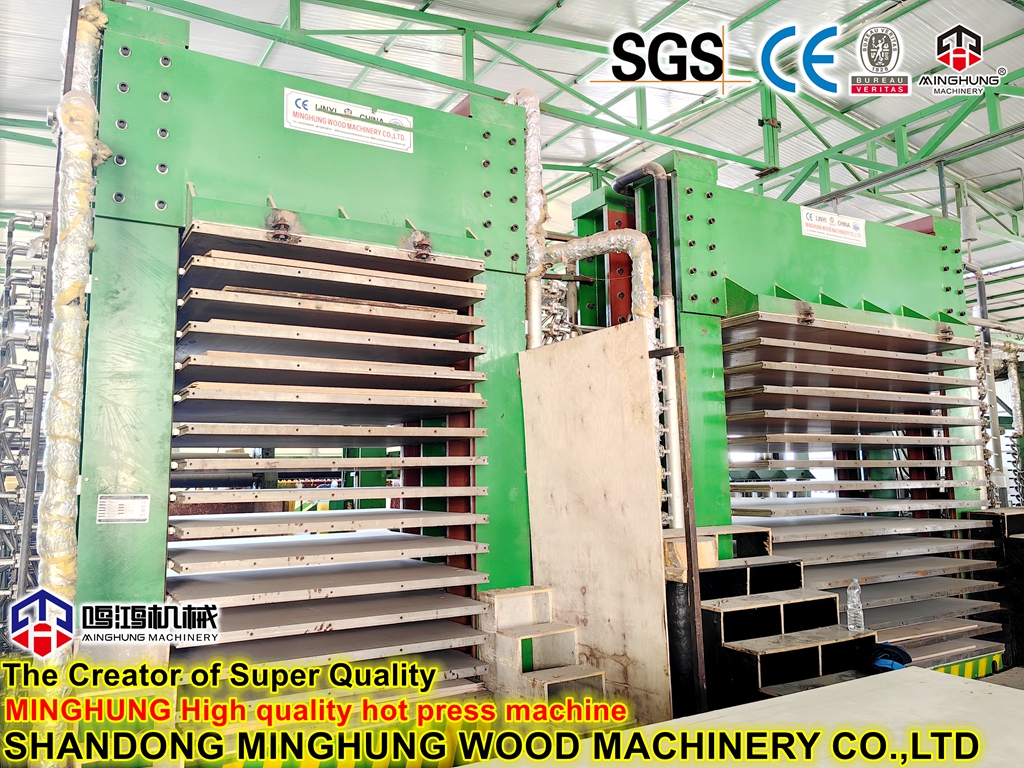
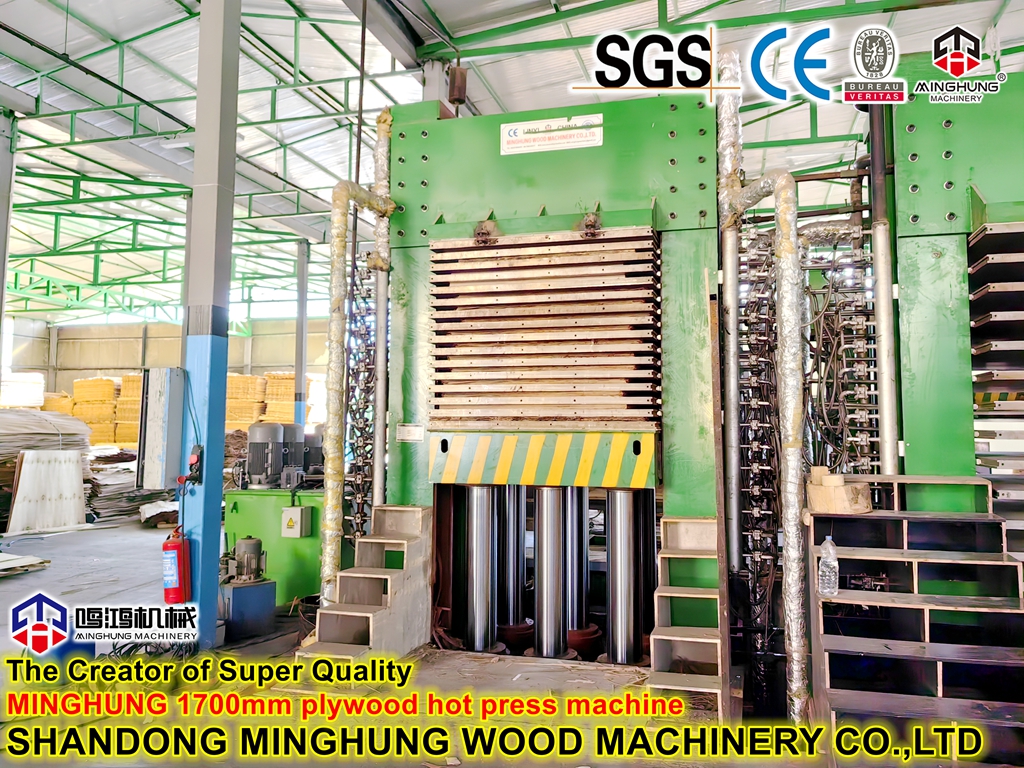
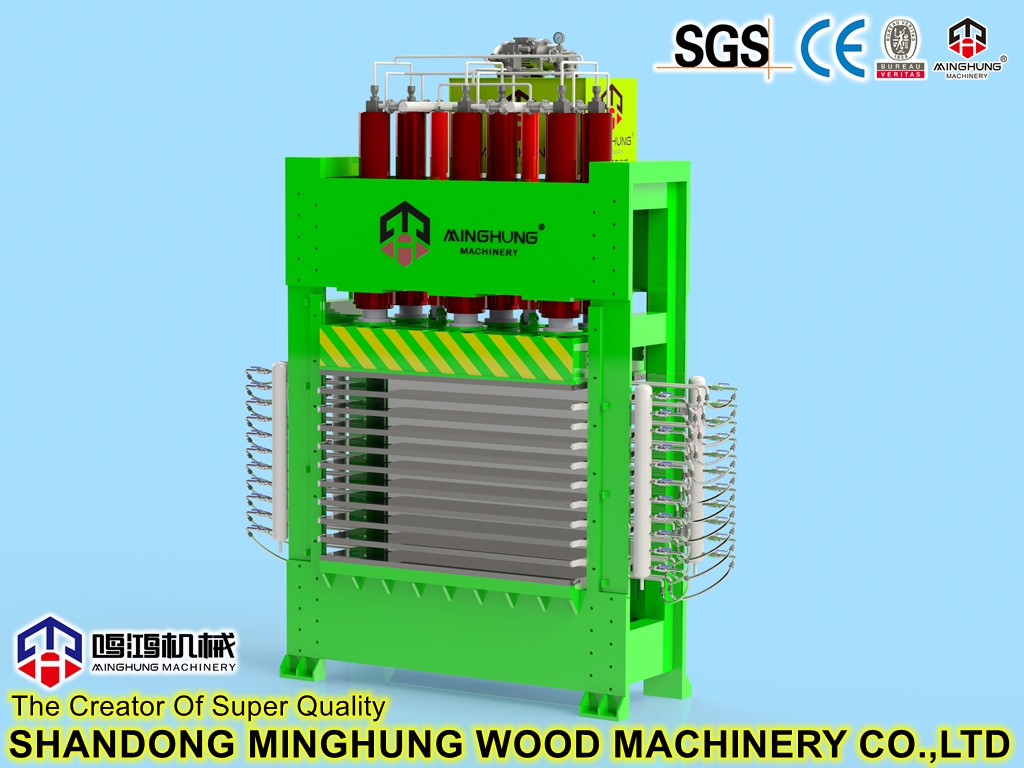
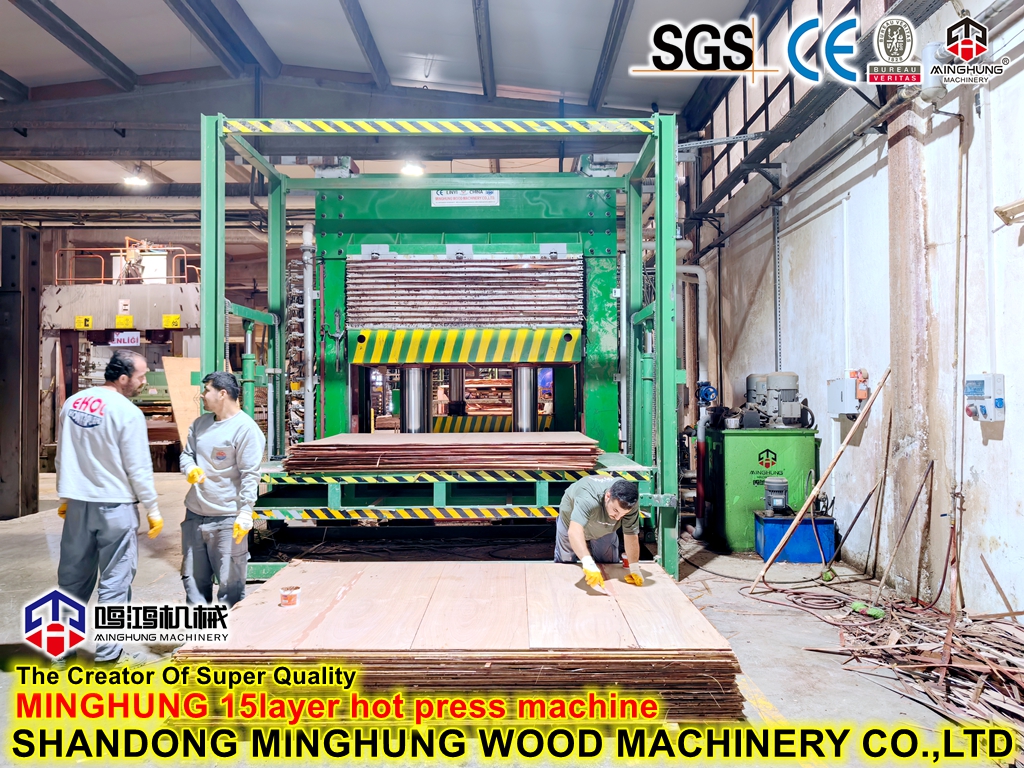
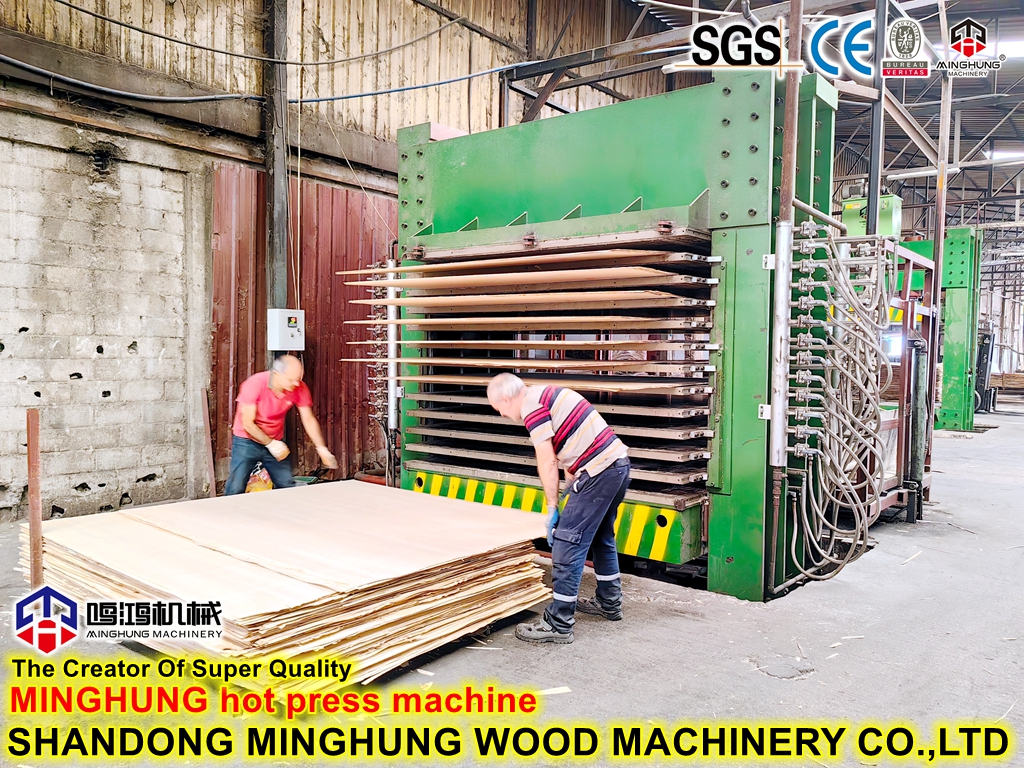
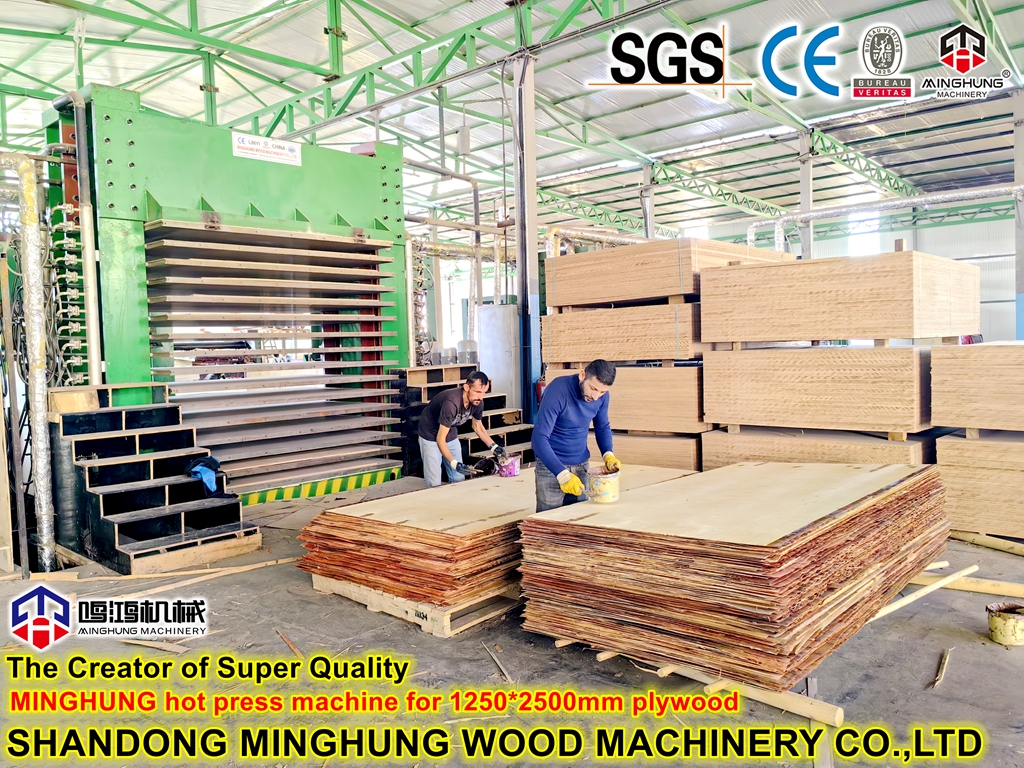
The working principle of the high-rigidity frame plywood hot press is based on the coordinated action of hydraulic pressing and hot plate heating. The complete working cycle is as follows.
Heating phase. Thermal oil is heated to the set temperature by an external boiler and circulated through the internal channels of each hot plate, allowing the plate surfaces to heat up rapidly and maintain a uniform temperature distribution.
Loading phase. The operator or an automatic board loader places glued veneer stacks into each opening of the hot press layer by layer, with each stack positioned between two hot plates.
Closing and pressing phase. The hydraulic system activates the main cylinder, pushing the moving platen upward to close all layers simultaneously. Once the pressure reaches the set value, the system enters pressure-holding mode, maintaining stable pressure to promote chemical crosslinking of the adhesive under high temperature and pressure.
Holding and curing phase. Under the set temperature and pressure, the press holds for a certain duration, ensuring full curing of the glue line and a dense internal structure of the board.
Pressure release and opening phase. After holding, the hydraulic system slowly releases pressure. The moving platen descends, and all layers open naturally. The finished plywood sheets are removed either manually or by an unloading device.
The frame body provides uniform restraint throughout the pressing process, preventing deformation of the machine body and thereby ensuring that each layer receives consistent pressure.
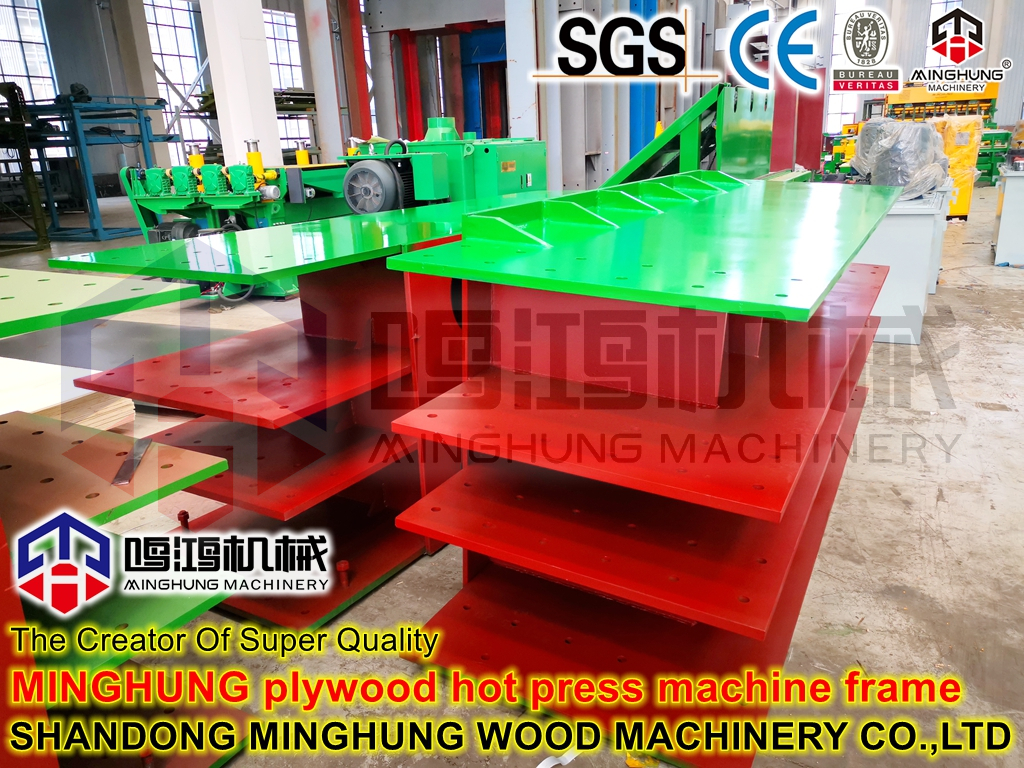
Main frame. Adopting an integral welded frame structure, machined in a single setup on a large machining center, offering extremely high rigidity and torsion resistance. The frame design ensures more uniform pressure distribution and resists deformation over long-term use.
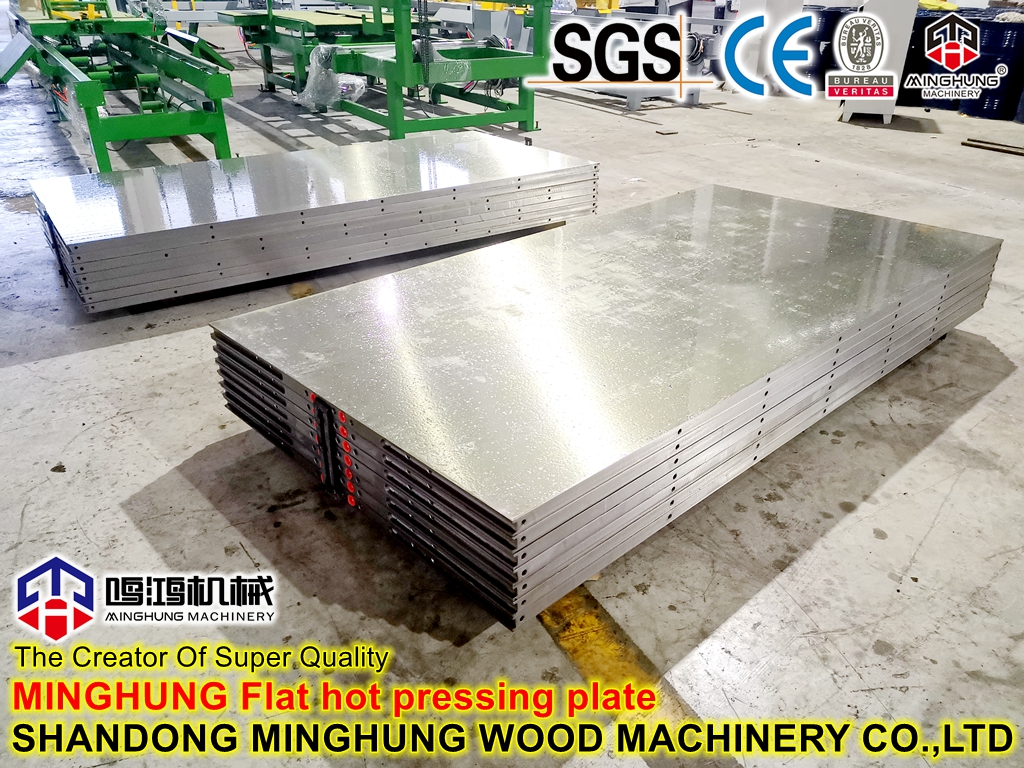
Hot plates. A corresponding number of hot plates are provided according to the number of layers. Each hot plate has internal channels for thermal oil circulation, and the surfaces are precision ground to ensure flatness and smoothness. The hot plates are made of high-strength steel, resistant to high temperature and corrosion.
Moving platen. Connects the main cylinder and the hot plate stack, transmitting pressure to each layer of boards. The platen is reinforced to minimize deflection under high pressure.
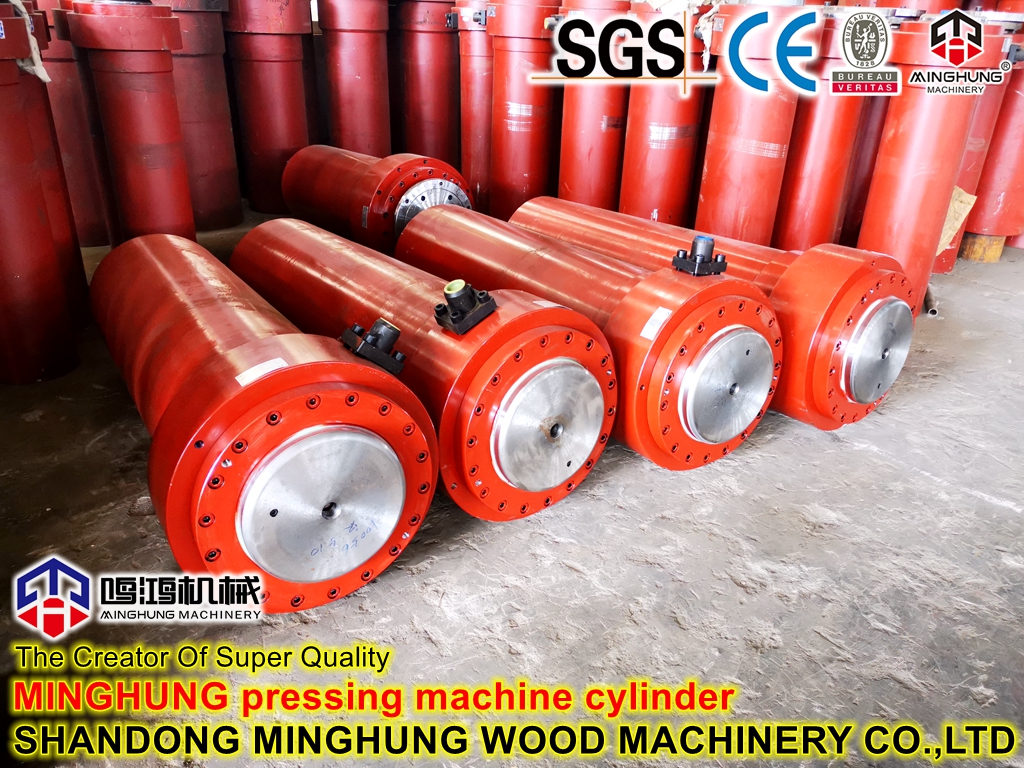
Main cylinder system. Typically arranged as a single cylinder or dual cylinders, providing the required total pressure. The cylinders use a plunger design with good sealing performance and long service life.
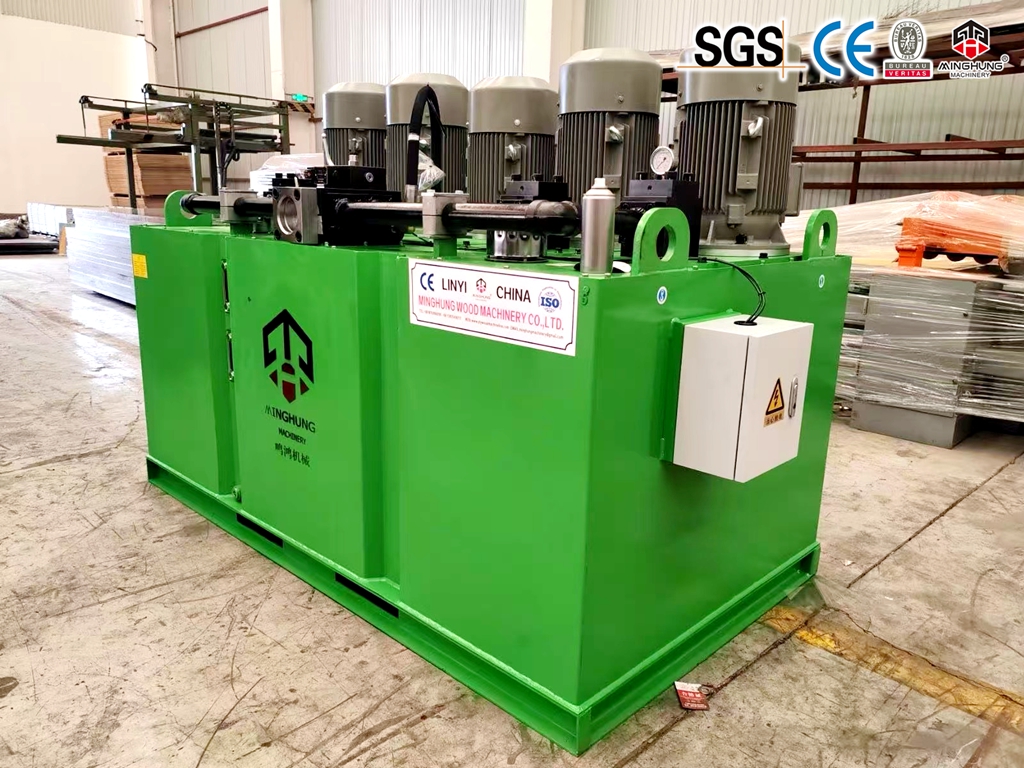
Hydraulic power unit. Consists of hydraulic pumps, oil tank, motor, proportional valves, pressure sensors, safety valves, and other components, responsible for supplying and precisely controlling hydraulic pressure. A multi-pump combination design enables switching between fast closing and slow pressing.
Thermal oil heating system. Includes a thermal oil boiler or electric heating device, circulation pump, piping, valves, expansion tank, and temperature controllers. The system heats the thermal oil to the set temperature, delivers it to the hot plates, and continuously circulates it to maintain temperature stability.
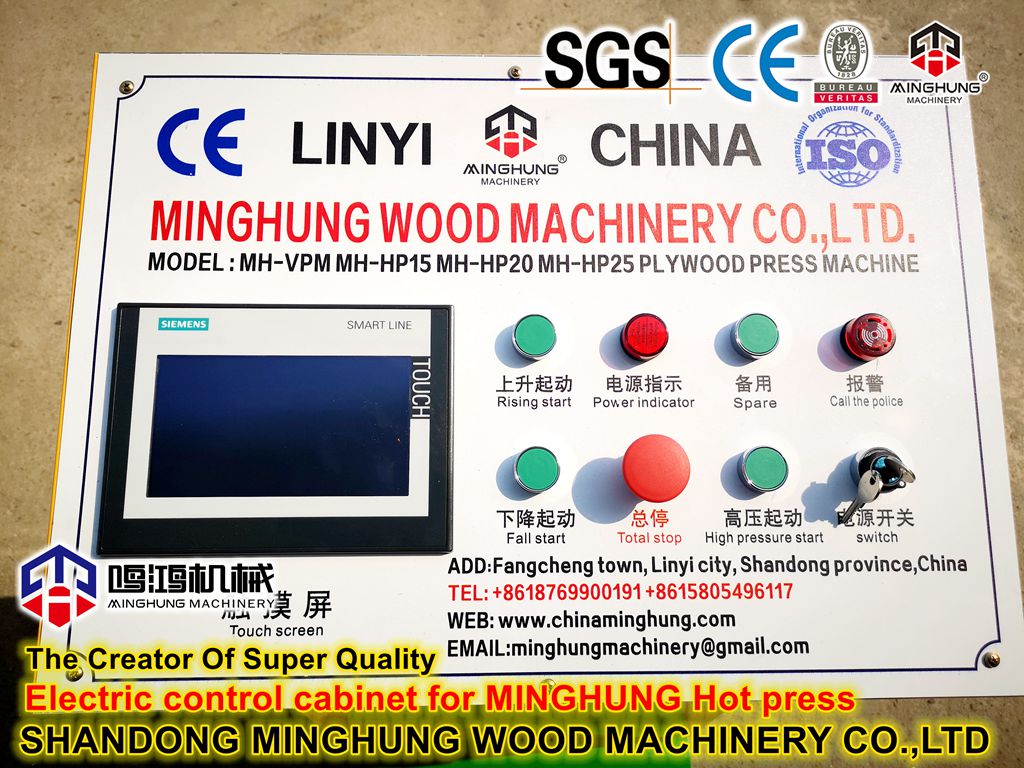
Control system. Uses a PLC controller with a touchscreen human-machine interface, enabling setting and automatic control of parameters such as temperature, pressure, holding time, and pressing curve. Supports storage and recall of multiple process recipes.
Safety protection devices. Includes safety light curtains on both sides of the machine, multiple emergency stop buttons, hydraulic system overpressure relief valves, hot plate overtemperature sensors, leak detection devices, and mechanical anti-fall locks.
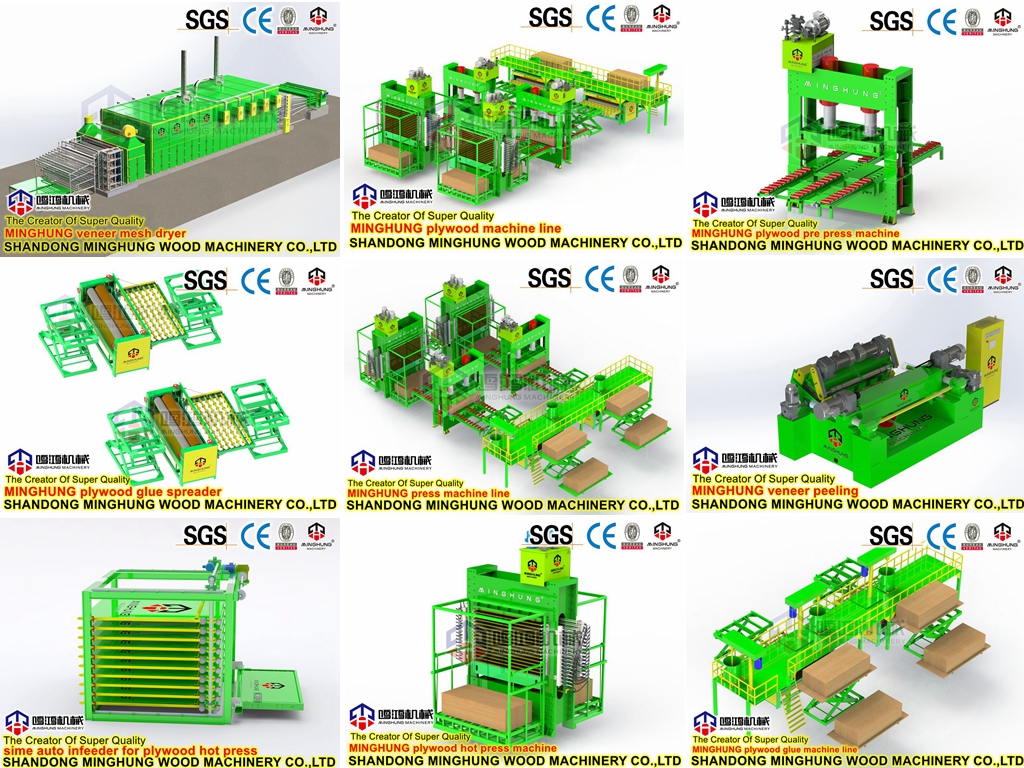
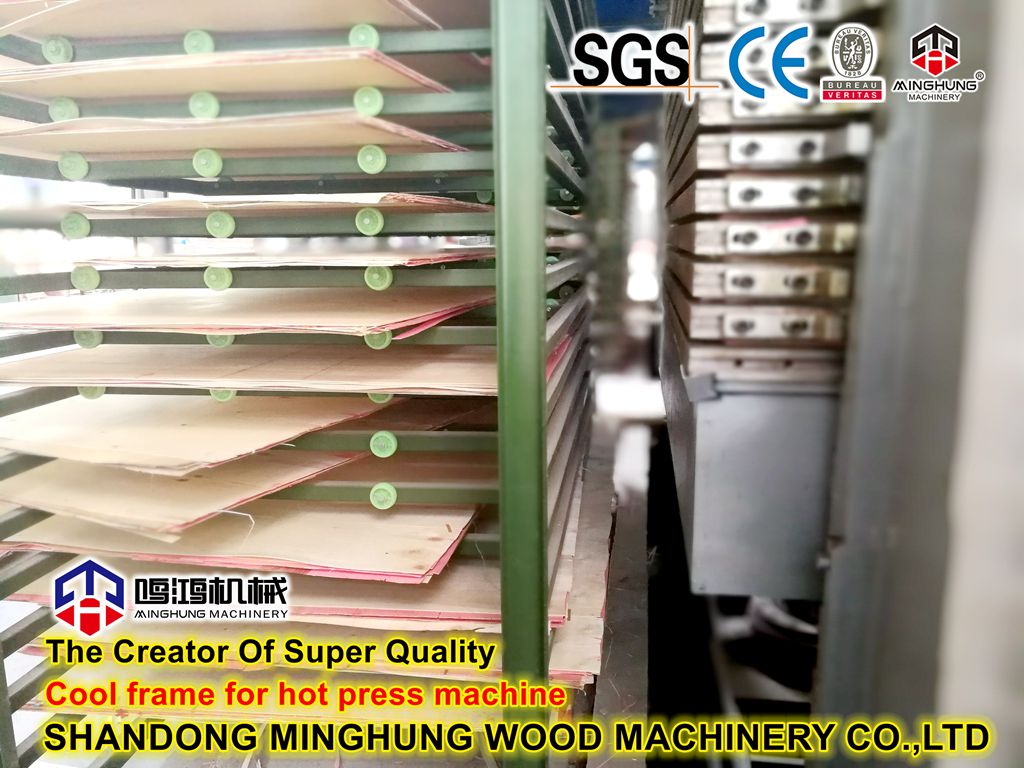
Loading and unloading auxiliary devices. Optional automatic board loader and unloader that work in coordination with the press operation, reducing manual labor and improving production efficiency and safety.
Concrete formwork. High-strength, water-resistant plywood used for concrete pouring, requiring flat surfaces, dense edges, and multiple reuses. The high-rigidity frame press produces formwork with higher flatness and longer service life.
Furniture manufacturing. Environmentally friendly plywood for wardrobes, cabinets, TV stands, tables, chairs, and other furniture, requiring strict surface flatness and thickness tolerance.
Packaging industry. Structural plywood for export crates, pallets, and dunnage, focusing on strength and cost balance.
Container flooring. Ultra-high-strength plywood used at the bottom of shipping containers, needing to withstand forklift traffic and heavy impacts, demanding extremely high pressing pressure and uniformity.
Multi-layer solid wood flooring substrate. Cross-laminated plywood as the base layer of flooring, requiring good dimensional stability and high internal bond strength.
Truck and trailer flooring. Wear-resistant and moisture-resistant plywood for truck, trailer, and RV floors.
Marine interiors. Moisture-resistant and fire-retardant treated plywood used for ship bulkheads, ceilings, and decorative panels.
Stage and exhibition construction. Reusable plywood with low deformation and high surface flatness for temporary structures.
Parameter | Specification Range |
Number of Openings | 5 – 25 layers |
Total Pressure | 200 – 1200 tons |
Hot Plate Length | 2500 – 2700 mm |
Hot Plate Width | 1300 – 1400 mm |
Hot Plate Size | Customizable |
Corresponding Board Size | 4×8 ft (1220×2440 mm) and custom |
Layer Spacing | 60 – 100 mm |
Number of Main Cylinders | 1 / 2 / 4 pcs |
Main Cylinder Diameter | 250 – 500 mm |
Working Temperature Range | Ambient – 220°C |
Temperature Accuracy | ±1.5°C |
Hot Plate Surface | ≤ 2°C |
Heating Method | Thermal oil (standard) / Electric (optional) |
Heating Time (Ambient→150°C) | ≤ 45 min |
Fast Closing Speed | ≥ 60 mm/s |
Pressing Speed | Steplessly adjustable |
Hydraulic System Pressure | 20 – 25 MPa |
Control System | PLC + Touchscreen |
Operation Modes | Manual / Semi-auto / Fully auto |
Recipe Storage | ≥ 50 sets |
Total Installed Power | 40 – 100 kW |
Machine Length | ≈ 6.0 – 7.0 m |
Machine Width | ≈ 3.0 – 4.0 m |
Machine Height | ≈ 3.0 – 3.5 m |
Machine Weight | ≈ 40 – 105 tons |
Technical consulting and solution design. Based on the customer's specific product type, target output, and factory site conditions, we provide the most suitable hot press model selection and complete line layout solution.
Installation and commissioning. We can send experienced engineers to overseas customer sites to provide full guidance on equipment installation and commissioning, ensuring the machine achieves its designed performance specifications.
Operation and maintenance training. We provide systematic training courses for customer operators and maintenance personnel, including equipment operation procedures, PLC parameter adjustment, daily inspection items, and common fault handling methods.
Remote technical support. We offer long-term free remote technical support services, responding quickly to customer questions via WeChat, WhatsApp, email, or video calls. Most faults can be resolved under remote guidance.
Spare parts supply. We supply all original spare parts long term, including seals, hot plates, hydraulic pumps, proportional valves, sensors, touchscreens, and more. Our spare parts inventory covers common wear parts, ready for shipment at any time.
Equipment upgrading and retrofitting. We provide automation upgrades, heating method modifications, control system replacements, and other retrofitting services for existing customers, helping them improve equipment performance at lower cost.
Warranty policy. The complete machine is warranted for twelve months from the date the equipment arrives at the customer's site. Faults caused by manufacturing defects during the warranty period are repaired or replaced free of charge. Wear parts such as seals and thermal oil are not covered under warranty but can be supplied at cost. After the warranty period ends, we provide paid repair services and spare parts supply for the lifetime of the equipment.