Differences between Corrugated Oriented Strand Boards And Ordinary Oriented Strand Boards
You are here:Home » News » OSB Production Machine Line » Differences between Corrugated Oriented Strand Boards And Ordinary Oriented Strand Boards
Differences between Corrugated Oriented Strand Boards And Ordinary Oriented Strand Boards
Views: 0 Author: Site Editor Publish Time: 2026-04-01 Origin: Site
corrugated OSB
OSB
Corrugated oriented strand board (corrugated OSB) and ordinary oriented strand board (ordinary OSB) both belong to the OSB family, but they are fundamentally different in structure, manufacturing process, and application.
Simply put, ordinary OSB pursues “high-strength flat panels,” while corrugated OSB pursues “high-strength three-dimensional structural panels.” The following detailed comparison is based on available information.
Core Definition and Structural Differences
1. Core Definition and Structural Differences
The fundamental difference lies in the macroscopic geometric structure of the final product.
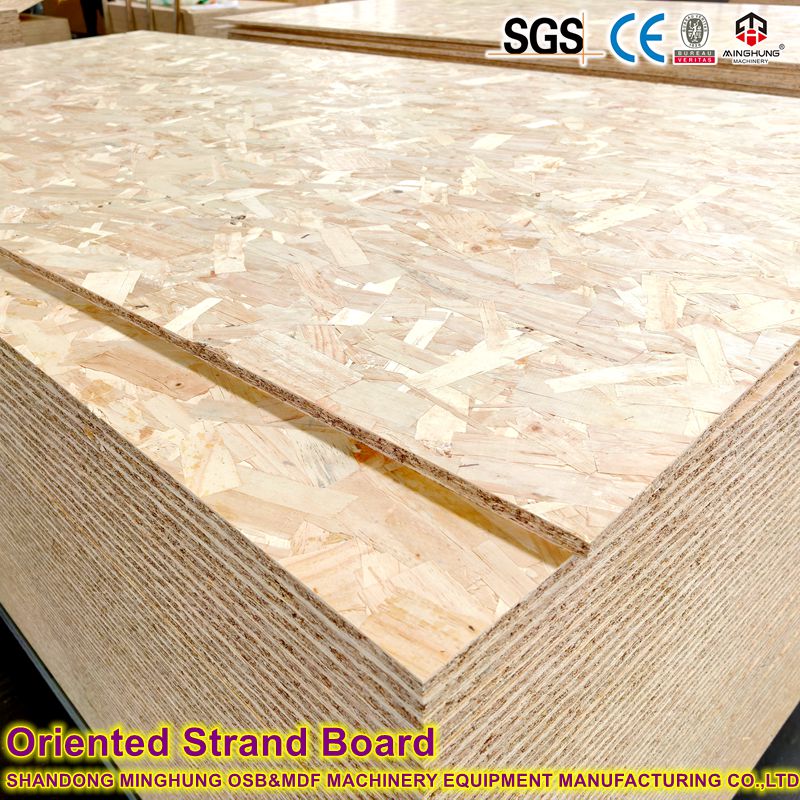
Ordinary OSB refers to the traditional flat‑panel oriented strand board. It is formed by hot‑pressing multiple layers of oriented strands under high temperature and pressure in a single step, resulting in a flat board with uniform thickness.
Corrugated OSB refers to a product that ultimately presents a corrugated or profiled shape (such as a wave, trapezoid, or V‑shape), similar to corrugated cardboard. It is produced by molding plant‑based fiber materials into a shape comprising peaks and valleys using a mold, thereby achieving significantly higher compressive strength.
Comparison of Production Processes
The raw material preparation and basic processes (strand production, drying, resin application) are similar for both types, but the lay‑up and forming stages are completely different.
Process Stage
Ordinary OSB
Corrugated OSB
Lay-up / Mat forming
Strands are oriented crosswise in multiple layers (typically three or five layers), e.g., surface layers oriented lengthwise and the core layer crosswise.
The basic orientation logic is similar to ordinary OSB, but the formed mat must be transferred into a mold with a specific corrugated shape.
Forming / Pressing
Pressed in a flat-platen press (multi-opening or continuous flat press) under high temperature and pressure, producing a flat panel in one step.
Formed via molding. The shape of the mold (male and female) determines the final corrugated profile of the board.
Comparison of Finished Product Characteristics
Due to the different structures and processes, the characteristics of the two products differ significantly.
Feature
Ordinary OSB
Corrugated OSB
Structural Form
Flat panel, uniform thickness.
Profiled panel with periodic peaks and valleys (corrugated or trapezoidal).
Mechanical Properties
Anisotropic – bending strength is much higher in the longitudinal (grain) direction than in the transverse direction. Good nail-holding strength.
Extremely high compressive strength; the corrugated arch structure distributes pressure, giving it much higher load-bearing capacity perpendicular to the panel surface than a flat panel.
Surface Characteristics
Surface retains the texture of large strands and is uneven, making it difficult to use directly for decorative purposes. Usually requires overlaying or serves as a substrate.
Has a regularly undulating three-dimensional surface and can be used as a structural component or decorative element in its own right.
Applications
Building structures (walls, roofs, floors), packaging crates, container flooring, furniture back panels, etc.
Used where high compressive strength and light weight are required, such as specialized packaging partitions, roof insulation support structures, etc.
Differences in Production Equipment
The most fundamental difference in production equipment between ordinary oriented strand board (OSB) and corrugated OSB lies in the type of forming press: ordinary OSB uses a flat‑platen press, whereas corrugated OSB uses a molding press.
This fundamental difference dictates the downstream equipment and supporting processes. The following table provides a clear comparison:
Equipment Aspect
Ordinary OSB
Corrugated OSB
Core Press
Flat-platen press: usually a continuous flat-platen hot press, but also single-opening or multi-opening hot presses. The press platens are flat.
Molding press: the core is a press equipped with dedicated forming molds; the upper and lower mold surfaces have the pre-configured corrugated shape.
Core Mold / Tooling
None. The product is formed directly between flat platens.
Dedicated forming mold: includes an upper mold and a lower mold with a corrugated cavity. This is the core specialized equipment for the line.
Lay-up / Mat Forming Equipment
Equipped with an orientation system that precisely arranges strands in longitudinal and transverse directions, using mechanical or electrostatic methods.
The basic lay-up equipment is similar to that of ordinary OSB, but the formed mat is then transferred into the molding press instead of a flat-platen press.
Production Mode
Highly continuous and automated, allowing uninterrupted feeding and panel output.
Mostly intermittent / batch production. The material is laid up outside the press on a specialized metal pallet, then the pallet is loaded into the press for molding; after molding, the product is separated from the pallet.
In‑Depth Analysis of the Core Differences
Fundamental Difference: Flat‑Platen Pressing vs. Molding
An ordinary OSB production line pursues “flatness.” Its press is like a giant “flat pan” that compresses the oriented mat into a large, flat panel in one step. In contrast, the core of a corrugated OSB line is to “shape” the product. Its molding press acts like a “mold,” using male and female halves that are the inverse of the target corrugated profile to “stamp” the mat into a panel with a corrugated or trapezoidal structure.
Equipment Investment and Production Rhythm
Because it enables continuous production, an ordinary OSB continuous flat‑platen press line requires a massive investment but achieves extremely high production efficiency, making it suitable for large‑scale, standardized production. Corrugated OSB production, due to the need for mold changes, off‑press mat forming, and demolding, is intermittent. Each cycle takes more time. Consequently, the investment cost is relatively lower, but the production capacity is typically much smaller than that of a large continuous flat‑platen line, and it is more focused on meeting the market demand for specific structural components.
Shared Front‑End Equipment
It is worth noting that before the mat enters the press, the raw material preparation equipment (such as stranders, dryers, screeners, blenders/resin applicators) and the basic orientation lay‑up equipment are essentially the same for both. The major equipment divergence occurs after the lay‑up stage.
Understanding these equipment differences helps explain why corrugated OSB is not as common as ordinary OSB on the market—it requires a specialized mold and molding system, making it more suitable for small‑batch, customized specialty products.
The first day of the 2026 Shanghai International Woodworking Machinery Fair – if this morning's keyword was "surprise," then this afternoon's keywords are definitely "explosive" and "confidence"!
This trip to Shanghai was not only a display of products, but also a dissemination of our brand and a connection of emotions. We will continue to stay true to our original aspiration and repay every customer's trust and support with even better products and services. The future is full of promise, and we are always on the way!
The Mid-Autumn Festival is approaching, and the moon is growing round. While many people are beginning to prepare for family reunions, the company’s factory tells a different story: forklifts weaving through the yard, crane arms rising and falling, containers lined up in rows, and loading work proceeding in a tense yet orderly manner.
How to produce Particle board? What is the production step of Making Particle board?Introduction:Particle board, also known as chipboard, is a versatile and cost-effective material widely used in the construction and furniture industries. It is made by compressing wood particles and adhesive togethe
This new facility marks a fresh start for our company. Guided by our enduring commitment to "precision engineering and quality first," we are now better equipped than ever to provide efficient, durable, and innovative machinery solutions for the worldwide wood-based panel industry.