| Availability: | |
|---|---|
| Quantity: | |

|
Product Description
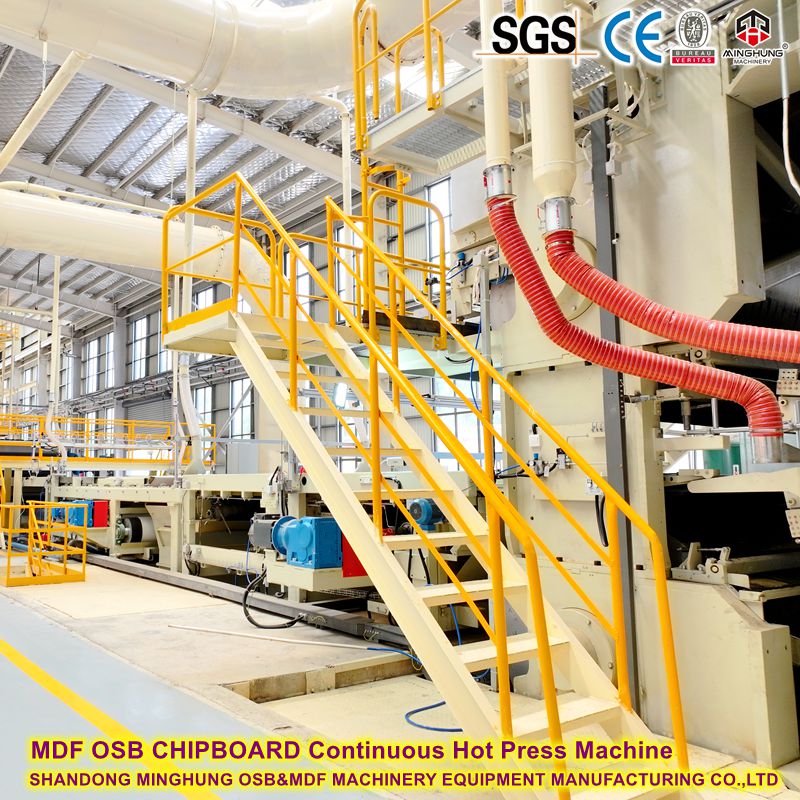
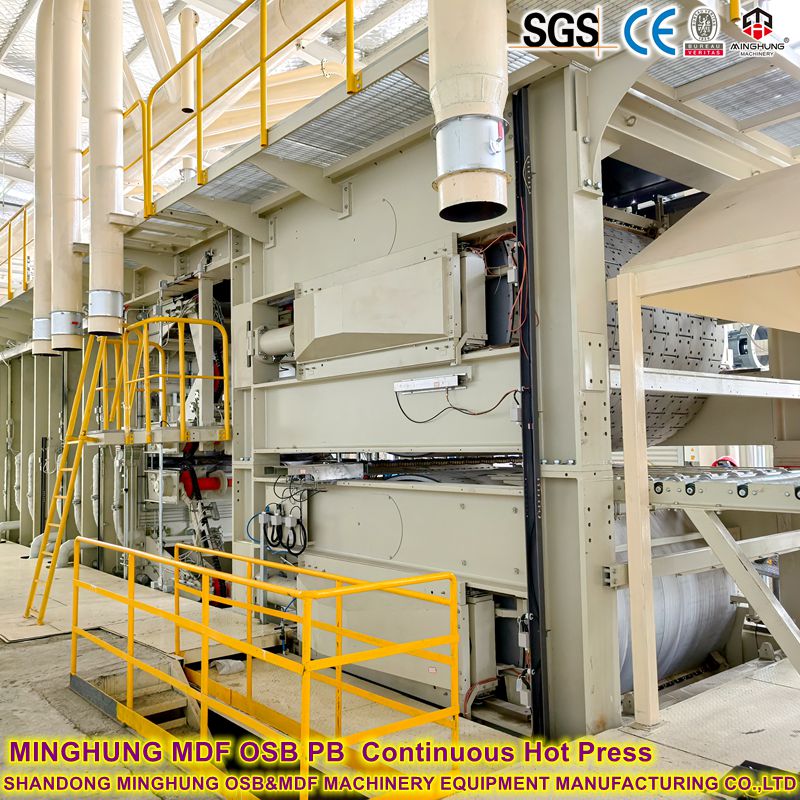
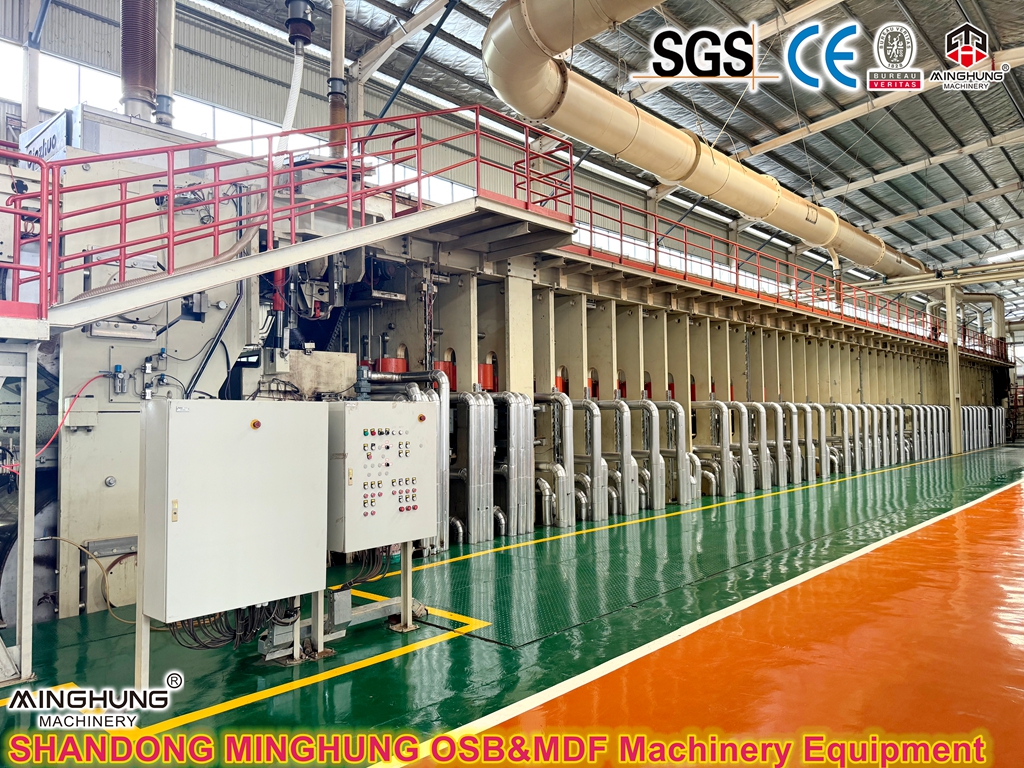
The 2mm Thin Fiberboard Continuous Flat Press is a cutting-edge technological system specifically designed for the efficient and stable production of ultra-thin fiberboard (typically referring to boards in the 1.5-3.0mm thickness range). It represents the height of precision and advanced technology in the fiberboard manufacturing sector, overcoming the technical limitations of traditional multi-opening presses or standard continuous presses when producing extremely thin panels. This equipment not only enables the continuous, large-scale production of ultra-thin boards but also ensures they possess exceptional physical properties and surface quality, meeting the stringent demands of high-end markets.
|
Working principle
The working principle of the 2mm Thin Fiberboard Continuous Flat Press is based on a precisely controlled, continuous dynamic hot-pressing process. Its core function is to sandwich a loose fiber mat between two parallel, continuously circulating steel belts under high temperature and pressure, conveying it through the press where resin curing and board formation into an ultra-thin panel occur simultaneously during transit. This entire process can be broken down into the following precise stages:
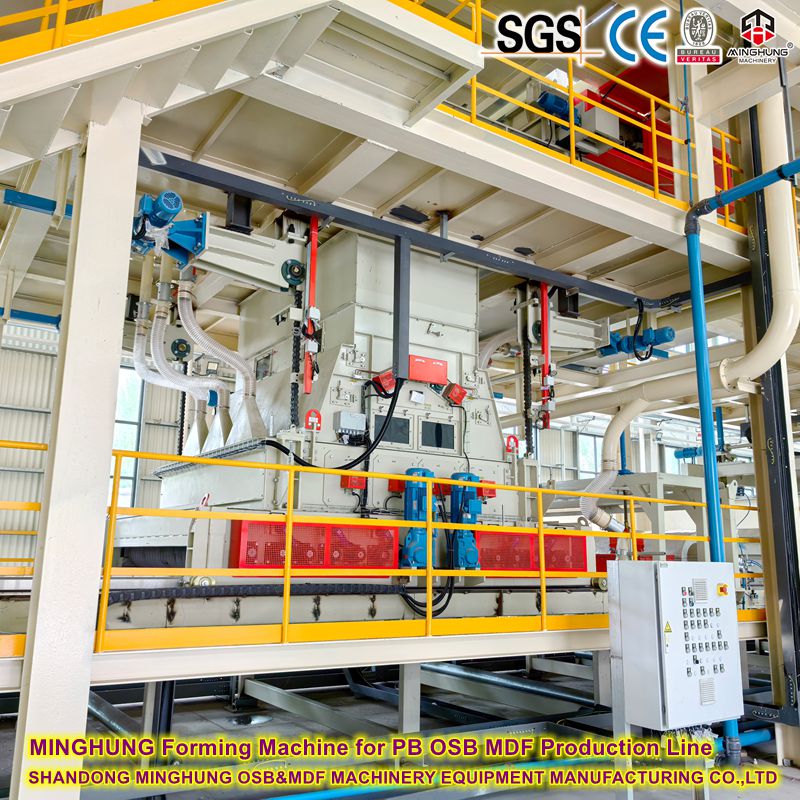
1. Fiber Forming and Mat Formation:
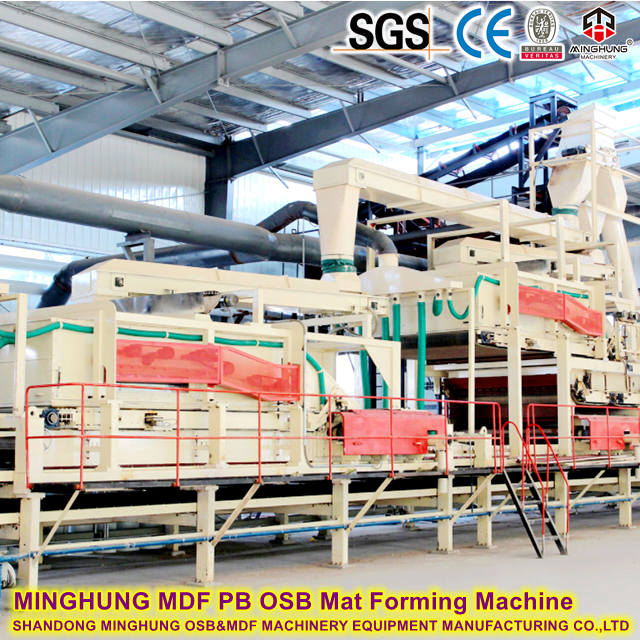
Dried and resinated fibers are formed into an exceptionally uniform and fluffy fiber mat via a high-precision air-forming or mechanical forming station on a moving conveyor.
Uniform formation is a prerequisite for producing 2mm thin board; any density variation can lead to warping or breaking in the final panel.
2. Mat Pre-pressing and Conditioning:
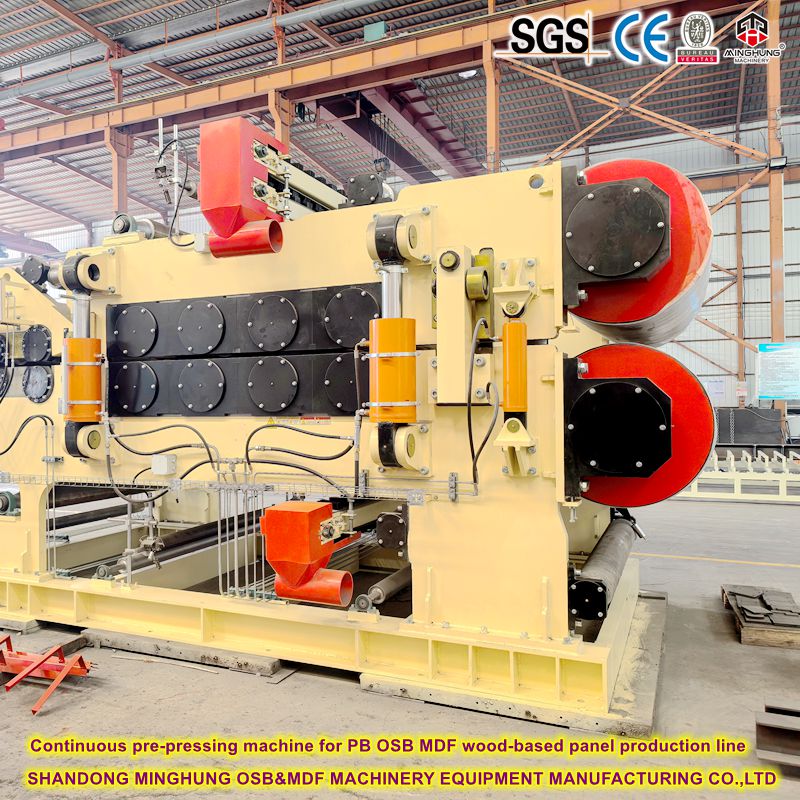
The fluffy fiber mat first enters a Gentle Pre-press. This stage does not aim for maximum compression but uses a mild, linearly increasing pressure to initially remove air, compact the mat into a stable state (much thicker than the final target), and impart sufficient initial strength (forming a "blank") to ensure it can be fed into the main press intact and without disruption.
3. Belt Clamping and Continuous Infeed:
The pre-pressed mat is accurately fed into the main press inlet. Here, it is clamped between two massive, circulating high-temperature steel belts.
The two belts converge at the press "nose," tightly enveloping the mat and synchronously carrying it into the main press section.
4. Zoned Hot-Pressing and Resin Curing (Core Stage):
Sandwiched between the steel belts, the mat continuously passes through multiple zones within the main press, each with independently controlled length, temperature, and pressure.
Infeed Zone: Pressure rapidly increases to its maximum, quickly compressing the mat close to the 2mm target thickness.
Main Pressing and Curing Zone: In this zone, the mat is subjected to stable high pressure. Simultaneously, heating platens (circulating with high-temperature thermal oil or steam) located behind the steel belts efficiently and uniformly transfer heat (typically 180-220°C) into the mat. Under this combined heat and pressure, the adhesives on the fibers rapidly cross-link, permanently bonding the wood fibers into a solid integral board.
Pressure Release and Calibration Zone: Pressure is precisely and gradually released in stages. This slow decompression process is critical for ultra-thin boards, allowing residual steam and stresses within the board to dissipate gently, effectively preventing "blowing," delamination, or spring-back deformation caused by instantaneous stress release, thereby ensuring precise 2mm thickness and dimensional stability.
5. Cooling and Setting:
A cooling system is typically integrated at the press discharge end to cool the steel belts and the now-solidified board. This sets the board's structure, further enhancing its strength, and prepares it for subsequent sawing.
6. Continuous Discharge and Post-Processing:
The continuous, cured, and cooled fiberboard ribbon is discharged from the press outlet and is subsequently cut to required market sizes by sawing equipment.
|
Main components
This equipment is a highly integrated system, and its capability to produce 2mm thin board relies on the following key high-precision components:
1. High-Precision Forming Station: A core upstream equipment. It must ensure absolute uniformity of fiber distribution, which is the foundation for consistent density and preventing cracks in the thin board.
2. Gentle Pre-Press: Specifically designed for handling fragile ultra-thin mats, providing smooth, adjustable pressure profiles to avoid crushing the mat.
3. Continuous Flat Press Main Unit:
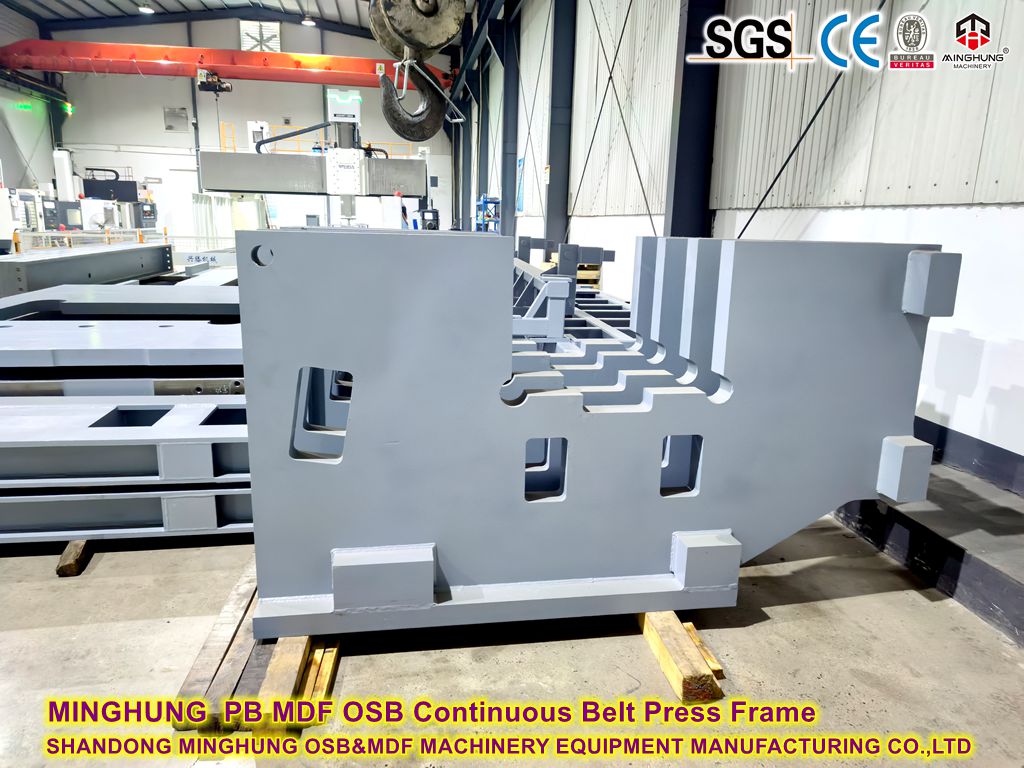
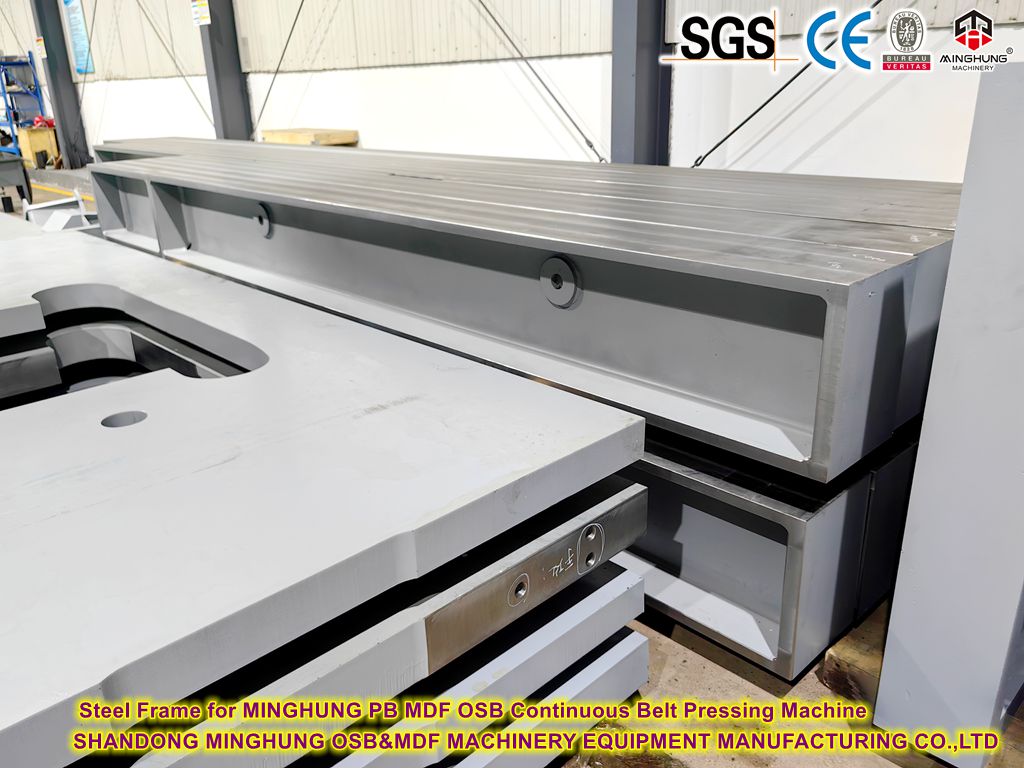
High-Rigidity Frame: A massive steel structure providing a stable, non-deforming foundation for the entire press, crucial for maintaining thickness accuracy.
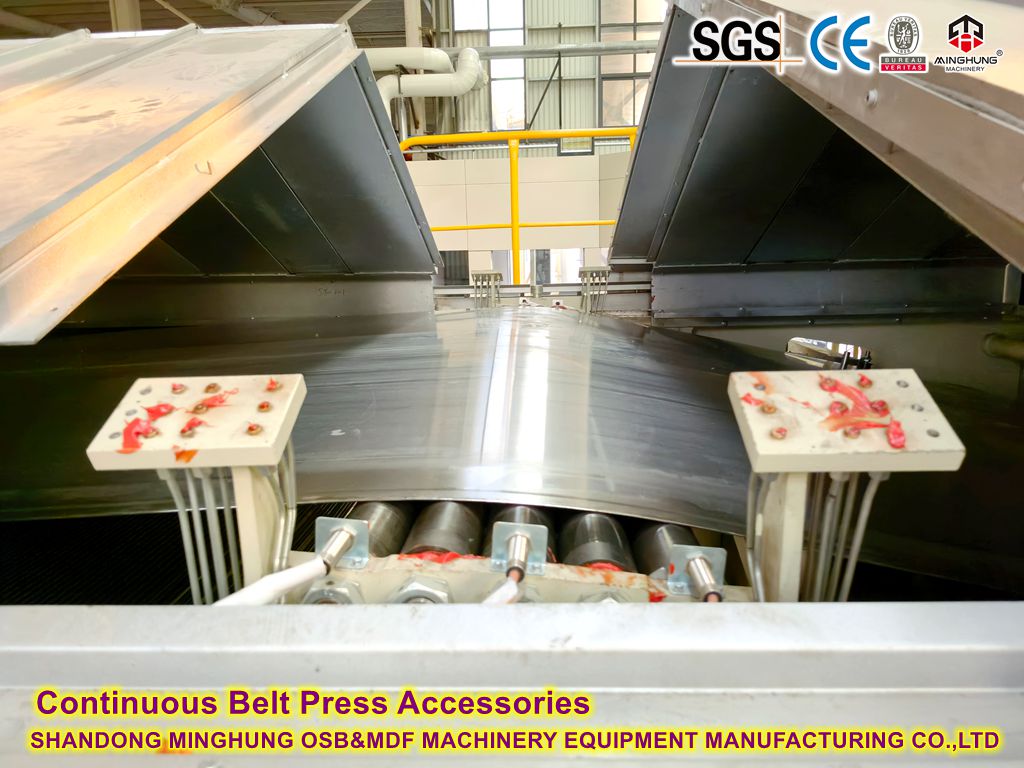
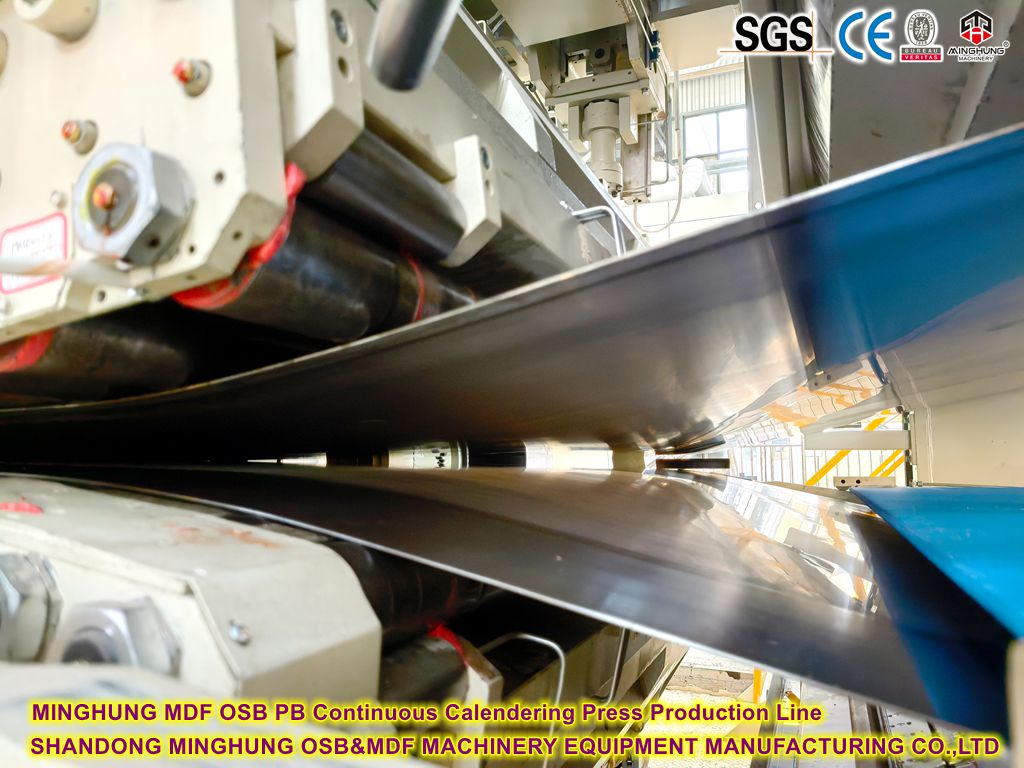
Dual Steel Belt System: Two heat-resistant, high-strength alloy steel belts. As the direct contact carriers and heat transfer surfaces for the mat, their surface finish, smooth operation, and tension stability are paramount.

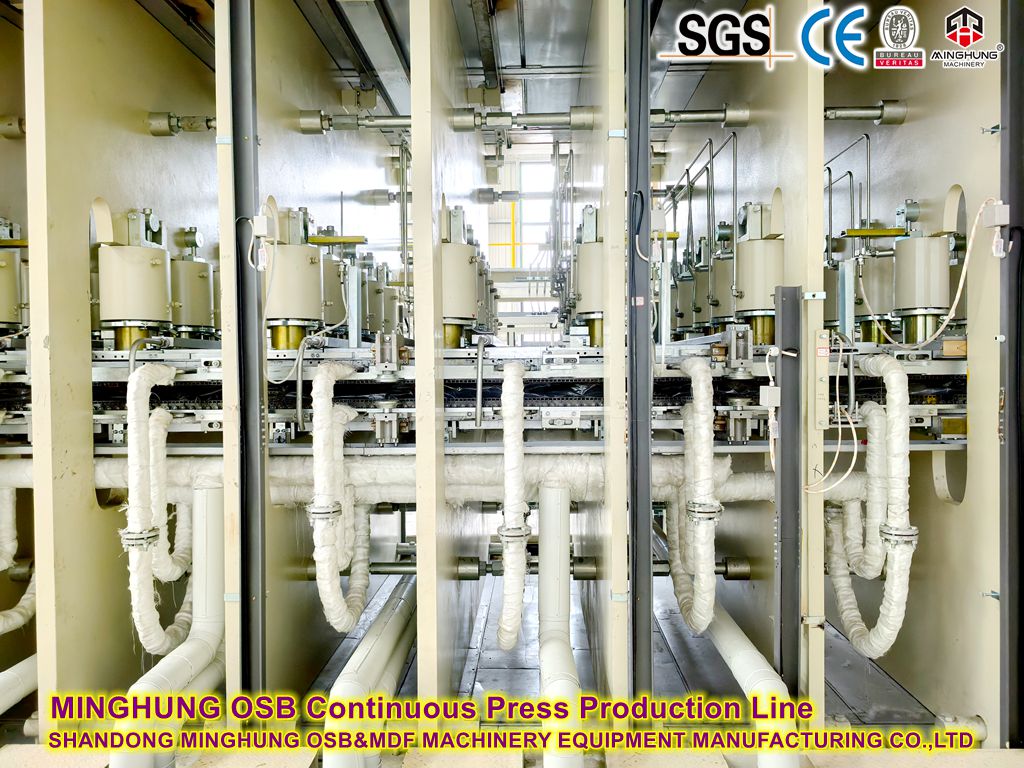
Heating Platen System: Zoned heating platens circulating thermal media, serving as the system's "heat source." For thin board production, temperature control must be more refined and responsive.
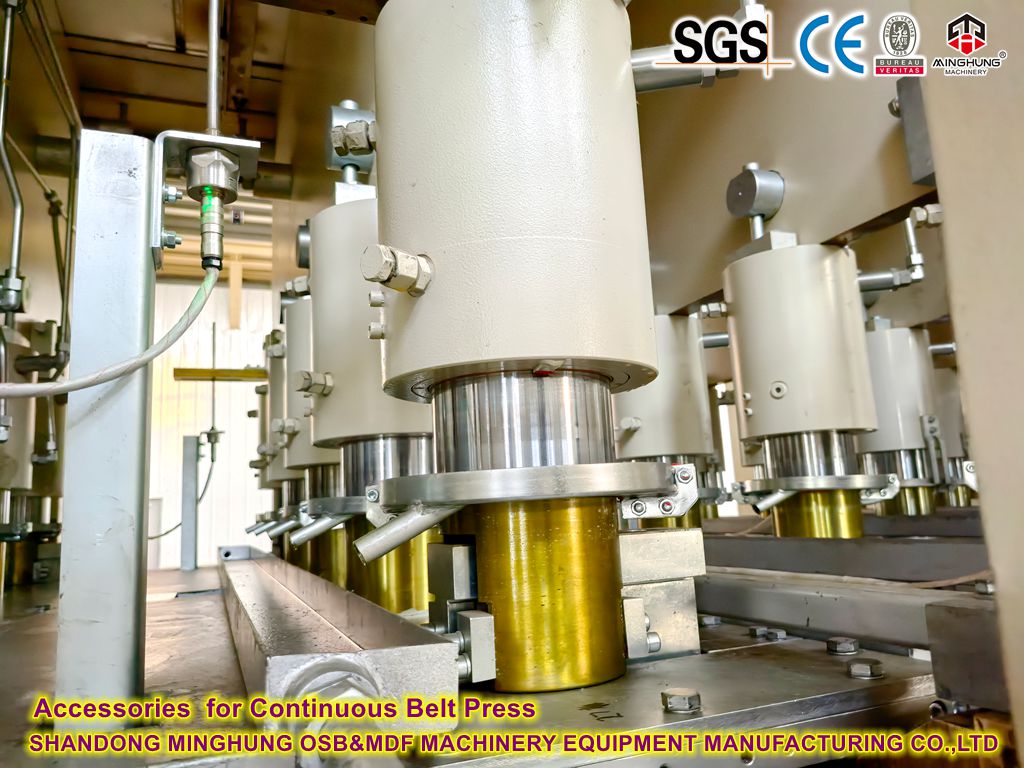
High-Response Hydraulic System: Comprises servo valves, pumping stations, and numerous zone-controlled hydraulic cylinders, acting as the system's "power source." It enables millisecond-level fine-tuning of pressure to adapt to the sensitive nature of ultra-thin mats.
Belt Drive and Tensioning System: Provides smooth traction and maintains optimal belt tension to prevent slippage or misalignment.
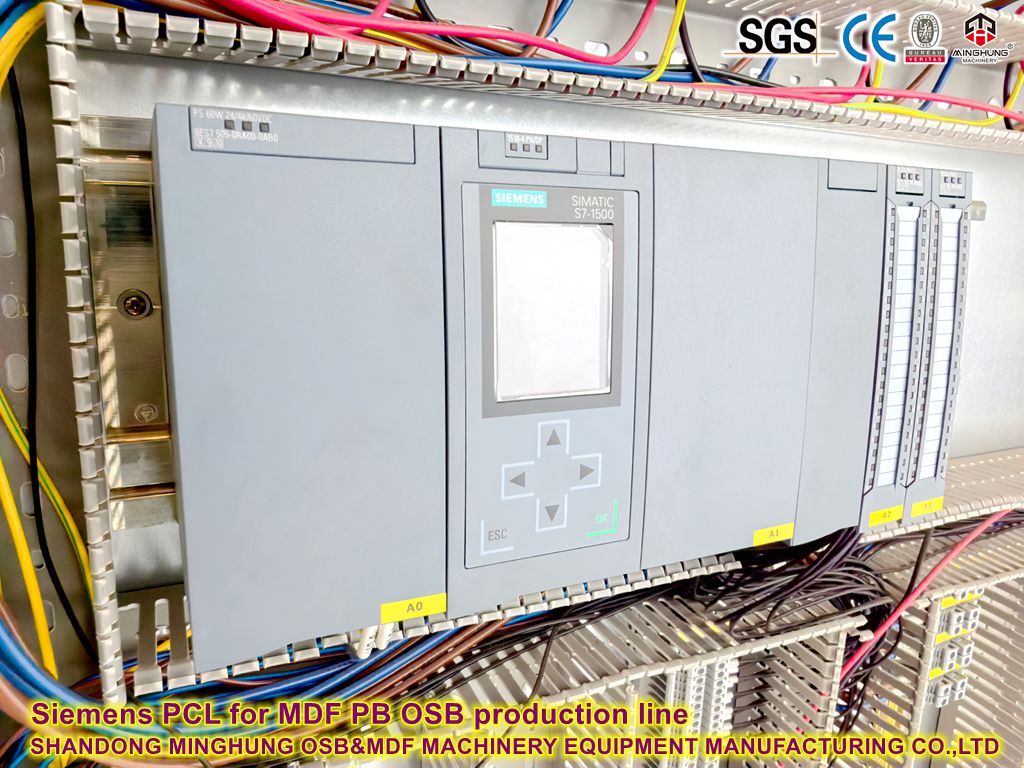
4. Micron-Level Thickness Control System: The brain and nervous system of the press. Includes online laser thickness gauges, pressure sensors, temperature sensors, and a high-speed PLC. It collects data in real-time and instantly adjusts hydraulic pressure and platen gap, achieving closed-loop control.
5. Central Control System: An integrated operating platform for setting and storing production recipes, monitoring the entire line's status, logging production data, and performing fault diagnosis.
6. Infeed and Discharge Synchronization Devices: Ensure precise synchronization between mat conveyance and steel belt speed, preventing pile-up or breakage at the inlet.
|
Key technical features & advantages
Stable Production of Ultra-Thin Board: Core capability to continuously and mass-produce high-quality thin fiberboard with a thickness as low as 2mm, with a very high yield rate.
Exceptional Board Quality:
Minimal Thickness Tolerance: Thickness variation across the entire board can be controlled within ±0.1mm or less.
High Density Uniformity: Avoids density gradients, giving the thin board superior stiffness and flatness, resistant to warping.
Perfect Surface Condition: The surface is extremely smooth and fine, often requiring minimal sanding before direct laminating, printing, or coating.
Outstanding Energy Efficiency & Environmental Performance: The continuous flat pressing process offers high thermal efficiency, and producing thinner boards inherently means lower raw material consumption per unit area, aligning with green manufacturing principles.
High Automation & Intelligence: The entire line is controlled by a central computer, capable of storing and recalling production recipes for different thicknesses, enabling quick changeovers. It features comprehensive production data tracking and intelligent diagnostics.
|
Application fields
The 2mm ultra-thin fiberboard produced by this equipment is an ideal material for:
Substrate for High-Pressure Laminates (HPL)
Balancer and Backer for Laminate Flooring
Back Panels for Home Appliances (e.g., TVs, Refrigerators)
High-End Gift Packaging and Premium Book Covers
Lightweight Furniture Doors and Exhibition/Display Materials
We are China professional factory and supplier of OSB board making machine, MDF/HDF making machine and Flakeboard/Particleboard making machine. Whatever which size, thickness, capacity you want to make, and whatever what kinds of raw materials do you use, our professional team can offer a suitable and good solution for you.
For more information, welcome contact us, we will reply you quickly and offer working videos with you.
Whatsapp: +8618769900191 +8615589105786 +8618954906501
Email: osbmdfmachinery@gmail.com

|
Product Description
The 2mm Thin Fiberboard Continuous Flat Press is a cutting-edge technological system specifically designed for the efficient and stable production of ultra-thin fiberboard (typically referring to boards in the 1.5-3.0mm thickness range). It represents the height of precision and advanced technology in the fiberboard manufacturing sector, overcoming the technical limitations of traditional multi-opening presses or standard continuous presses when producing extremely thin panels. This equipment not only enables the continuous, large-scale production of ultra-thin boards but also ensures they possess exceptional physical properties and surface quality, meeting the stringent demands of high-end markets.
|
Working principle
The working principle of the 2mm Thin Fiberboard Continuous Flat Press is based on a precisely controlled, continuous dynamic hot-pressing process. Its core function is to sandwich a loose fiber mat between two parallel, continuously circulating steel belts under high temperature and pressure, conveying it through the press where resin curing and board formation into an ultra-thin panel occur simultaneously during transit. This entire process can be broken down into the following precise stages:
1. Fiber Forming and Mat Formation:
Dried and resinated fibers are formed into an exceptionally uniform and fluffy fiber mat via a high-precision air-forming or mechanical forming station on a moving conveyor.
Uniform formation is a prerequisite for producing 2mm thin board; any density variation can lead to warping or breaking in the final panel.
2. Mat Pre-pressing and Conditioning:
The fluffy fiber mat first enters a Gentle Pre-press. This stage does not aim for maximum compression but uses a mild, linearly increasing pressure to initially remove air, compact the mat into a stable state (much thicker than the final target), and impart sufficient initial strength (forming a "blank") to ensure it can be fed into the main press intact and without disruption.
3. Belt Clamping and Continuous Infeed:
The pre-pressed mat is accurately fed into the main press inlet. Here, it is clamped between two massive, circulating high-temperature steel belts.
The two belts converge at the press "nose," tightly enveloping the mat and synchronously carrying it into the main press section.
4. Zoned Hot-Pressing and Resin Curing (Core Stage):
Sandwiched between the steel belts, the mat continuously passes through multiple zones within the main press, each with independently controlled length, temperature, and pressure.
Infeed Zone: Pressure rapidly increases to its maximum, quickly compressing the mat close to the 2mm target thickness.
Main Pressing and Curing Zone: In this zone, the mat is subjected to stable high pressure. Simultaneously, heating platens (circulating with high-temperature thermal oil or steam) located behind the steel belts efficiently and uniformly transfer heat (typically 180-220°C) into the mat. Under this combined heat and pressure, the adhesives on the fibers rapidly cross-link, permanently bonding the wood fibers into a solid integral board.
Pressure Release and Calibration Zone: Pressure is precisely and gradually released in stages. This slow decompression process is critical for ultra-thin boards, allowing residual steam and stresses within the board to dissipate gently, effectively preventing "blowing," delamination, or spring-back deformation caused by instantaneous stress release, thereby ensuring precise 2mm thickness and dimensional stability.
5. Cooling and Setting:
A cooling system is typically integrated at the press discharge end to cool the steel belts and the now-solidified board. This sets the board's structure, further enhancing its strength, and prepares it for subsequent sawing.
6. Continuous Discharge and Post-Processing:
The continuous, cured, and cooled fiberboard ribbon is discharged from the press outlet and is subsequently cut to required market sizes by sawing equipment.
|
Main components
This equipment is a highly integrated system, and its capability to produce 2mm thin board relies on the following key high-precision components:
1. High-Precision Forming Station: A core upstream equipment. It must ensure absolute uniformity of fiber distribution, which is the foundation for consistent density and preventing cracks in the thin board.
2. Gentle Pre-Press: Specifically designed for handling fragile ultra-thin mats, providing smooth, adjustable pressure profiles to avoid crushing the mat.
3. Continuous Flat Press Main Unit:
High-Rigidity Frame: A massive steel structure providing a stable, non-deforming foundation for the entire press, crucial for maintaining thickness accuracy.
Dual Steel Belt System: Two heat-resistant, high-strength alloy steel belts. As the direct contact carriers and heat transfer surfaces for the mat, their surface finish, smooth operation, and tension stability are paramount.

Heating Platen System: Zoned heating platens circulating thermal media, serving as the system's "heat source." For thin board production, temperature control must be more refined and responsive.
High-Response Hydraulic System: Comprises servo valves, pumping stations, and numerous zone-controlled hydraulic cylinders, acting as the system's "power source." It enables millisecond-level fine-tuning of pressure to adapt to the sensitive nature of ultra-thin mats.
Belt Drive and Tensioning System: Provides smooth traction and maintains optimal belt tension to prevent slippage or misalignment.
4. Micron-Level Thickness Control System: The brain and nervous system of the press. Includes online laser thickness gauges, pressure sensors, temperature sensors, and a high-speed PLC. It collects data in real-time and instantly adjusts hydraulic pressure and platen gap, achieving closed-loop control.
5. Central Control System: An integrated operating platform for setting and storing production recipes, monitoring the entire line's status, logging production data, and performing fault diagnosis.
6. Infeed and Discharge Synchronization Devices: Ensure precise synchronization between mat conveyance and steel belt speed, preventing pile-up or breakage at the inlet.

|
Key technical features & advantages
Stable Production of Ultra-Thin Board: Core capability to continuously and mass-produce high-quality thin fiberboard with a thickness as low as 2mm, with a very high yield rate.
Exceptional Board Quality:
Minimal Thickness Tolerance: Thickness variation across the entire board can be controlled within ±0.1mm or less.
High Density Uniformity: Avoids density gradients, giving the thin board superior stiffness and flatness, resistant to warping.
Perfect Surface Condition: The surface is extremely smooth and fine, often requiring minimal sanding before direct laminating, printing, or coating.
Outstanding Energy Efficiency & Environmental Performance: The continuous flat pressing process offers high thermal efficiency, and producing thinner boards inherently means lower raw material consumption per unit area, aligning with green manufacturing principles.
High Automation & Intelligence: The entire line is controlled by a central computer, capable of storing and recalling production recipes for different thicknesses, enabling quick changeovers. It features comprehensive production data tracking and intelligent diagnostics.
|
Application fields
The 2mm ultra-thin fiberboard produced by this equipment is an ideal material for:
Substrate for High-Pressure Laminates (HPL)
Balancer and Backer for Laminate Flooring
Back Panels for Home Appliances (e.g., TVs, Refrigerators)
High-End Gift Packaging and Premium Book Covers
Lightweight Furniture Doors and Exhibition/Display Materials
We are China professional factory and supplier of OSB board making machine, MDF/HDF making machine and Flakeboard/Particleboard making machine. Whatever which size, thickness, capacity you want to make, and whatever what kinds of raw materials do you use, our professional team can offer a suitable and good solution for you.
For more information, welcome contact us, we will reply you quickly and offer working videos with you.
Whatsapp: +8618769900191 +8615589105786 +8618954906501
Email: osbmdfmachinery@gmail.com
As Christmas approaches, Shandong MINGHUNG wood based panel machinery Co., Ltd. has welcomed another peak in shipments.
In early December 2025, the culmination of close collaboration between the MINGHUNG foreign trade team and our partners — 9 containers fully loaded with the core equipment for a plywood production line .
Shandong Minghung Wood Machinery Factory Shandong minghung wood machine factory produces plywood machinery in linyi city city, china, dedicated to providing high-quality and suitable machines veneer machine,plywood machine,veneer splicing machine.veneer dryer machine,veneer peeling machine,plywood v
How to produce Particle board? What is the production step of Making Particle board?Introduction:Particle board, also known as chipboard, is a versatile and cost-effective material widely used in the construction and furniture industries. It is made by compressing wood particles and adhesive togethe
The Ultimate Guide to Plywood Hot Press Machines: Crafting High-Quality Plywood Introduction:Plywood is a versatile and widely used material in various industries, from construction to furniture manufacturing. Behind the scenes, plywood hot press machines play a crucial role in the production proces
What is a veneer dryer?MINGHUNG Roller veneer dryer for drying original wood veneer, remove abundant humidity, in the end, the wood veneer humidity will be 5%-10%, so it is suitable for making plywood.Veneer roller dryer are suitable for big drying capacity per day, it can be different length, width
Recently, a high-performance plywood sander was prepared for shipment at Qingdao Port, ready for its journey to our valued partner in Russia.
This shipment not only demonstrates Minghung Machinery’s strong production coordination and international trade execution capabilities but also ensures the rapid commissioning of the customer's production line.
MINGHUNG is a leading company in the industry of OSB&MDF making machine. With a strongfocus on producing high-quality machinery, we specialize in manufacturing thecomplete production line of Medium density fiberboard (MDF), High densityfiberboard (HDF),Particle board (PB), Oriented strand board (OSB) and Veneerable super strong particle board (LSB).
Peeling is the pre-treatment process. Chopping and planing are both aimed at obtaining specific forms of wood materials, but the forms and application scenarios are different.