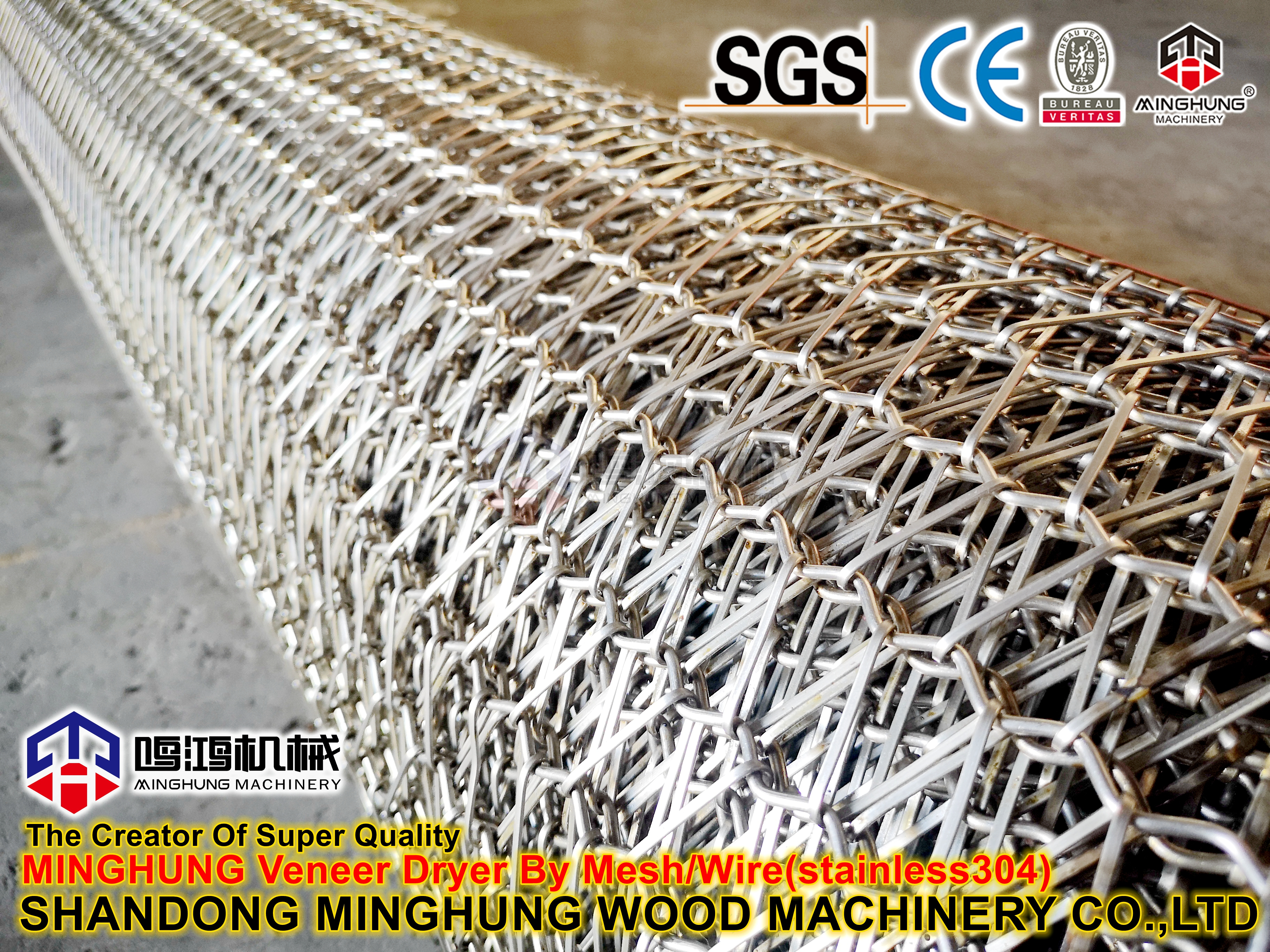
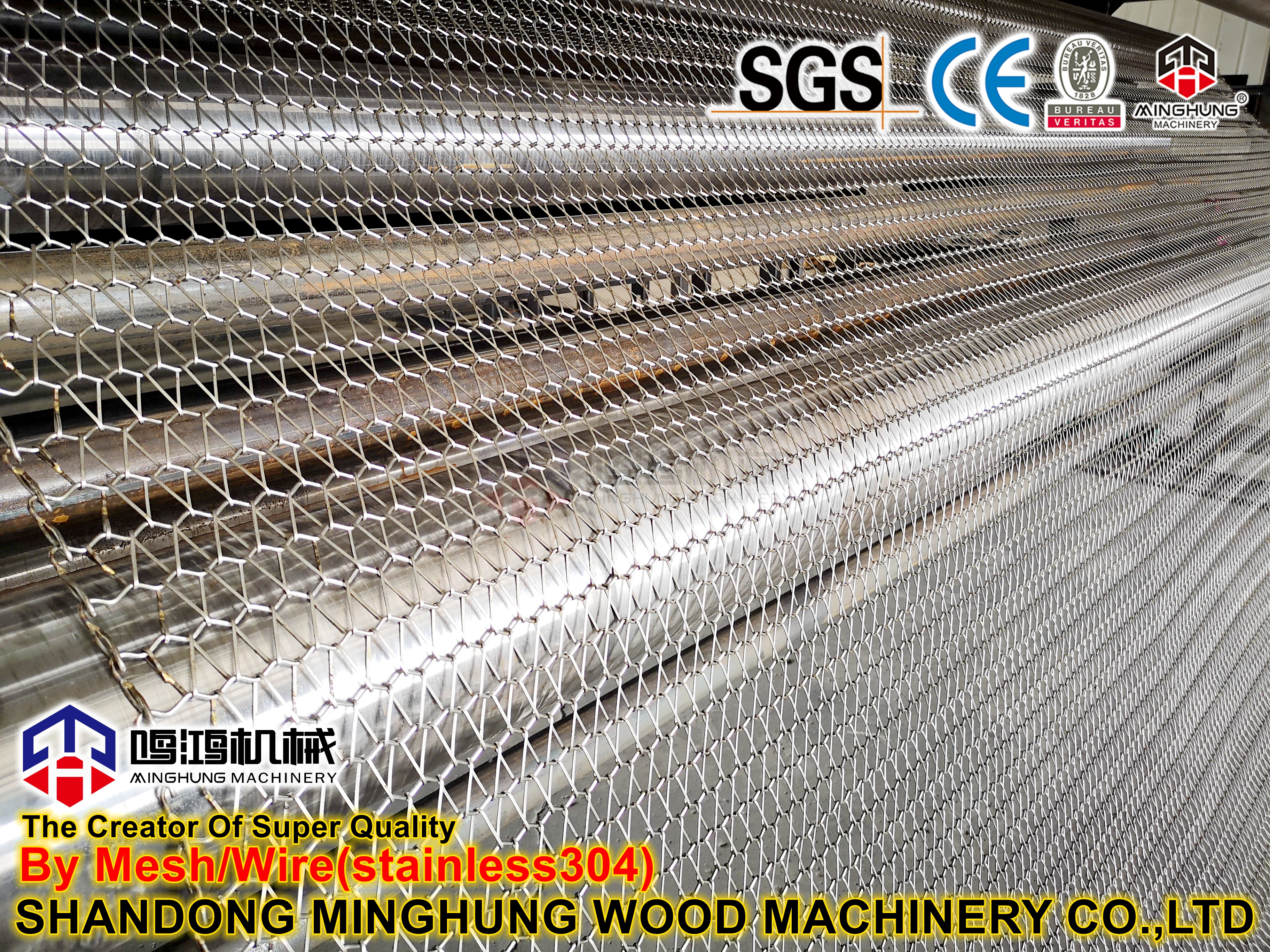
MINGHUNG veneer dryer adopts stainless steel 30 mesh bag + roller to ensure the flatness of veneer. The working width of the machine is 2.8 meters, with four layers. Taking drying eucalyptus as an example, the thickness of eucalyptus veneer is 1.7mm, and the moisture content is 60-70%. The dryer works for 20 hours a day and can dry 90-120 cubic eucalyptus veneer. The remaining moisture of eucalyptus veneer is: %10--%14, the eucalyptus veneer after drying has a smooth and even moisture content. Because the mesh bag method is adopted, the problem of reducing the thickness of the veneer caused by roller extrusion is eliminated, and it is suitable for drying various veneer veneers.
This model has the following advantages:
1. High output at low temperature, ensuring the flexibility and flexibility of the veneer, fast speed and large output. According to the needs of different users and different materials, the output of the equipment can reach 3-4 cubic meters per hour.
2. In order to achieve the flatness of the drum, we optimize the density of the internal machine structure to reduce the pressure, completely solve the problem of the flatness of the veneer, and avoid the problem of reducing the size of the veneer caused by excessive pressure. Smaller shrinkage than all dryers on the market, no loss of veneer,
3. High degree of automation, automatic feeding and labor saving, automatic dehumidification, low cost of consumables, high efficiency and energy saving, low power consumption, the equipment adopts all-aluminum fin heating device, large heat exchange area, fast heating, large circulating air volume, and many cycles. High thermal efficiency, drying equipment saves more than 40% energy. All cooling fins adopt forced circulation system to enhance fluid flow rate, improve heat exchange efficiency, and effectively reduce heat loss. At the same time, the problem of excessive wind resistance caused by high coil density is effectively solved, and the heat transfer process is improved by 1.5 times compared with the traditional dryer.
4. To prevent the phenomenon of returning moisture, the length of the cold air area is longer than that of the traditional dryer, the cooling effect of the veneer is better, and the drying is even. The stripped veneer undergoes multi-stage heat exchange and dehumidification. After drying for about 1.5 hours, the moisture content is low and uniform, which can meet the production needs of veneer and plywood.
5. The whole machine is insulated to prevent heat loss and reduce the impact on the environment.
6. The negative pressure fan design is adopted, which improves the air volume and wind pressure efficiency by 2-3 times compared with the traditional positive pressure fan, effectively solving the problem of low conversion efficiency of the fan motor power large air volume transmission
7. The dryer is forced to dehydrate due to interference. During the dehydration process, the veneer will have problems of poor flatness and finish due to excessive shrinkage. We increase the density and reduce the pressure to effectively solve the problem of the flatness of the veneer, while avoiding excessive pressure. Mass reduction problem.
On October 20, 2026, the foreign trade team of Shandong Minghung Wood Base Panel Machinery Co., Ltd. set off from China and flew to Istanbul, Turkey, to take part in the 39th International Woodworking Machinery, Cutting Tools and Hand Tools Exhibition (WoodTech Istanbul 2026). The show runs from October 22 to 25 at the Tüyap Fair and Congress Center in Istanbul, and Minghung's booth number is 905E.
The first day of the 2026 Shanghai International Woodworking Machinery Fair – if this morning's keyword was "surprise," then this afternoon's keywords are definitely "explosive" and "confidence"!
This trip to Shanghai was not only a display of products, but also a dissemination of our brand and a connection of emotions. We will continue to stay true to our original aspiration and repay every customer's trust and support with even better products and services. The future is full of promise, and we are always on the way!
The Mid-Autumn Festival is approaching, and the moon is growing round. While many people are beginning to prepare for family reunions, the company’s factory tells a different story: forklifts weaving through the yard, crane arms rising and falling, containers lined up in rows, and loading work proceeding in a tense yet orderly manner.
How to produce Particle board? What is the production step of Making Particle board?Introduction:Particle board, also known as chipboard, is a versatile and cost-effective material widely used in the construction and furniture industries. It is made by compressing wood particles and adhesive togethe